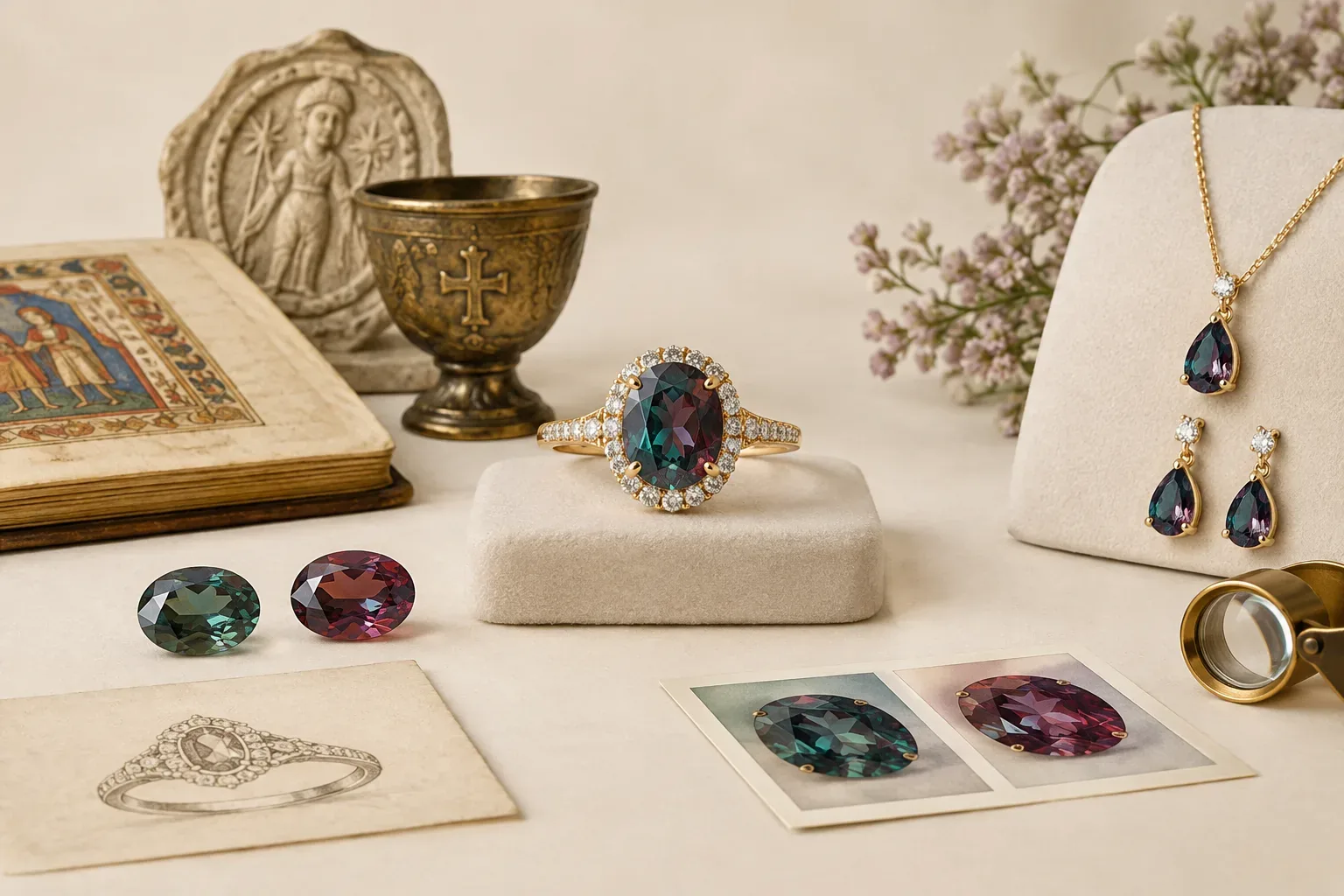
Meaning at a glance
This article explains documented history and changing contexts of alexandrite quality and value factors, separates historical evidence from modern interpretation, and gives practical guidance for choosing and gifting alexandrite jewelry.
Direct answer — what this guide covers
Alexandrite quality and value factors hinge on documented gemological attributes (color-change strength, hue under different lights, clarity, cut and carat weight), provenance and rarity, and honest disclosure about treatments and imitations. This guide explains the historically documented context for alexandrite, separates that evidence from later or personal meanings, describes how alexandrite has been used in jewellery, and gives practical, respectful selection and gifting guidance grounded in museum and consumer-protection sources.
What alexandrite is (short, evidence-led)
Alexandrite is a gem material long known to collectors for a striking optical effect: a visible change or shift in apparent colour depending on the light source. The Victoria and Albert Museum’s reference resources on gemstones provide an accessible, museum-curated overview of gemstone identification and historical context that explains why colour behaviour, clarity, cut and weight are decisive when judging value.
Documented history and cultural periods
The best-documented aspects of alexandrite’s history are recorded in museum and curatorial literature rather than in myth or universal tradition. Museum material on gemstones and the social history of jewellery explains how particular gems gain cultural prominence through discovery, patronage and fashionable use. The Victoria and Albert Museum’s resources on jewellery history and gemstones describe how gem types are collected and reused across periods and how tastes change over time.
For alexandrite specifically, documented historical evidence (as summarized in museum guides) ties the gem’s early popularity to 19th-century collecting and high-status jewellery. That documented link is a historical association, not a universal symbolic meaning: the archival and curatorial record shows where and when alexandrite appeared in high jewellery, and how that presence shifted as new sources and gem varieties entered trade.
Separating documented historical meanings from modern interpretations
Documented meanings are those recorded by curators, collectors and contemporaneous sources: for example, museum accounts identify which social groups owned certain gems and how jewellery styles changed across periods. The Victoria and Albert Museum’s materials are useful for understanding those changing social contexts for gemstones.
Modern personal interpretations — for instance, reading alexandrite as a symbol of transformation, balance, or romantic fate — are contemporary, sentimental or marketing-driven attributions. Those personal meanings are valid for wearers and givers today but are not the same as historical evidence preserved in museum records. Treat modern symbolic claims as individual or cultural interpretations rather than universally documented facts.
Key quality and value factors explained
Colour behaviour: The defining factor for alexandrite is how strongly and cleanly its apparent colour shifts between lighting conditions. Museum gemstone guides emphasise visual character as central to valuation: a pronounced, distinct change is typically the most prized characteristic documented in reference materials.
Hue and tone: Within that colour-change, the precise hues and their balance matter. Curatorial descriptions note whether the stone shows clear, attractive colours in both daylight and incandescent light. More vivid, saturated hues in both conditions generally command higher prices in the market.
Clarity and inclusions: As with other gems, internal characteristics affect value. Museum gemstone references discuss how clarity, the type and visibility of inclusions, and how inclusions affect optical properties are considered when assessing gems.
Cut and proportions: The cut is evaluated for how well it presents the colour-change and maximises light return. Historical and contemporary jewellery literature identifies cut as both an aesthetic and technical factor that affects perceived colour and overall beauty.
Carat weight and rarity: Larger fine-quality examples are rarer and therefore more valuable. Museum collections and exhibition catalogues repeatedly show that rarity and documented provenance contribute to the historical and market value of gems.
Provenance and source claims: Where a stone is reported to have come from can influence price. Museum and curatorial records explain that provenance adds cultural and scholarly interest, but modern buyers should treat origin claims as one factor among many and seek documentation.
Treatments and imitations: The U.S. Federal Trade Commission’s guidance on buying gemstones stresses that dealers must disclose treatments, enhancements, and imitation materials. Such disclosure is a consumer-protection standard: treated or synthetic stones should be clearly identified, and imitations must not be misrepresented as natural gems.
How alexandrite appears in jewellery
Historically and today, alexandrite has been set in rings, brooches, pendants and cluster pieces. Museum exhibitions and historic jewellery surveys show examples where gem shapes and settings are chosen to present colour-change in the most flattering light. Period jewellery often pairs colour-change stones with supporting diamonds or companion coloured gems to emphasise contrast.
Contemporary jewellers continue to use alexandrite in engagement rings, cocktail rings and bespoke pieces where the wearer values a gem with visual surprise. Designers may select settings with open backs to allow varied lighting, or bezels and low profiles for everyday wear if the buyer prioritises durability.
Practical selection and gifting guidance
Decide what matters most: strong colour-change, size, absolute colour hues, or documented provenance. Be explicit about priorities before you start shopping: that will help you compare like for like.
Ask for objective evidence: request a description of the colour behaviour (how the stone looks in daylight versus incandescent light), a report from a recognised laboratory where appropriate, and a clear statement about any treatments or enhancements. The Federal Trade Commission’s consumer guidance makes clear that material treatments and imitations must be disclosed; insist on written confirmation.
Inspect for colour change in person where possible: view the stone in natural daylight and under a warm, incandescent or LED light to judge the strength and appeal of the change. If you cannot see the stone in person, ask the seller for calibrated photos or videos and be cautious about representation.
Consider wear and setting: alexandrite is a durable gem when properly set, but daily wearers may prefer protective settings. Match the piece to the recipient’s lifestyle: a low-profile ring for someone active, a pendant or earrings for everyday elegance, or a show-piece ring for occasional wear.
Budget realistically and compare offers: because top-quality alexandrite can be rare, be prepared for price variation. Compare stones by the same criteria — colour-change strength first, then clarity, cut and carat — rather than by overall impression alone.
Gift with context: if the gift’s meaning matters, explain the distinction between historical associations and modern interpretations. A short note that names a documented historical connection (for example, when a gem rose to prominence) alongside a personal message about why you chose the stone balances scholarship and sentiment.
Care, insurance and resale considerations
Care: clean alexandrite with mild detergent, warm water and a soft brush, and avoid thermal shock and harsh chemicals. Museum conservation and consumer guidance generally recommend gentle handling for all coloured gemstones.
Insurance and documentation: obtain written documentation of the stone’s specifications and an appraisal for insurance purposes. Keep certificates, receipts and any lab reports together with the piece.
Resale: resale value depends on documented quality factors, market demand and documentation. Museum and trade literature remind buyers that provenance and condition influence secondary-market interest, so retain all paperwork and maintain the piece carefully.
Final practical note
Use the museum-curated resources and consumer-protection guidance referenced here when evaluating alexandrite. Prioritise clear documentation of colour-change and treatments, match the stone and setting to the wearer’s needs, and respect the distinction between historically documented associations and modern personal meanings when describing the gift.
Frequently asked questions
How can I tell if an alexandrite is genuine?
Ask for a reputable laboratory report and inspect the stone under natural daylight and a warm light source to judge its colour-change. The Victoria and Albert Museum’s gemstone overview stresses visual and documented characteristics for identification, and the Federal Trade Commission advises buyers to request written disclosure of treatments or synthetic status.
Does alexandrite always change colour?
Alexandrite is prized for a noticeable colour shift between lighting conditions, but the strength and exact hue of that change vary. Museum references describe the colour behaviour as the defining trait, so evaluate each stone individually rather than assuming every example shows the same effect.
Are treatments common and should they be disclosed?
Treatments and enhancements must be disclosed under consumer-protection guidance. The Federal Trade Commission’s buying guide makes clear that sellers should state whether a gem has been treated or is synthetic, so ask for full disclosure and written confirmation.
What should I prioritise: colour-change or size?
Prioritise colour-change strength if you want the classic alexandrite effect; a smaller stone with exceptional colour behaviour can be more desirable than a larger stone with a weak shift. Use museum-curated criteria—colour behaviour first, then clarity, cut and carat—when comparing stones.
How should I care for alexandrite jewellery?
Clean alexandrite gently with warm soapy water and a soft brush, avoid harsh chemicals and protect the gem from hard knocks. For insurance and resale, keep documentation and appraisals in a safe place.
Sources and further reading
- Bedazzled: A History of Jewellery — Victoria and Albert Museum
- An A-Z of Gemstones — Victoria and Albert Museum
- Buying Gemstones, Diamonds, and Pearls — Federal Trade Commission