Meaning at a glance
This article documents what museums and consumer authorities say about alexandrite and gemstones, separates historical evidence from modern personal meanings, explains how cuts and settings change the look and durability of alexandrite jewelry, and gives practical guidance for choosing and gifting pieces.
What the historical record actually shows
Documented history about gemstone use and jewellery practices comes primarily from museum and curatorial research rather than folklore. The Victoria and Albert Museum (V&A) places jewellery decisions in their wider social and technical contexts, showing how cutting styles, mounting techniques, and the cultural value of gems changed over time as tastes, tools, and trade networks evolved. The V&A's exhibition and reference material emphasise changing social contexts for jewellery rather than fixed symbolic meanings tied to a single culture.
Precise cultural and period contexts
When discussing alexandrite specifically, it is important to separate what is documented from later storytelling. The V&A's resources on gemstones describe how gem types entered European collections and the fashions that followed, but they do not assert any single, universally held cultural meaning for alexandrite across societies. In short, European gem-cutting and setting trends—documented in museum collections and catalogues—explain many of the ways alexandrite has been cut and mounted in the 19th century and later revival periods, while contemporary interpretations about personal or mystical meanings are largely modern and variable.
Documented historical meanings versus modern interpretations
The historical record preserved in museum literature tends to document how gems were used and who wore them rather than definitive symbolic meanings. The V&A places jewellery within social, economic, and technological histories, showing that features such as gem size, cut, and setting often reflected wealth, fashion, or the capabilities of local workshops rather than a single symbolic message. Modern personal interpretations—such as assigning alexandrite a symbolic association with transformation, mood, or mysticism—are contemporary attributions layered onto the stone and are not documented as universal historical meanings in museum sources.
How alexandrite appears in jewellery: historical and modern forms
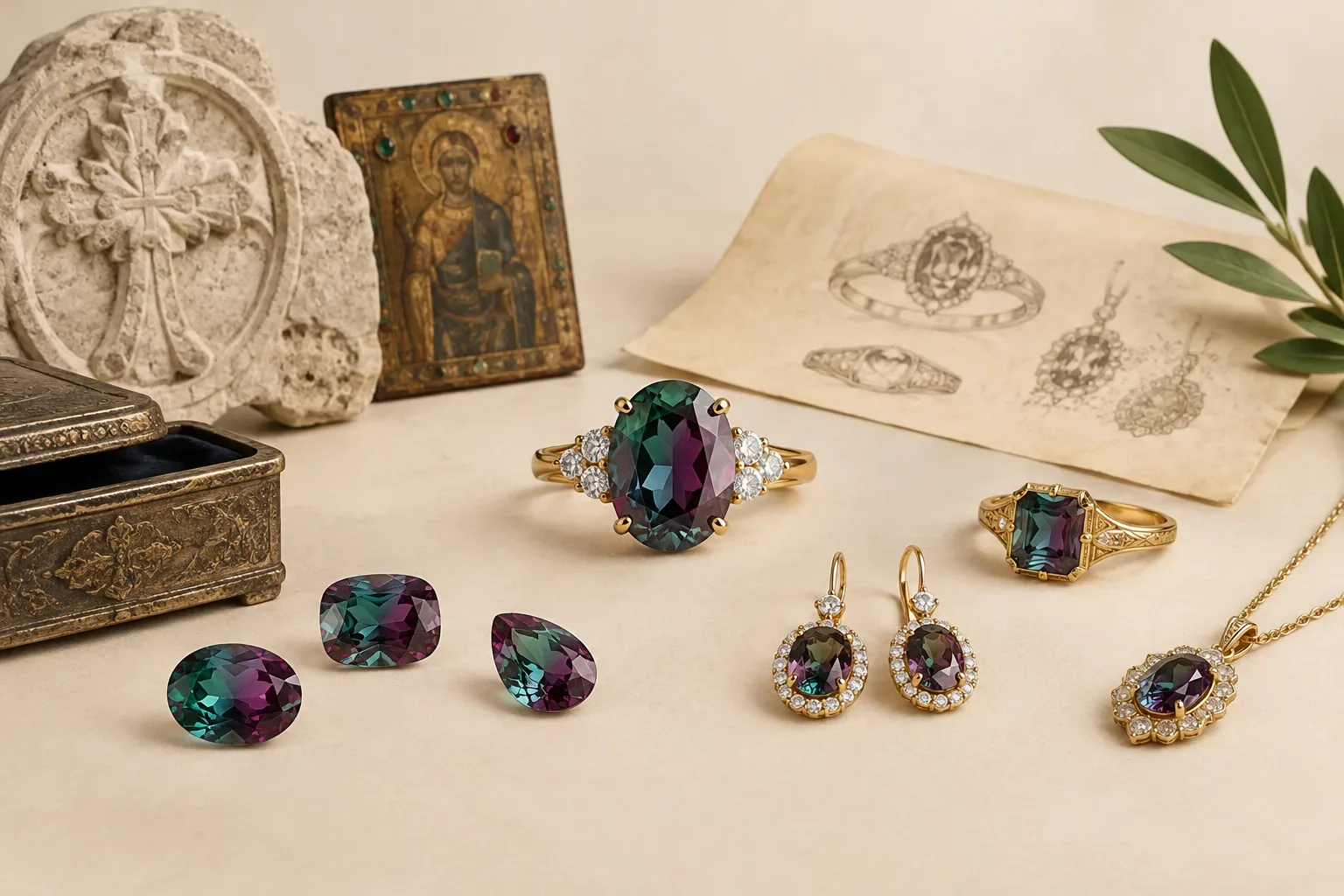
Historically, gems moved into jewellery in forms that reflected available cutting styles and mounting techniques. Museum surveys show rings, brooches, and clasps where gems were chosen for visibility and protection. In modern jewellery alexandrite commonly appears in rings, pendants, and earrings that showcase its color-change quality—pieces where faceting and lighting show off color shifts. Contemporary designers also echo period styles, combining alexandrite with halo diamonds or in vintage-inspired mounts, but these are design choices rather than continuations of a single cultural symbolism.
How cuts and faceting influence alexandrite's appearance
Cuts and faceting change how light interacts with a gemstone; the V&A's guidance on gemstones explains that cutting affects a stone's apparent colour, sparkle, and overall character. For alexandrite this is particularly important because collectors and wearers prize the stone for its colour change under different lighting. A cut that maximises light return and presents larger, even facets can deepen the apparent colour shift, while a shallow or overly deep cut may reduce visual impact. That general relationship between cutting and appearance is documented in museum discussions of gem workmanship and identification.
Settings that protect and display alexandrite
Historical and curatorial research shows that mountings have always balanced protection with display. A setting that cups and surrounds a stone reduces the chance of edge chips and loosening, while settings that leave a larger amount of the stone exposed will show more colour but offer less protection. Contemporary jewellery practice follows the same balance: secure mountings are recommended for daily wear pieces, and more open designs are chosen for occasional-wear showpieces. These considerations reflect long-standing practical concerns highlighted in museum collections and caregiving notes.
Durability considerations and practical trade-offs
Although alexandrite is generally regarded as a durable gem within the gem trade, every stone-maker and curatorial source treats mounting and cut as important protective decisions. A well-cut alexandrite that sits low in a sturdy setting is less likely to chip if knocked than the same stone with high prongs or exposed facets. Conversely, low or closed settings can mute the stone's colour-change effect because less light reaches and returns from the gem. Buyers must therefore decide whether daily durability or maximum optical drama is the priority for the intended wearer.
Careful buying: disclosure, treatments, and verification
Consumer protection guidance from the Federal Trade Commission (FTC) stresses that sellers must accurately disclose treatments, imitations, and the origin of gemstones. Before buying alexandrite, ask the seller for a written description of any treatments and, when possible, an independent gemological report. The FTC emphasises transparency about enhancements and imitations; this is important because such interventions can affect both appearance and long-term care. Museum references remind buyers that documented provenance and clear labelling are the best indicators of responsible practice.
Selection and gifting guidance
For a ring meant for everyday wear, prioritise a secure setting that protects the stone's girdle and edges and choose a shape that sits low to the finger. For a special-occasion ring or pendant, select a cut and mounting that maximise the colour-change display and accept that such pieces may require more careful handling. When gifting, consider the recipient's lifestyle: if they are active with their hands, choose a protective mount; if they prefer fine jewellery for occasional wear, opt for a showpiece that highlights alexandrite's unique optical character. Always request written disclosure about treatments and, if provenance matters, ask about documentation or a gem lab report.
Respectful cultural use and personal meaning
If you are drawn to alexandrite for perceived symbolic properties, make a personal choice rooted in respect for historical evidence and cultural context. Museum sources indicate that jewellery meanings shift across time and communities, so assigning a modern, personal significance to a stone is common and acceptable as long as it is presented as an individual interpretation rather than a claimed historical fact. When presenting a piece as a cultural or historical token, avoid asserting universality and instead contextualise the piece using reliable museum or scholarly references.
Final practical checklist
Prioritise secure settings for daily wear and more open settings for display pieces. Ask for disclosures about treatments and independent verification when possible. Consider the intended use and the recipient's lifestyle when choosing between protective and dramatic mounts. Use museum resources and consumer-protection guidance to inform your purchase and distinguish documented history from contemporary symbolic interpretations.
Frequently asked questions
What cut best shows alexandrite's color change?
Cuts that balance good light return with broad, even facets typically present alexandrite's colour change most effectively. Museum guidance on gemstones notes that cutting alters a stone's apparent colour and character, so choose a cut that presents an even, well-proportioned table and crown for the clearest display.
Which settings protect alexandrite for everyday wear?
A setting that surrounds and secures the stone—such as a low bezel or a protective halo with sturdy prongs—will reduce the risk of edge chipping during daily use. Historical and curatorial sources emphasise that mountings have long balanced protection with display, so opt for a protective mount when durability is a priority.
Are treatments and lab-grown alexandrite common, and how should I verify a stone?
The FTC requires accurate disclosure about treatments, imitations, and lab-grown stones. Always request written disclosure and, when possible, an independent gemological report. Transparent sellers will provide information about any enhancements and provenance.
Should I prioritise beauty or durability when gifting alexandrite?
Consider the recipient's lifestyle. For active wearers, prioritise protective settings and modest elevation. For collectors or occasional wear, you may prioritise a cut and mounting that maximise optical drama. In all cases, ask for treatments disclosure and documentation to ensure long-term satisfaction.
Does alexandrite have a single historical meaning?
No. Museum research indicates that documented historical meanings for gemstones vary by time and place and that the record emphasises social and material contexts. Modern symbolic associations are personal or contemporary additions, not universally documented historical facts.
Sources and further reading
- Bedazzled: A History of Jewellery — Victoria and Albert Museum
- An A-Z of Gemstones — Victoria and Albert Museum
- Buying Gemstones, Diamonds, and Pearls — Federal Trade Commission