Meaning at a glance
Norse knotwork in Viking Age jewelry belongs to changing animal-art and interlace traditions with regional and chronological styles; decorative structure can be described securely, while a fixed symbolic meaning for every knot or creature usually cannot.
What the historical evidence shows
Archaeological and museum research makes clear that the decorative vocabulary now called “Norse knotwork” grew out of longer northern European traditions of interlace and animal ornament. The Metropolitan Museum of Art describes a succession of animal styles that developed and changed from the Migration Period into the Viking Age, showing both chronological and regional variation across northern Europe and the North Atlantic islands.
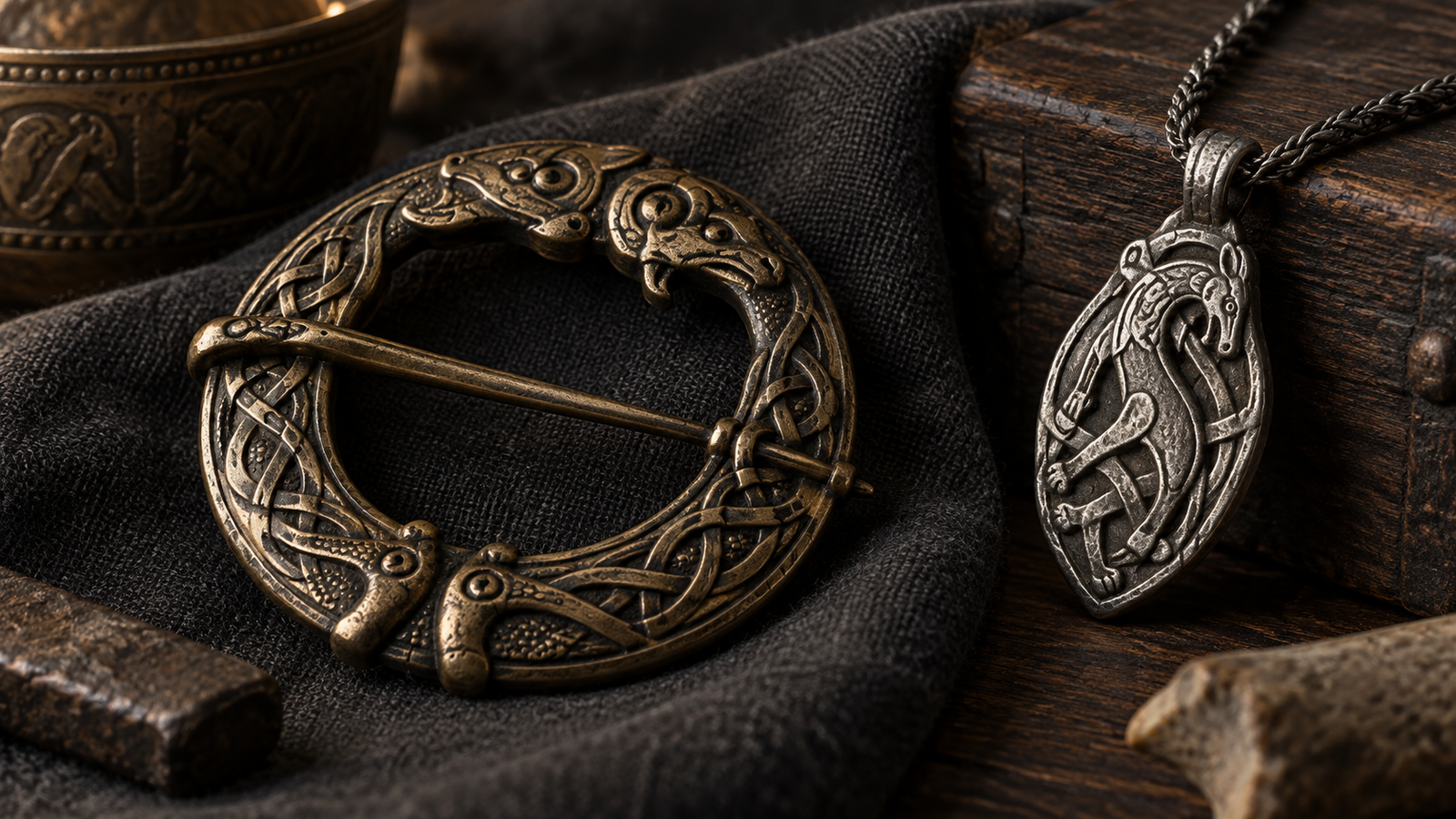
Objects recovered from graves and hoards—brooches, arm-rings, pendants, and fittings—frequently combine braided interlace with stylized animals, often in highly elongated or ribbon-like forms. The National Museum of Denmark points out that Viking jewelry commonly used interlace and animal ornament as surface decoration, and that such decoration alone does not prove a single symbolic meaning.
Scholars therefore treat knotwork and animal motifs as elements of visual language: useful for dating and locating an object, useful for recognizing cultural connections and workshop practices, but not automatically evidence of uniform beliefs or fixed symbolic messages across different communities. The Met’s cataloguing of Migration Art emphasizes these shifts in style and regional forms, and an example object titled “Animal-Head Brooch” held by the Met illustrates how a single motif can appear in regional variants without clear, documented symbolic intent.
Which cultures and periods are we talking about?
The motifs span a wide chronological scope. The Migration Period (roughly A.D. 300–800, as treated in museum literature) shows early animal-style ornament that feeds into later northern European decorative strategies. By the Viking Age (the period covered in National Museum of Denmark summaries of Prehistoric Scandinavia up to around 1050 AD), interlace and animal forms are prominent in Scandinavian and Insular work.
Geographically, the relevant traditions include Scandinavian workshop centers in what are now Denmark, Norway, and Sweden, as well as influences from earlier continental and Insular (British and Irish) metalwork traditions. Objects excavated in Viking Age contexts from these regions display both local tastes and imported fashions, and museums treat variants as evidence of regional styles rather than uniform meanings.
Documented historical meanings versus modern interpretations
What we can document from archaeological contexts and contemporary written evidence is limited. Museum records show that craftsmen consistently used interlace and animal ornament for surface decoration, and that particular forms help scholars identify period and region. That is a documented, evidence-based claim: stylistic change and regional variation are visible on the objects themselves and in museum catalogues.
What we cannot reliably document for most knots or creatures is a single fixed symbolic meaning. The cited museum sources document interlace, animal heads, gripping beasts, and changing styles, but they do not provide one universal spiritual meaning for every example. An animal head or braided motif can therefore be discussed securely as decoration and as an indicator of style without assigning a single talismanic or narrative interpretation across time and place.
Modern interpretations—such as linking a particular knot form to protection, fate, or a named god—are often personal or contemporary religious readings rather than conclusions grounded in direct historical evidence. These modern meanings may be meaningful to the wearer and are a valid part of today’s cultural use of Viking imagery, but they should be presented separately from documented historical claims.
How the motif appears in jewelry
On Viking Age metalwork you will commonly see interlace produced by cutting, casting, or engraving, and animals elongated to form ribbon-like plaits that weave through or around other elements. Brooches, arm-rings, pendants, strap-ends, and sword fittings often feature continuous interlace borders or panels with animal bodies that curl and interlock in repeating patterns.
Technically, artists achieved these effects through techniques such as die-stamping, casting in open or closed moulds, engraving, and niello inlay. The practical result is a durable decorative surface that catches light and repeats a motif across multiple objects from the same workshop or region. Museums like the Met and the National Museum of Denmark display many such objects and emphasize how patterning helps specialists classify finds into stylistic groups.
Choosing or gifting Norse knotwork jewelry respectfully
If you are selecting knotwork or animal-style pieces for yourself or as a gift, keep two respectful practices in mind. First, separate historical description from modern symbolism: advertise or explain the piece by noting its stylistic roots and the period or region it echoes, and clarify if any stated meanings are contemporary interpretations rather than historical facts.
Second, avoid assuming that every Viking motif carries a universal spiritual power. Treat the jewelry as carrying layered meanings: historical and aesthetic value grounded in regional craftsmanship, and a personal or contemporary symbolic layer chosen by the wearer. This approach honors the object’s archaeological context while allowing modern cultural or spiritual use.
Practical considerations also matter. For authenticity of feel, choose pieces that reference known forms—such as brooch shapes or arm-ring profiles visible in museum collections—while being transparent if the item is a modern reproduction. If giving a piece as a gift, mention the museum or publication that inspired it, or include a short note on whether the symbolism is modern or historically attested. That offers both educational value and respectful framing.
What to look for when assessing authenticity and quality
Stylistic details can indicate whether a piece follows an archaeological model. Look for consistent interlace patterns, animal bodies that interweave rhythmically, and surface techniques appropriate to metalwork (clear casting lines, tool marks or fine engraving). Museums describe how such elements cluster in particular styles and periods, so similar visual grammar on a modern piece signals a design source.
Materials and maker information matter as well. Reproductions are often made in silver, bronze, or modern base metals; genuine archaeological objects were made in a range of metals and might show patina or wear patterns that are difficult to replicate artificially. Sellers who reference museum catalogues or specific archaeological finds and who clearly disclose modern manufacture are easier to evaluate responsibly.
Final perspective
Norse knotwork and Viking animal styles are compelling because they combine technical skill and a visual vocabulary that changed across centuries and places. The secure historical claim is that interlace and animal ornament were standard decorative strategies whose stylistic details allow specialists to track regional and chronological change, as documented by institutions such as the Metropolitan Museum of Art and the National Museum of Denmark.
Beyond that, symbolic readings are often modern or personal choices. If you value historical accuracy, present the decorative lineage clearly and leave room for contemporary meanings chosen by the wearer. Doing so respects both the archaeological record and the living cultural uses these motifs enjoy today.
Frequently asked questions
Does every Norse knot have a specific historical meaning?
No. Museum research indicates that knotwork and animal motifs function as a decorative and stylistic vocabulary; while they are useful for dating and regional attribution, the decoration alone does not prove a single symbolic meaning.
Can knotwork identify where a Viking object was made?
Knotwork and animal-style details can help specialists suggest a regional origin or chronological range, because particular styles cluster in certain areas and periods, but they are one line of evidence among many, such as find context and metal composition.
Are modern interpretations—like protection or fate—authentic historical meanings?
Modern symbolic readings are often contemporary or personal. They can be meaningful to today's wearers but are usually not documentary conclusions drawn from archaeological evidence; museums separate stylistic description from speculative symbolism.
How do I choose a respectful reproduction or gift with Norse knotwork?
Choose pieces that clearly reference known archaeological models, disclose whether the item is a modern reproduction, and explain whether any stated symbolism is a contemporary interpretation. This practice respects both history and modern meaning-making.
What types of Viking jewelry commonly show knotwork and animal styles?
Brooches, arm-rings, pendants, strap-ends, and sword fittings frequently display interlace and animal ornament; museum collections include many such objects that illustrate these common applications.
How can I learn more about the styles and their chronology?
Consult museum publications and catalogues that treat migration and Viking-era art as evolving stylistic systems. The Metropolitan Museum of Art and the National Museum of Denmark provide accessible introductions and object records useful for further study.
Sources and further reading
- Clothes and jewellery — National Museum of Denmark
- Migration Art A.D. 300-800 — The Metropolitan Museum of Art
- Animal-Head Brooch — The Metropolitan Museum of Art