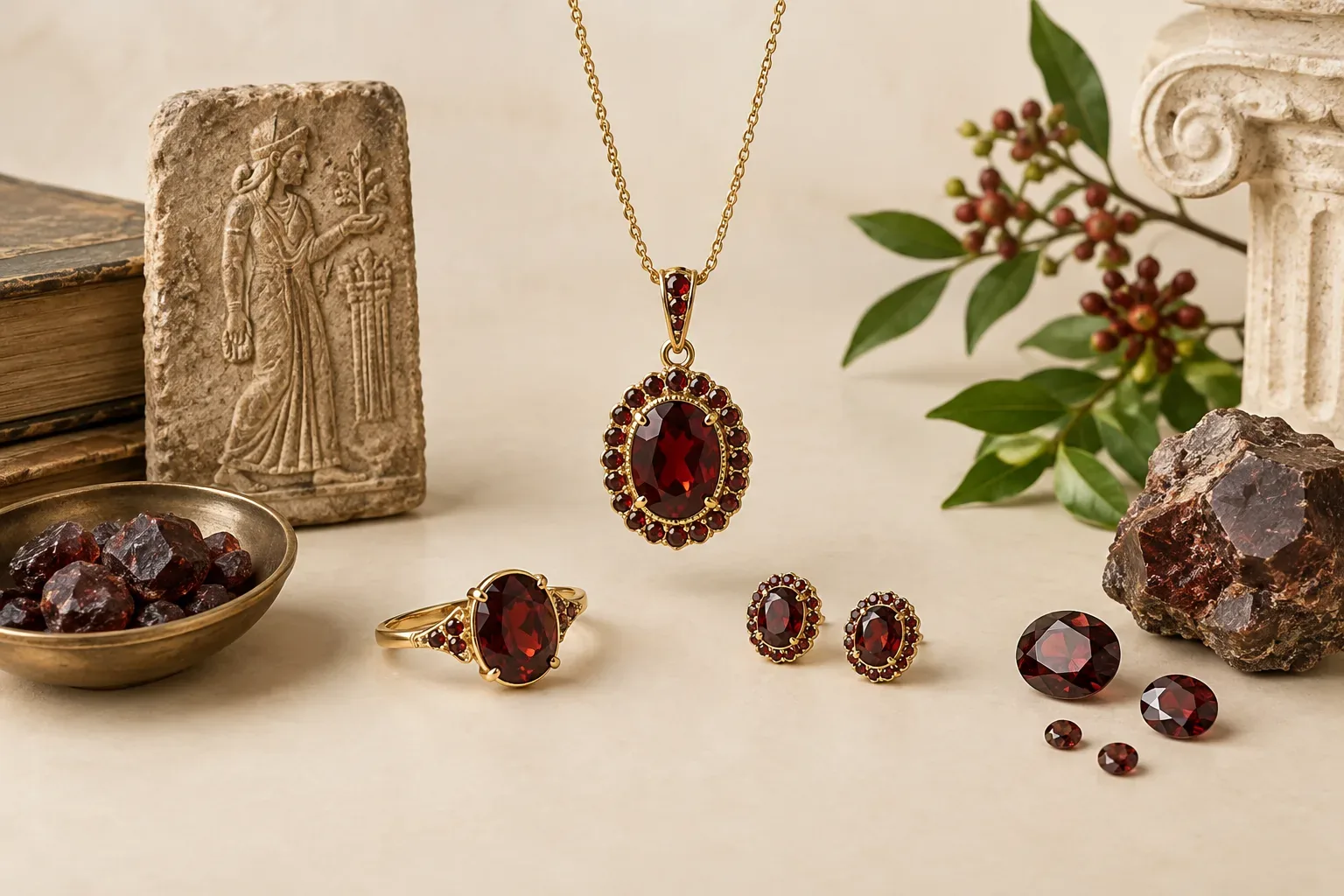
Meaning at a glance
Garnet quality and value factors depend on variety, color, clarity, cut, carat, treatments, provenance and craftsmanship; documented historical uses and meanings are recorded by museums, while many modern symbolic claims are personal or commercial interpretations—ask sellers about treatments and certification and choose pieces that suit taste, budget and cultural sensitivity.
What the historical record shows (and who records it)
When we talk about garnet in historical jewellery, we are relying on documented examples and interpretation made by museum specialists rather than on general folklore. The Victoria and Albert Museum (V&A) places jewellery in social and historical context and illustrates how gemstones — including garnets — appear across periods and cultures. According to the V&A, garnets are found in ancient, medieval and later European and Asian collections and are visible in different types of objects from signet stones to clustered brooches and decorative inlays.
The V&A’s surveys of gemstones emphasise how materials and their uses change over time, so a garnet set into a Roman intaglio, a medieval reliquary, and a nineteenth-century sentimental brooch are different types of objects with different social meanings. Those meanings are documented by curators and historians based on surviving objects, inventories and contemporary records; museums report the contexts in which gems were used rather than asserting a single, universal symbolism.
Separate documented historical meanings from modern interpretations
Documented meanings: Museum records and catalogues — such as those compiled and described by the Victoria and Albert Museum — report how garnets were used, which social groups owned them, and how they fit decorative and liturgical fashions in particular times and places. These are evidence-based descriptions: for example, a garnet set in a ring or brooch in a museum catalogue is described by its function, date, manufacturing technique and provenance when known.
Modern interpretations: Statements about garnet’s powers, health benefits, or universal spiritual meanings are modern or popular attributions and should be treated as personal belief rather than established historical fact. Such contemporary meanings can be meaningful for the giver or wearer, but they are not the same thing as the documented social uses recorded by historians and museum collections. Distinguishing the two keeps historical evidence clear and allows personal sentiment to coexist without being presented as proven history.
How garnet appears as a motif and as a gemstone in jewellery
Garnet appears in jewellery both as a material and as a visual motif. Historically and today it is used as faceted stones and polished cabochons, as beads in strings, and as inlaid elements in metalwork. Museum collections described by the V&A show garnets used in engraved signet stones, clustered settings that emphasise colour, and as accent stones in larger precious-metal designs.
As a motif, the deep colour and reflective surface of many garnets have been used to create dramatic contrasts in metalwork and enamel. Garnets were often grouped into repeating patterns or clusters to make a strong visual field of colour; in other cases, a single larger garnet becomes the focal point in a ring or pendant. Contemporary jewellers continue these traditions, combining historical forms with modern cutting and setting techniques to emphasise the stone’s optical properties.
Practical factors that determine garnet quality and value
Variety and color: The garnet family includes several varieties that differ in chemistry and typical colors. Color is typically a primary influence on desirability: buyers pay attention to hue, saturation and tone because these determine the stone’s visual appeal. Choose the variety and color that you or the recipient find most attractive, understanding that rarity and market demand for particular colors can affect price.
Clarity: Like other gemstones, garnets are judged by how free they are from visible inclusions at normal viewing distances. Cleaner stones with minimal eye-visible inclusions command higher prices, while intentionally included material or certain internal features can be characteristic of particular sources or varieties.
Cut and shape: The quality of the cut affects a garnet’s brilliance and how it displays color. Well-proportioned faceting or a clean cabochon finish will enhance light return and appearance. The fashionability of a particular shape or cut can influence value in addition to optical performance.
Carat weight and size: Larger garnets are rarer within a given quality grade and can be disproportionately more expensive. Balance size with cut quality and color to get the most appealing stone for your budget.
Treatments and imitations: Ask sellers about any treatments, enhancements or whether the stone is a natural garnet at all. The Federal Trade Commission (FTC) advises buyers to expect clear disclosures about treatments, imitations and any enhancements. Some garnets are heat-treated or subjected to other processes that should be disclosed; likewise, synthetic or simulated materials must be sold with full transparency.
Origin, provenance and setting: The known origin and documented history of a stone or finished piece can influence value, especially for antique or museum-quality items. The quality of the metalwork and the craftsmanship of the setting also affect final price and longevity.
Asking the right questions and verifying claims
When buying, request clear answers about whether the stone is natural or treated and whether the seller provides any laboratory reports or certifications. The FTC’s consumer guidance on gemstones recommends that sellers disclose treatments and not mislead buyers about the nature of the material. A reputable seller will provide condition details, return policies and, where appropriate, third-party identification.
If you are considering an antique garnet piece, ask for provenance information and any conservation or repair records. Museum catalogues, including those compiled by the V&A, show how documentation contributes to understanding an object’s cultural place; you can use similar questions to assess an item’s history and authenticity in the marketplace.
Selection and gifting guidance: practical and respectful advice
Match the stone to the recipient’s taste and lifestyle. Choose a garnet color and setting that fits everyday wear if the recipient is active, or a more ornamental design if it will be worn only on special occasions. Consider metal hardness and setting security for rings or bracelets that see frequent wear.
Be culturally respectful. Garnet has different meanings in different traditions and time periods; do not assume one symbolic meaning is universal. If gifting to someone whose cultural or religious background gives particular importance to certain gemstones or colors, ask sensitively or choose a neutral design to avoid unintended offence.
Budget with priorities. Decide whether you value color, size, or clarity most and allocate your budget accordingly. You can get an attractive garnet at modest prices by prioritising good color and craftsmanship rather than maximum carat weight.
Consider certification and warranties. For higher-value purchases, seek third-party gem reports or lab identifications when available and insist on clear written disclosure about treatments. A return policy or warranty gives added protection if the stone’s characteristics differ from the seller’s description.
Caring for garnet jewellery
Garnets are generally durable, but care depends on the specific variety and the setting. Protect garnet pieces from strong knocks, prolonged exposure to harsh chemicals, and extreme temperature changes. Clean gently with a soft brush and mild detergent, and store jewellery so stones do not rub against harder materials.
If you are unsure about cleaning or repair, consult a reputable jeweller or conservator. For antique pieces, professional conservation advice preserves both the stone and any historical mounting.
Putting history and personal meaning together
Use museum-recorded history to inform but not limit your choice. The V&A and similar institutions document how garnets were used over centuries; that evidence can inspire designs or give depth to a gift. At the same time, personal and modern symbolic meanings are legitimate choices for wearers and givers, provided they are presented as contemporary interpretations rather than proven historical facts.
In short, select a garnet that pleases the eye, choose a reputable seller who discloses treatments and provenance, and frame any symbolic meaning as a personal or cultural choice rather than as a universal truth.
Frequently asked questions
What are the most important factors to assess when buying a garnet?
Assess variety and color first, then clarity, cut, carat weight and the quality of the setting. Also ask about treatments, origin and provenance. The V&A’s gemstone guides explain how different materials and uses change over time, and the FTC recommends that sellers disclose treatments and any imitations.
How can I tell if a garnet has been treated or is an imitation?
Request written disclosure from the seller and, when appropriate for higher-value stones, an independent laboratory report. The Federal Trade Commission advises buyers to expect transparent information about treatments and not to accept vague or misleading descriptions.
Are antique garnet pieces more valuable than modern ones?
Value depends on condition, provenance, craftsmanship and market demand rather than solely age. Museums such as the Victoria and Albert Museum document historical uses and provenance, which can increase interest and value for collectors, but each object must be assessed on its own merits.
Is garnet suitable for everyday wear, such as engagement rings?
Many garnet varieties are durable enough for everyday jewellery, but suitability depends on the specific variety and the security of the setting. Choose a protective setting and consult a jeweller about the particular garnet and how it will withstand daily wear.
Can I rely on modern symbolic meanings of garnet when gifting?
Modern symbolic meanings can make a gift personally meaningful, but they are not universal. If cultural significance matters to the recipient, ask respectfully or choose a neutral design. Use museum-documented history for context and present modern meanings as personal interpretations rather than established fact.
Sources and further reading
- Bedazzled: A History of Jewellery — Victoria and Albert Museum
- An A-Z of Gemstones — Victoria and Albert Museum
- Buying Gemstones, Diamonds, and Pearls — Federal Trade Commission