Meaning at a glance
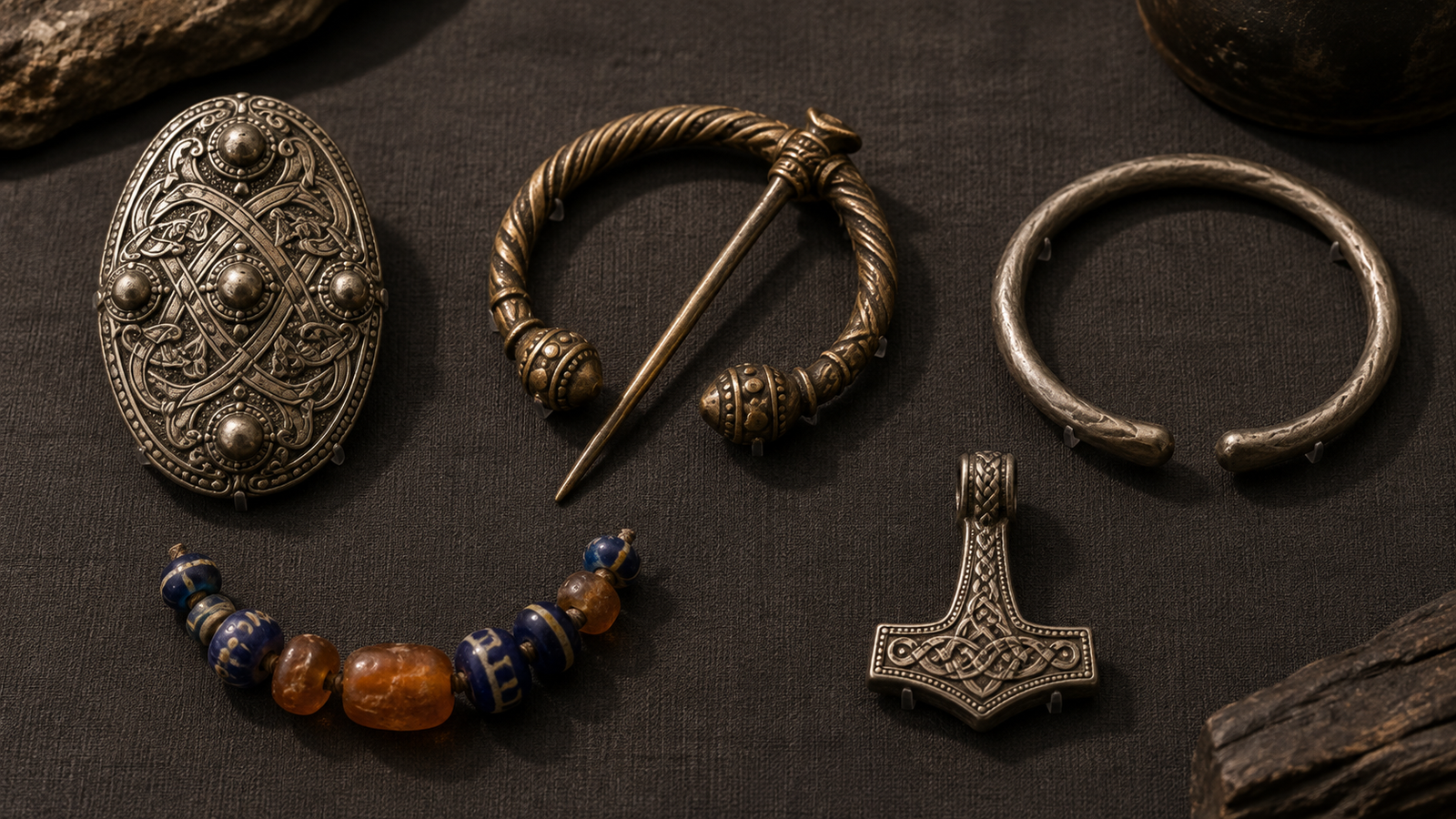
Archaeology shows Viking Age jewelry in varied forms including brooches, arm rings, necklaces, beads, pendants, and amulets, made in materials ranging from bronze and glass to silver and gold, with practical, social, decorative, and sometimes religious functions.
Direct answer — what archaeology actually shows
Archaeology shows Viking Age jewelry in varied forms including brooches, arm rings, necklaces, beads, pendants, and amulets, made from materials ranging from copper alloys and glass to silver and gold, and used for practical fastening, display of social identity, trade, decoration, and in some cases ritual or protective purposes. This summary reflects the core interpretation presented by museum collections and research, notably work published by the National Museum of Denmark, the Metropolitan Museum of Art, and the Swedish History Museum.
Historical evidence and the cultures or periods involved
When people use the phrase “Viking jewelry” they are most often referring to objects recovered from contexts associated with the Viking Age and the broader Norse cultural sphere. Museum descriptions and archaeological reports use the term Viking Age to group material culture from communities in what is today Denmark, Sweden, Norway, and their overseas contacts; the National Museum of Denmark presents clothing and jewellery from this northern European cultural horizon as varied in form and material depending on region and social context.
Archaeology shows regional and chronological variation within that broad cultural area. The Metropolitan Museum of Art’s catalogue entries for individual pieces, such as animal-head brooches, demonstrate regional styles and workshop practices: certain brooch shapes and animal motifs are associated with particular regions and find contexts. The Swedish History Museum presents examples of amulets and objects interpreted as ‘magical’ or protective, again emphasizing that specific forms and uses vary by place and time. Treat references to “Viking” objects as shorthand for a complex set of local traditions rather than a single uniform culture.
Documented historical meanings versus modern personal interpretations
Museums and archaeologists are cautious about assigning single, universal meanings to jewelry. The National Museum of Denmark notes that many items served practical functions—fastening clothing, securing a cloak, or bearing weight—while also acting as visible markers of wealth or group identity. The Metropolitan Museum of Art illustrates how brooches can be both practical and decorative, and how stylistic details can signal local fashion or craft traditions.
The Swedish History Museum presents finds categorized as magical amulets but also makes clear that the interpretation of an object as an amulet is an archaeological interpretation based on context, iconography, and comparison with written sources. That means some pieces were likely used with ritual intent, while others may have been worn primarily as decoration or as a marker of social ties. Modern meanings people ascribe today—spiritual protection, claimed direct lineage to Viking beliefs, or marketed “authentic Viking power”—are modern interpretations and personal beliefs rather than universal historical facts. Museums provide the evidence and possible functions; contemporary symbolic uses are separate and reflect present-day values and choice.
Types of authentic Viking jewelry the archaeology actually records
Brooches: Archaeological collections show a wide range of brooch types used to fasten garments or cloaks. Brooches could be plain and functional or richly decorated with animal motifs and interlacing patterns; the Metropolitan Museum of Art’s catalogue entries for animal-head brooches exemplify zoomorphic decoration and regional styles. Brooches are among the most clearly documented items and illustrate both utility and display.
Arm rings and bracelets: Metal arm rings and bracelets appear in many hoards and graves. The National Museum of Denmark highlights that metalwork served as portable wealth and visible status. Arm rings could be solid, twisted, or cast, and they are often cited in finds associated with gift exchange and social bonds as well as ornament.
Necklaces and beads: Necklaces appear in the archaeological record both as strings of glass or stone beads and as metal pendants hung on chains. The National Museum of Denmark points out that materials range from inexpensive glass beads to more valuable metal and stone elements, reflecting differences in wealth and trade connections.
Pendants and amulets: Pendants range from simple metal shapes to iconographic pieces that may have held symbolic or religious meaning. The Swedish History Museum displays objects described as magical amulets, emphasizing that some pendants were likely intended as protective or talismanic items. Other pendants are best understood as personal ornament without clear ritual function.
Beads and small ornaments: Small beads and spacer elements frequently appear in graves and settlement contexts. These items demonstrate extensive trade in raw materials and finished goods; glass beads in particular show long-distance exchange of fashions and materials across northern Europe.
Materials and techniques: Museum descriptions underline that a range of materials—bronze and other copper alloys, iron, silver, gold, and glass—appear in finds. The choice of material carried social meaning and practical consequences: cheaper materials for everyday dress, and precious metals for wealth display and hoarding.
How motifs, gemstones, and traditions appear in the archaeological record
Motifs: Animal heads, interlaced patterns, and stylized plant or geometric forms appear in metalwork and are well documented by museum catalogues and exhibits. The Metropolitan Museum of Art’s presentation of animal-head brooches is a clear example of how a motif can be worked into metal for both aesthetic and possibly symbolic effect. Such motifs are not automatically religious statements; they are decorative languages that can indicate regional style, a workshop’s preferences, or an owner’s taste.
Gemstones and glass: Archaeology documents glass and amber among the materials used for Viking Age jewelry, including beads and necklace elements. The National Museum of Denmark lists both materials alongside metals used in jewelry. A particular bead or material may help researchers investigate craft and contact, but its presence does not by itself prove one shared symbolic meaning.
Traditions and wear: Certain jewelry types recur in contexts like female dress assemblages or male hoards, which helps archaeologists infer traditions of wearing and gifting. Arm rings recovered from hoards are often interpreted as portable wealth and may reflect practices of exchange or savings. The Swedish History Museum’s descriptions of amulets show that objects interpreted as protective appear in particular contexts, though interpretation always depends on archaeological context and comparison with literary or iconographic evidence when available.
Practical and respectful guidance for selecting or gifting Viking-style jewelry
If you want a piece that reflects archaeological types, choose items described by museums or makers as inspired by specific archaeological finds or by clear regional styles. Museum catalogues from institutions such as the National Museum of Denmark and the Metropolitan Museum of Art are reliable references for shapes and motifs attested in excavations, and they help distinguish historically attested forms from modern creative inventions.
Consider material and provenance. Authentic ancient pieces are museum artifacts and are not available for private purchase without careful provenance and legal documentation. Contemporary makers produce reproductions in a variety of metals and beads; choosing reputable makers who explain their sourcing and the archaeological inspiration for a design helps maintain ethical standards and respect for cultural heritage.
Be explicit about modern meanings. If you give jewelry as a gift and ascribe modern symbolic meanings—such as protection, links to Norse spirituality, or claimed ancestral authority—be clear that this is a contemporary interpretation rather than a direct continuation of a single historical practice. This transparency is especially important when gifting to people for whom cultural or spiritual claims may be sensitive.
Respect cultural context. Treat historic Norse styles as part of the cultural heritage of people in Scandinavia and their descendants. Avoid using archaeological designs in ways that mock or trivialize the cultures that produced them. If in doubt, refer to museum resources or work with makers who consult with historians to ensure respectful and informed use of motifs.
Practical wear: Pay attention to modern allergies and metal quality when buying wearable items. Many reproductions use bronze or plated base metals; those with metal sensitivities should look for reputable descriptions of alloys or choose higher-purity metals. Also consider how a piece will be worn: some brooch shapes and arm rings are heavy or require a particular clothing style to function as historically intended.
Concluding note
Archaeology provides a grounded picture of Viking Age jewelry as diverse in form, material, and function. Museums such as the National Museum of Denmark, the Metropolitan Museum of Art, and the Swedish History Museum present primary evidence that helps us understand how brooches, arm rings, beads, pendants, and amulets were made, worn, and sometimes used in ritual contexts. Modern personal or spiritual meanings are valid as contemporary choices but should be distinguished from what the archaeological record directly documents.
Frequently asked questions
What are the most common types of Viking jewelry found by archaeologists?
Archaeology commonly records brooches, arm rings and bracelets, necklaces and beads, pendants and amulets, and small metal ornaments. Museum collections and catalogues from institutions such as the National Museum of Denmark and the Metropolitan Museum of Art document these types and their regional variations.
Were Viking jewelry pieces purely decorative?
No. Museums note multiple functions: many items were practical (for fastening clothing), served as visible markers of wealth or status, acted as portable wealth, and in some contexts were likely used with ritual or protective intent. The precise function of any object depends on its form and archaeological context.
Are motifs like animal heads or interlace symbolic of specific Viking beliefs?
Motifs such as animal heads and interlace certainly appear in archaeological finds, but museums emphasize that motifs can indicate regional style, workshop practice, or personal choice as much as religious symbolism. Interpretation as a specific belief symbol requires contextual evidence and should not be assumed universally.
Can I buy authentic Viking jewelry?
Authentic museum-grade Viking artifacts are not generally available for purchase. Reproductions inspired by archaeological finds are widely made; when buying, choose reputable makers who document their sources and materials, and avoid items of questionable provenance.
How should I respectfully gift Viking-style jewelry?
Choose pieces clearly described as historically inspired, be transparent about modern meanings if you attach them, consider cultural sensitivity, and prefer reputable makers who provide accurate information about materials and design inspiration. Avoid claiming unprovable ancestral or spiritual authority for objects.
Where can I learn more about specific finds and styles?
Museum catalogues and online collections—for example those of the National Museum of Denmark, the Metropolitan Museum of Art, and the Swedish History Museum—are reliable starting points because they present archaeological context and curatorial interpretation.
Sources and further reading
- Clothes and jewellery — National Museum of Denmark
- Animal-Head Brooch — The Metropolitan Museum of Art
- Magical amulets — Swedish History Museum