Meaning at a glance
Use documented museum work on jewellery history to place tourmaline cuts and settings in context, separate those facts from modern symbolic interpretations, and apply practical guidance—choice of cut, protective settings, and vendor questions—to select durable, attractive tourmaline jewellery.
What the historical record shows (and what museum scholarship supports)
The Victoria and Albert Museum frames jewellery as a craft that evolves with social, technological and stylistic change. The V&A’s exhibition materials and its A–Z articles on gemstones document how cutting styles, mounting techniques and the social uses of jewellery shifted across recognized periods such as Georgian, Victorian and Art Nouveau, and how these changes affected which gems were cut and how they were set.
Those museum resources provide a reliable baseline for understanding that cut and setting choices are historically contingent: faceting techniques, the popularity of large tables, the appearance of low-profile bezels or wire prongs, and the adoption of particular stones all reflect the tools and tastes of specific periods. The V&A’s work supports describing those changes and the broad eras in which they occurred, but it does not assign a single, timeless meaning to any cut or setting.
The sources available for this article do not form a comprehensive catalogue of tourmaline use across ancient or medieval cultures. Where direct, named historical uses of tourmaline are absent in the referenced museum material, it is more accurate to describe how gem cutting and mounting practices developed generally, and to note that tourmaline has been adopted into these practices at various times as gem availability and consumer taste allowed.
Documented history versus modern interpretations
Documented history, as presented in museum research, links specific cuts and settings to particular technological developments or stylistic trends. For example, changes in cutting technology and the expansion of gem markets influenced late 18th- and 19th-century jewellery design, and 20th-century movements introduced new shapes and metalwork techniques; the Victoria and Albert Museum describes these broad shifts in its historical overviews.
Modern interpretations often layer personal symbolism—emotional, spiritual or marketing-driven—onto stones and styles. These contemporary meanings are legitimate as personal or cultural choices, but they are not the same thing as documented historical practice. When a seller or friend says a tourmaline symbolizes a particular idea, that is a modern meaning and should be distinguished from the museum-documented evidence about how and why cuts and settings changed over time.
Another important distinction concerns material treatments and disclosures. The Federal Trade Commission provides consumer guidance about disclosure of treatments, imitations and enhancements. When assessing a stone, ask specifically whether it has been treated or reconstituted; this is a matter of commerce and transparency rather than symbolism.
How tourmaline — as a gemstone and motif — appears in jewellery
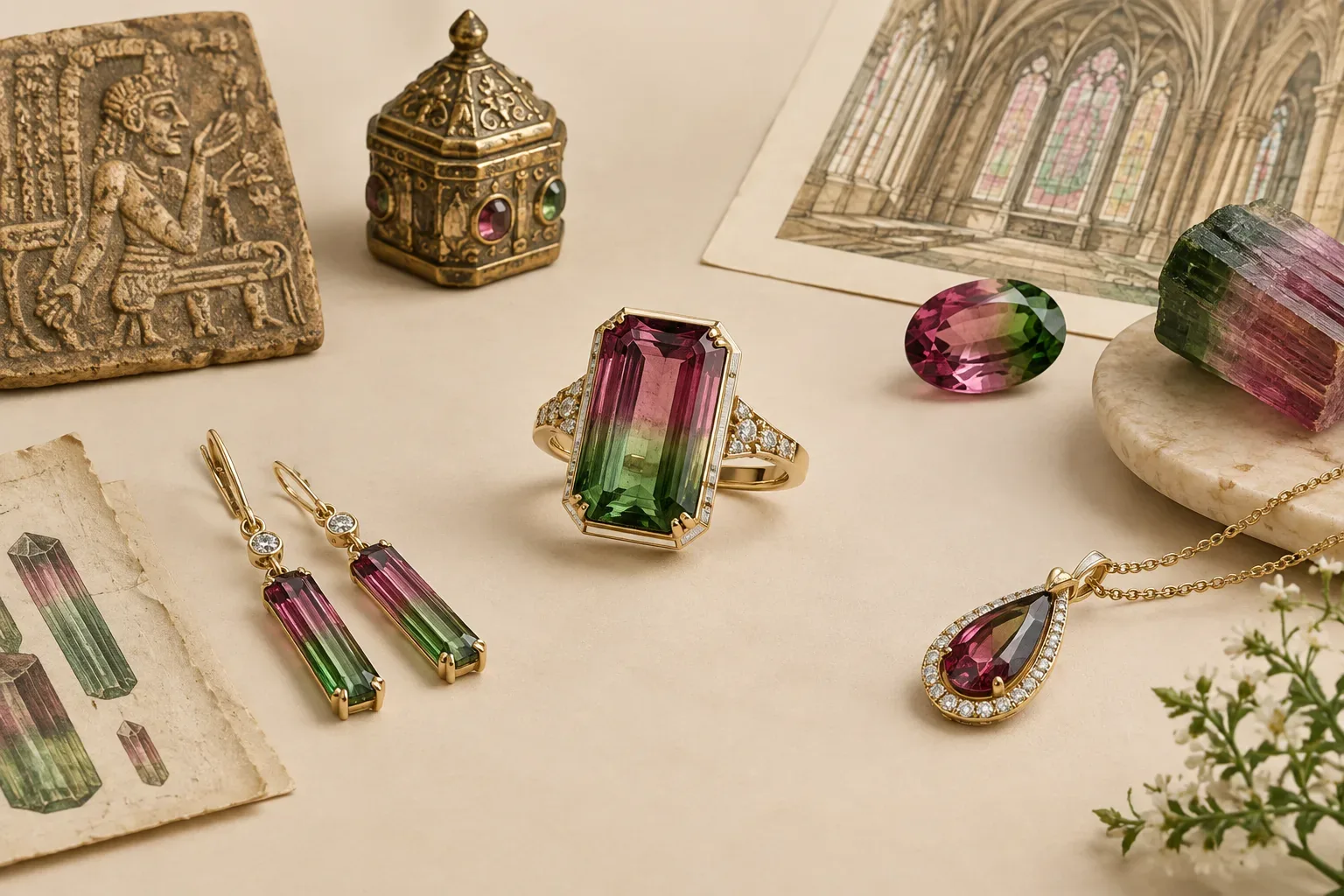
In contemporary jewellery, tourmaline appears in a wide range of cuts and mountings. Designers choose faceted cuts such as ovals, cushions, emeralds and pears to emphasize color and brilliance, and they sometimes use cabochons for saturated or included stones where a smooth surface highlights color depth. The choice between a faceted stone and a cabochon is a design decision that balances color, light performance and the stone’s internal character.
Settings range from delicate prong mounts, which maximize visible surface area and light exposure, to bezel mounts, which surround the stone with metal and offer greater edge protection. Open-backed settings let light enter faceted stones and can make colors appear livelier, while closed-back mountings or bezel silhouettes can provide stronger mechanical protection for pieces intended for everyday wear.
Historically informed designs sometimes borrow the language of a period described by the Victoria and Albert Museum — for example, integrating flowing metalwork reminiscent of Art Nouveau or the tighter, geometric lines of late 19th-century revival styles — while modern workshop techniques allow for precise, secure settings that were not always available to earlier jewellers.
Choosing cuts and settings for durability and everyday wear
Decide how the piece will be used before choosing cut and setting. For an occasional pendant or earrings, open prong settings and larger faceted cuts that emphasize sparkle often work well because those pieces are less likely to strike hard surfaces. For a ring intended for daily wear, prioritize protection: bezel, half-bezel or low-profile settings reduce the chance of chipping or catching and generally keep the stone safer in everyday activities.
Select a cut that suits the stone’s qualities. If the stone has exceptional clarity, a cut that maximizes light return will enhance brilliance. If the stone shows rich color but includes internal characteristics, a cut or a cabochon that concentrates color rather than sparkle can produce a more attractive result. Ask the seller to show the stone under different lights so you can assess how the cut, setting and mounting metal influence appearance.
Because gemstones can be treated to alter color or durability, request written disclosure from the seller. The Federal Trade Commission advises consumers to ask whether a gem has been heat-treated, irradiated, filled or otherwise altered and to request details in writing. Know the return policy, get any treatment disclosures in writing, and consider an independent appraisal if provenance or treatment disclosure is important to you.
Care, maintenance and responsible gifting
Provide care instructions with the piece. Advise the recipient about routine inspection of prongs and bezels, gentle cleaning methods appropriate for coloured stones, and the importance of removing jewellery during heavy manual tasks. Regular checks by a qualified jeweller can prevent a small loose prong from becoming a lost stone.
When gifting, be mindful of the recipient’s style, lifestyle and any cultural meanings they attach to particular stones or colours. If you wish to reference a historical style, use museum descriptions as context rather than asserting universal symbolic meanings. For example, say that a design is inspired by Victorian jewellery as documented by the Victoria and Albert Museum, rather than claiming the stone 'meant' the same thing to everyone in that period.
Finally, for ethically minded buyers, ask about the stone’s origin and the seller’s sourcing practices. Good vendors will be transparent about treatments, origin, and return or warranty policies; insist on written disclosures for treatments in line with FTC consumer guidance.
Making the choice: a short checklist
Match the cut to the stone’s strengths and your aesthetic goal; choose a bezel or low-profile setting for pieces that will see rougher use, and a prong setting for occasional-wear items where maximum light is desired. Request treatment disclosures in writing and confirm return and warranty terms. If a design references a historic period, use museum sources such as the Victoria and Albert Museum to explain that reference rather than presenting the style as carrying a single historical meaning for all people.
Final note
Tourmaline cuts and settings are a dialogue between the stone’s natural character, the maker’s technique and the wearer’s needs. Use museum scholarship to understand historical context, rely on consumer-protection guidance to verify material disclosures, and choose cuts and settings that serve both the look you want and the level of protection the piece requires.
Frequently asked questions
Are faceted cuts or cabochons better for tourmaline?
Choose the cut to suit the stone’s qualities and intended use. Faceted cuts emphasize brilliance and are well suited to clean, transparent stones worn for occasional use. Cabochons highlight saturated color and can be attractive for included or opaque stones. Consider the wear environment: cabochons in protective settings are often better for frequently worn pieces.
Which setting offers the most protection for a wearable tourmaline ring?
Bezel and half-bezel settings generally provide more edge protection than tall prong settings and are a good choice for rings intended for daily wear. Low-profile mountings reduce the chance of catching and help protect the stone during routine activities.
How can I tell if a tourmaline has been treated?
Ask the seller for written disclosure of any treatments. The Federal Trade Commission advises consumers to request information about heat treatment, irradiation, filling, or any other enhancement. Reputable sellers will provide this information, and you can request an independent appraisal if provenance or treatment status is important to you.
What basic care do tourmaline pieces need?
Provide gentle cleaning instructions, recommend removing jewellery during heavy manual tasks, and suggest periodic checks of settings by a qualified jeweller. Specific cleaning methods can vary by setting and any treatments the stone has received, so always confirm care recommendations with the seller or a professional.
Can I rely on historical meanings when gifting tourmaline jewellery?
Use documented historical context as inspiration but avoid asserting universal symbolic meanings. If a design is inspired by a historical period, reference museum scholarship (for example, the Victoria and Albert Museum) to explain that inspiration rather than stating it as a fixed cultural meaning for all recipients.
Sources and further reading
- Bedazzled: A History of Jewellery — Victoria and Albert Museum
- An A-Z of Gemstones — Victoria and Albert Museum
- Buying Gemstones, Diamonds, and Pearls — Federal Trade Commission