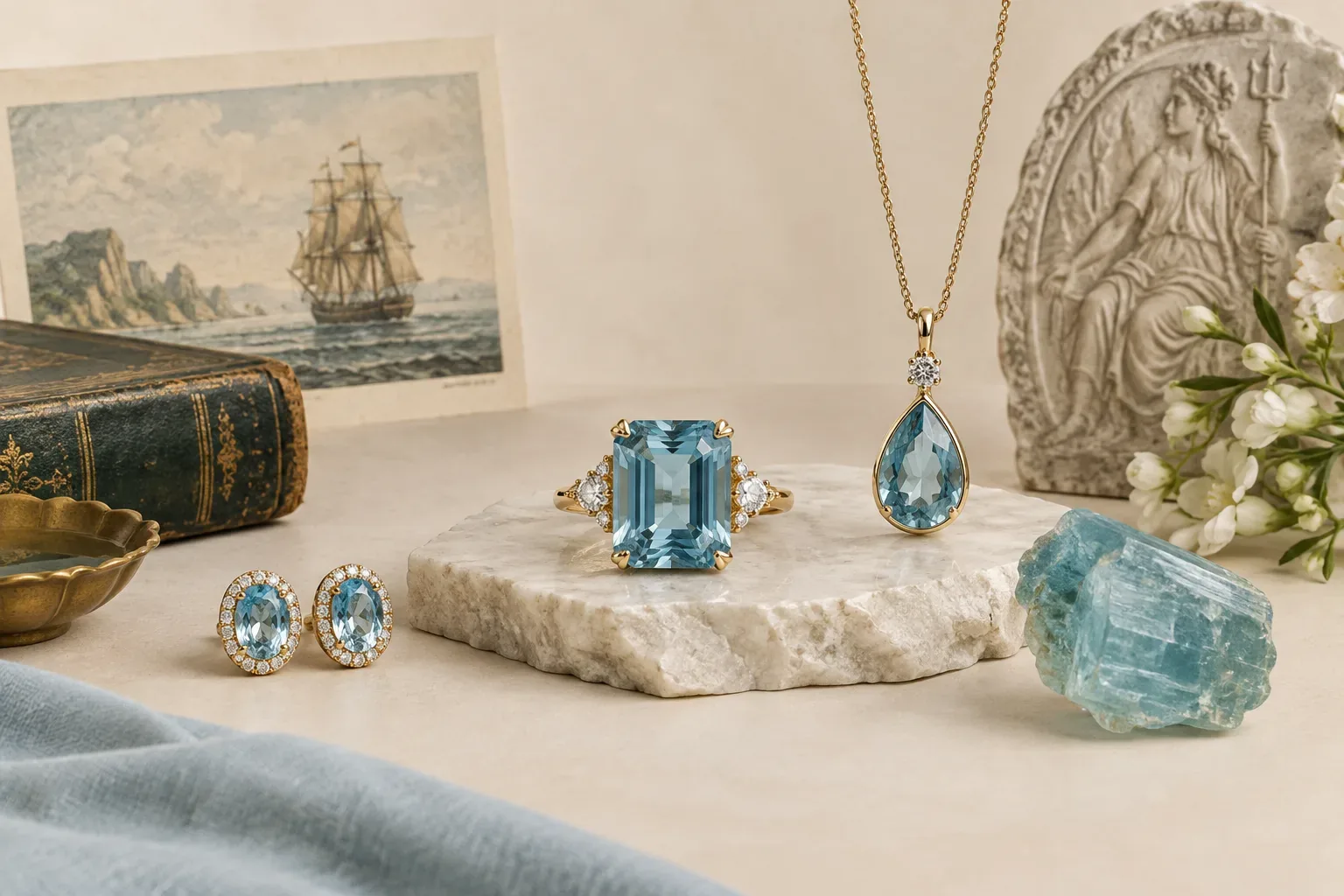
Meaning at a glance
Explain the documented history and changing contexts of the aquamarine quality and value factors motif, separate cultural or religious evidence from later popular interpretations, and give practical guidance for choosing and wearing the motif in modern jewelry.
Historical evidence and contexts (what museums document)
What we know from museum collections and label research is more reliable than modern lore. The Victoria and Albert Museum's exhibitions and reference material trace the use of colored gemstones across historical periods and cultures, showing that blue and green stones were valued for status, ornament, and symbolism in recognizable phases of jewelry history rather than carrying one single meaning across all times and places.
The V&A places gemstone use within clearly identified historical contexts—classical antiquity, the medieval and Renaissance periods, and the 18th and 19th centuries—documenting how tastes, lapidary technology, and social meanings shifted between these periods. For example, gemstones in general were used as signs of wealth and as decorative elements on court and ecclesiastical jewelry in Renaissance Europe, and later Victorian fashions introduced different sentimental and symbolic uses. These are museum-documented contexts rather than universal cultural claims.
Separating documented historical meanings from modern interpretations
Museum documentation records how societies used and regarded gemstones at particular times; such sources support statements about historical uses and changing social contexts. The V&A's resources show that historical meanings often related to status, the materials' rarity, and the fashions of the period rather than consistent metaphysical properties across cultures and centuries.
In contrast, many modern interpretations of aquamarine—for example, associations with calmness, communication, or specific spiritual properties—are contemporary personal or popular beliefs. These modern meanings have cultural merit for the people who adopt them, but they are not the same as historically documented roles of the stone. When choosing or gifting aquamarine, it is helpful to distinguish whether a meaning is supported by museum-documented historical context or is a recent personal interpretation.
How aquamarine appears in jewelry and historical styles
Aquamarine and other blue-green gems appear in jewelry in several recurring ways: as faceted center stones in rings, as elongated or oval stones in necklaces and pendants, and as accent stones in multi-gem compositions. The V&A’s surveys of jewellery history show how lapidary techniques and fashion determined how gemstones were cut and set in each period, which in turn affects how aquamarine is likely to be presented in antique and revival pieces.
Historically documented: in museum-labeled collections you will find gemstones used in court jewels, devotional objects, and later in the highly personal settings of 19th-century sentimental jewelry. Modern commercial jewelry commonly places aquamarine in a range of contemporary settings—solitaire rings, halo styles, drop earrings—reflecting current fashion and the gem’s aesthetic qualities rather than a single traditional motif.
Practical guide to assessing aquamarine quality and value
When assessing aquamarine quality and value, begin with the standard gem-trade characteristics while keeping in mind the need for clear information about any enhancements. Color is a primary factor: look for a clean, attractive blue or blue-green that suits your preference; intensity of color typically affects value. Clarity matters: many aquamarines are eye-clean, and stones with few visible inclusions are generally more desirable. Cut affects both brilliance and color presentation, so a well-proportioned cut that maximizes the stone’s color and light return is important.
Carat weight influences price but also affects how color and clarity appear at scale. Origin can be relevant to some buyers and to market perception, though documented origin claims should be supported by reliable information where possible. The Federal Trade Commission reminds buyers that material treatments and imitations must be disclosed, so always ask whether the stone has been enhanced (for example, heat treatment or other processes) and request that any disclosures be provided in writing. If authenticity or uncommon claims (such as rare provenance) are part of the price, consider asking for an independent gemological report to substantiate them.
Finally, evaluate the setting and metal: a setting that protects the stone, shows it to good advantage, and suits the intended use (daily wear versus occasional wear) will affect the overall value proposition.
Selection and gifting guidance
Buy for the person as well as the gem. Practical considerations like ring size, daily activities, and wardrobe are important. If the recipient prefers subtle pieces, a lighter-toned aquamarine in a modest setting may be more appropriate than a large, intensely colored stone in an elaborate mount. For someone who values historical resonance, choose pieces whose style matches a documented period—Victorian-style mounts for sentimental pieces, for example—using museum references such as those from the Victoria and Albert Museum to match historical aesthetics responsibly.
Ask sellers for clear, written answers to basic questions: Has the stone been treated or enhanced? Does the price include certification or a written appraisal? What is the return policy? The Federal Trade Commission recommends insisting on disclosure of treatments and imitations; use that guidance to avoid misunderstandings. When gifting, present any available documentation along with the jewelry and explain whether the symbolic meaning you attach to the stone is a personal choice or rooted in a documented historical context. That transparency is respectful and helps the recipient understand both the object and your intentions.
Final considerations
Aquamarine quality and value factors combine objective gem characteristics with personal taste and provenance. Rely on documented museum sources to understand historical context, and on consumer-protection guidance when you evaluate treatments and authenticity. Remember that museum evidence shows change over time and between cultures; do not assume any one symbolic meaning is universal. With informed questions and written disclosures, you can choose aquamarine jewelry that fits both aesthetic priorities and respectful historical understanding.
Frequently asked questions
What are the main factors that determine aquamarine value?
The principal factors are color intensity, clarity (eye-clean stones are generally preferred), cut quality (which affects light and color), carat weight, and documented provenance when relevant. Also confirm whether any enhancements or treatments have been applied, and request written disclosure from the seller.
How can I be sure an aquamarine hasn't been treated or imitated?
Ask the seller for written disclosure about any treatments and whether the stone has been synthetically produced or otherwise imitated. The Federal Trade Commission recommends insisting on these disclosures. For valuable purchases, consider an independent gemological report from a reputable laboratory to confirm authenticity and any treatments.
Are historical meanings of aquamarine the same as modern spiritual claims?
No. Museum documentation, such as resources from the Victoria and Albert Museum, shows historical uses and social meanings within specific cultures and periods. Modern spiritual or healing claims are contemporary personal interpretations and are not the same as documented historical roles.
What should I ask for when buying an aquamarine as a gift?
Request written information on treatments, any available provenance or certification, the seller’s return policy, and practical advice about the ring or setting for daily wear. Consider the recipient’s style and whether they prefer historically styled or contemporary settings, and include documentation with the gift so your intentions are clear.
Is aquamarine suitable for everyday jewelry?
Many aquamarines are used in rings and other everyday pieces, but suitability depends on the setting, the wearer’s lifestyle, and the stone’s size and cut. Ask the seller about the best mounting for durability and whether the piece is intended for daily wear or occasional use.
Sources and further reading
- Bedazzled: A History of Jewellery — Victoria and Albert Museum
- An A-Z of Gemstones — Victoria and Albert Museum
- Buying Gemstones, Diamonds, and Pearls — Federal Trade Commission