Meaning at a glance
Citrine treatments and imitations are matters of disclosure and provenance: consult museum and consumer-protection guidance for historical context and ask sellers directly whether a stone is natural, treated, synthetic, or an imitation and for written documentation.
Short answer
Ask whether a stone sold as citrine is natural, treated, synthetic, or an imitation, and request written disclosure or a lab report for gemstones of significant value; treat historical meanings of citrine separately from modern personal interpretations. This aligns with the Victoria and Albert Museum’s documentation of gemstones’ changing social roles and the U.S. Federal Trade Commission’s guidance that sellers should not misrepresent treated or imitation gems.
What the historical record shows
Museum collections and curatorial research make clear that gemstones, including yellow-to-golden stones later labeled as citrine, have been part of jewelry across many cultures and periods. The Victoria and Albert Museum describes the long sweep of jewellery history from ancient Egypt and classical antiquity through the medieval and Renaissance periods to the Georgian, Victorian and modern eras, and documents how different societies used gemstones for social display and ornament rather than a single fixed symbolic meaning.
When discussing citrine specifically, museum resources place it within the broader category of coloured gemstones that were cut, set and traded in different ways at different times. The V&A’s A–Z of Gemstones explains how curators and historians identify stones and trace their use in decorative arts, and it emphasizes that gemstones’ social meanings shift with fashion, technology and trade.
Distinguishing documented historical meanings from modern interpretations
Documented historical evidence collected by museums such as the Victoria and Albert Museum shows that gemstones were primarily used as markers of social status, wealth, and craft skill in many periods. These are observable social facts derived from surviving objects, inventories and contemporary descriptions, rather than uniform spiritual or emotional meanings.
Modern attributions—such as claims that citrine universally symbolizes prosperity, healing, or specific personality traits—are largely contemporary personal or commercial interpretations. Those modern meanings are layered on top of historical practice and vary by culture, seller and individual preference; they are not a consistent historical fact recorded across the periods the V&A documents.
How citrine and similar yellow gemstones appear in jewelry
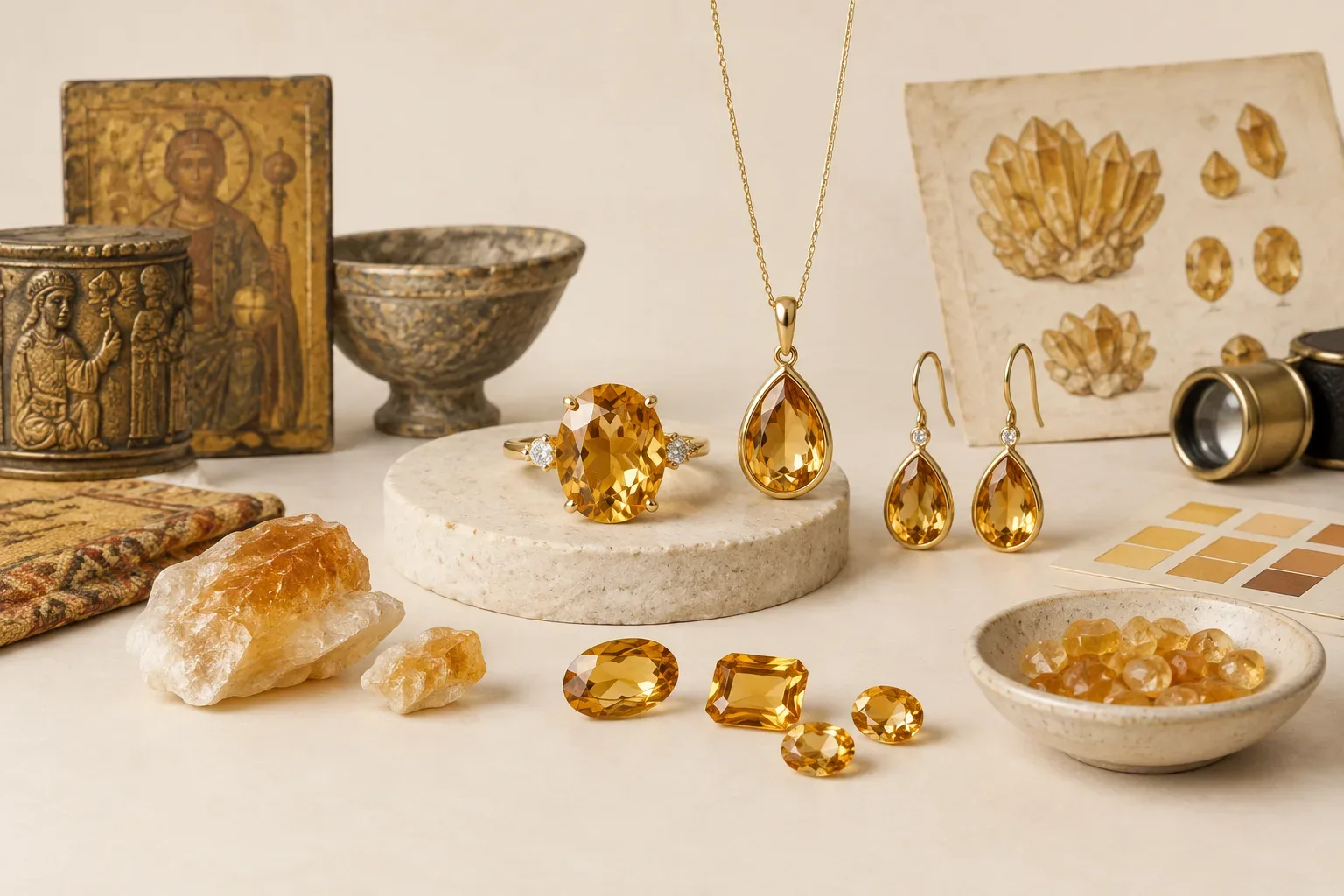
In museum collections and historic jewellery, yellow-to-gold stones appear as centerpieces in rings, brooches, pendants and earrings, set to catch light and show colour. The V&A’s summaries of gemstone objects explain that gem cutting, mounting styles and settings have evolved with technology and taste, so the way a yellow stone is presented in a Georgian brooch differs from a twentieth-century cocktail ring.
In modern jewellery the same variety of settings continues: faceted stones set in prong, bezel or halo settings; cabochons in antique-style mounts; and mass-produced or designer pieces that use stones of varying origins and treatments. Because the visual motif—warm yellow colour—can be produced by different natural stones, treated stones, synthetics and imitations, the look alone does not confirm material authenticity.
Why treatments and imitations matter for buyers
Treatments and imitations affect durability, long-term appearance and value. The U.S. Federal Trade Commission’s guidance on buying gemstones, diamonds and pearls explains that sellers must avoid misleading consumers and should disclose material treatments and whether a stone is synthetic or an imitation. That means whether a stone has been altered to change its colour or clarity, or whether it’s a man-made substitute, should be made clear at point of sale.
For buyers this matters because two visually similar yellow stones can have very different prices and care requirements depending on their nature. When a seller provides clear, accurate information about treatments and origin, you can make a choice that matches your budget, the intended use, and expectations for longevity and resale.
Practical questions to ask before buying or gifting
Start by asking the seller to describe the stone in plain terms: Is it natural, treated, synthetic, or an imitation? If the seller uses technical terms (for example, naming a specific treatment), ask them to explain what that means for the appearance and care of the stone and to provide written confirmation. The Federal Trade Commission recommends getting material disclosures in writing where possible so you have a record of the claims made at purchase.
For higher-value purchases ask if a recognized gemological laboratory report is available or can be obtained, what the return policy is, and whether any treatment could change over time with exposure to heat, light or chemicals. If you are buying as a gift, consider the recipient’s preferences about natural versus treated stones, and whether they value provenance and documentation as part of the meaning of the present.
Practical tips for selection and respectful gifting
Treat the choice of gemstone as both an aesthetic and a factual decision. If the recipient prefers natural, untreated stones, communicate that preference to the seller and expect corresponding documentation. If budget or durability is the primary constraint, a well-disclosed treated stone or a high-quality synthetic can be a thoughtful and lasting choice; just make sure the nature of the stone is clearly explained to the recipient.
Be mindful of cultural context. While museums like the V&A record many historical uses of gemstones, meanings differ between communities and individuals today. If you are uncertain whether a particular motif or stone carries cultural or religious significance for the recipient, ask them or someone close to them before buying. When in doubt, present the item with an explanation of your choice and the documentation supplied, so the gift’s material facts and your intent are both clear.
When to seek independent verification
For stones that are costly or intended as heirloom pieces, consider obtaining an independent gemological report from a recognized laboratory before finalizing a purchase. The FTC’s advice supports consumers making informed choices and seeking verification when material representation affects value or use. Independent reports can confirm whether a stone is natural, treated or synthetic and list specific treatments when those tests are reliable.
Independent verification is especially useful if the seller cannot or will not provide written disclosure about treatments and origin. It also helps preserve the gift’s provenance if you plan to pass the piece to future owners.
Summary
Historical sources such as the Victoria and Albert Museum show that gemstones have long been used in many cultures with meanings that change over time; those documented historical roles are not the same as modern commercial or personal interpretations. The Federal Trade Commission emphasizes that sellers should not misrepresent materials and that buyers should ask clear questions about treatments, synthetics and imitations and obtain written disclosures.
In practice, ask direct questions about whether a stone is natural, treated, synthetic or an imitation; request written confirmation or a lab report for high-value items; consider the recipient’s preferences and cultural context; and choose a piece whose documentation matches the meaning you intend to convey.
Frequently asked questions
What should I ask a seller about a stone sold as citrine?
Ask whether the stone is natural, treated, synthetic, or an imitation; request written disclosure; and for significant purchases ask if a recognized lab report is available. The U.S. Federal Trade Commission advises consumers to get clear material information in writing where possible.
Are sellers required to disclose treatments or imitations?
The Federal Trade Commission’s guidance to consumers indicates sellers should not misrepresent gemstones and that material treatments and whether a stone is synthetic or an imitation are matters that should be disclosed to buyers.
If a seller says a stone is ‘treated,’ is that bad?
Not necessarily. Treatments can improve appearance or durability and are widely used across many gemstones. What matters is full disclosure so you can decide whether the altered stone fits your budget, care expectations, and meaning for a gift.
Should I get a lab report for a citrine?
For higher-value purchases or pieces intended as heirlooms, obtaining an independent gemological report from a recognized laboratory is prudent. The FTC supports verification when material claims affect value or use.
How do historical meanings of citrine differ from modern ideas?
Museum research shows gemstones historically served social and decorative functions, with meanings shifting by culture and period. Modern attributions—such as consistent metaphysical properties—are contemporary interpretations and are not uniform across historical sources.
What if I’m buying citrine as a gift and the recipient cares about authenticity?
Discuss preferences before purchase or choose a stone with clear documentation and a generous return policy. If provenance and natural origin matter, ask the seller for written proof or a lab report and explain your choice to the recipient when gifting.
Sources and further reading
- Bedazzled: A History of Jewellery — Victoria and Albert Museum
- An A-Z of Gemstones — Victoria and Albert Museum
- Buying Gemstones, Diamonds, and Pearls — Federal Trade Commission