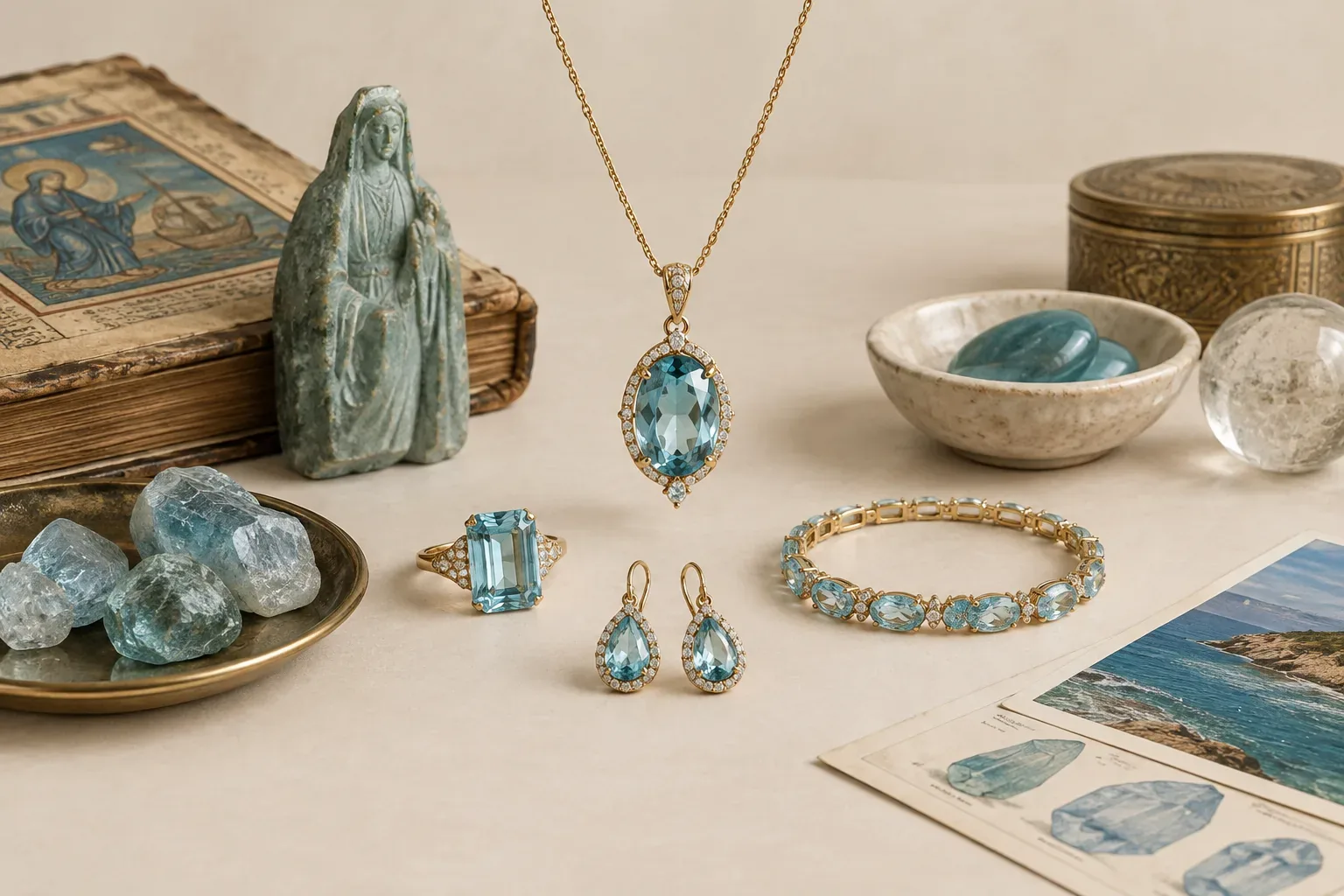
Meaning at a glance
The documented history and uses of aquamarine in jewelry are distinct from modern personal meanings, and buyers should ask specific questions about treatments and imitations—request written disclosure and, when appropriate, independent testing—because sellers are required to disclose material treatments and imitations under consumer-protection guidance.
What the historical record shows
The use of blue-green beryls in jewelry has a long material history. Curators and historians at the Victoria and Albert Museum discuss how gemstones have been used, reworked, and revalued across time in their exhibition and reference material, placing gems within changing social contexts and fashions. The V&A’s work on the history of jewelry explains that gems move between practical, decorative, and symbolic roles as tastes, technologies and markets change.
Those historical accounts show two separate but related facts: gemstones were prized for their color and rarity, and artisans and dealers have always adjusted stones—cutting, polishing and sometimes altering appearance—to suit fashion or market demand. The V&A’s A–Z of Gemstones places individual gems, including beryl varieties, in that long craft and collecting context rather than presenting a single, fixed meaning for how they were used.
Documented meanings versus modern interpretations
When museums and historical sources describe how a gem was worn or displayed, they are documenting contexts of use and the values placed on materials at particular times. Those documented contexts are not the same as universal spiritual or cultural properties. The V&A content shows that a gem’s role can shift: a stone valued for rarity in one period might be prized for color or sentiment in another.
Modern personal and popular interpretations—associating aquamarine specifically with healing, calm, or particular romantic meanings—are contemporary layers of meaning that people validly assign today, but they should be treated as personal or cultural interpretations rather than fixed historical facts. When choosing or giving aquamarine, separate what is documented about how societies used and traded the gem from what people today might personally intend the stone to symbolize.
Treatments and imitations: what the record and law say
Historical practice shows that altering and imitating gems is not new; the same commercial impulses that shaped historical gem use also appear in the modern market. Contemporary consumer guidance from the Federal Trade Commission makes this explicit for today’s buyers and sellers: material treatments and imitations must be disclosed to consumers. That legal and regulatory context is the practical framework buyers should use when evaluating aquamarine.
The FTC guidance frames the buyer’s rights and the seller’s responsibilities. It recommends that sellers clearly identify whether a gem is natural, treated, synthetic or an imitation and that any enhancement or treatment affecting appearance or durability be disclosed. This means the appropriate first question to ask a seller is whether the stone is natural, treated, synthetic or an imitation, and to request written confirmation of that status.
How aquamarine appears in jewelry, historically and today
Museum histories show beryl varieties have been set in many kinds of jewelry across periods, from rings and brooches to pendants and long necklaces. The pale sea-blue of aquamarine has made it a recurring choice for pieces where color and clarity are visible features of the design. Exhibitions and curatorial notes emphasize the relation between the gem’s optical properties and the technical choices of setting and cutting that designers have used to show off its color.
In modern jewelry aquamarine is used both in classic solitaire pieces and in more elaborate, fashion-driven designs. Contemporary cutters and setters consider how color, clarity and size will read in the intended setting. Because treatments can affect color saturation and stability, jewelers and designers often disclose treatments in product descriptions, but disclosure practices vary, which is why buyer questions and documentation matter.
Practical questions to ask when buying or accepting a gift
Start with: is the stone natural, treated, synthetic or an imitation? Ask the seller to describe any treatments and to provide that information in writing. If the piece is expensive, ask for a report from a reputable gem laboratory. The FTC’s consumer guidance recommends clear, upfront disclosure, and written confirmation helps avoid later misunderstandings.
If you are buying for durability or daily wear, ask whether a disclosed treatment affects stability or care requirements. If you are buying for symbolic reasons, explain your intention to the seller and ask how the stone’s appearance and any treatments align with that meaning. Remember that documented historical contexts noted by museums show how uses and meanings change, so align the physical characteristics of the gem with the contemporary meaning you want it to have.
When receiving aquamarine as a gift, it is reasonable and respectful to ask about provenance and treatment if the giver does not mention it. Frame the question as curiosity about the stone’s story rather than suspicion. This approach recognizes both the emotional value of a gift and the practical right to know whether a stone has been altered or imitated.
Red flags and reasonable verification steps
A seller’s reluctance to answer whether a stone is treated, synthetic or an imitation is a red flag. Equally, vague product descriptions that avoid the words natural, treated, synthetic or imitation should prompt follow-up. The FTC’s consumer guidance makes clear that transparency is a seller’s responsibility.
For mid- to high-value purchases, a laboratory report is the standard verification. If a lab report is not practical, ask for a clear, documented seller statement about the stone’s status and any return policy that covers undisclosed treatments or imitations. For lower-value pieces, use the seller’s disclosure, visual inspection, and your comfort level about provenance to decide.
Making meaning and choosing respectfully
If you value the historical resonance of aquamarine, use museum references and reputable gem guides to understand how the gem was used in different periods and cultures. The V&A’s materials are a useful starting point for understanding how gems were positioned within changing fashions and social meanings, and they show that context matters.
If you and the wearer prefer a particular modern symbolic meaning, state that intention when purchasing or gifting. Many jewelers will help you select a stone whose color and clarity support that intention. Whether you prioritize historical authenticity, physical permanence, or symbolic meaning, be explicit about which of these concerns is most important to you when you ask a seller your initial questions.
Final practical checklist
Ask if the stone is natural, treated, synthetic, or an imitation and request that information in writing. Ask whether any known treatments affect color, durability or care. For higher-value pieces, request an independent laboratory report. Consider the piece’s intended use—daily wear, occasional wear, or purely symbolic—and match that use to the seller’s disclosure. Use museum and gem reference material to understand historical contexts if historical authenticity matters to you, and rely on consumer-protection guidance to enforce transparency.
Frequently asked questions
Do sellers have to tell me if an aquamarine is treated or an imitation?
Yes. Contemporary consumer-protection guidance from the Federal Trade Commission advises that sellers must disclose material treatments, synthetics, and imitations. Ask for those disclosures in writing so you have a record and can compare claims.
How can I verify whether an aquamarine has been treated?
For mid- to high-value stones, request a report from a reputable gemological laboratory. For lower-value purchases, request a clear seller statement and check the return policy; persistent ambiguity about treatment or origin is a reason to pause.
Are treated aquamarines less valuable than untreated ones?
Value depends on buyer priorities and market norms. Treatments that improve color or stability can make a stone more attractive to many buyers, while collectors who prize natural, untreated stones may pay a premium for documented natural material. Separate historical documentation from current market preferences when deciding what matters to you.
Is an imitation automatically a bad choice?
Not necessarily. Imitations and synthetic stones can offer durability, color, and affordability for everyday wear or fashion pieces. The key is transparent disclosure. If an imitation is intentionally presented as a natural aquamarine, that is misleading; if it is clearly labeled, the choice rests on personal priorities.
What should I ask if I want a piece that reflects historical use or meaning?
Use museum sources to understand how a gem was used in a particular period, and tell the seller that historical authenticity is important to you. Ask about provenance, cutting style, and whether the stone has been altered in ways that would affect historical appearance.
Sources and further reading
- Bedazzled: A History of Jewellery — Victoria and Albert Museum
- An A-Z of Gemstones — Victoria and Albert Museum
- Buying Gemstones, Diamonds, and Pearls — Federal Trade Commission