Meaning at a glance
Documented history shows amethyst has appeared in different cultures and contexts; its current market value depends chiefly on color, clarity, cut, carat, and treatments with disclosure rules governed by regulators. This guide separates historical evidence from later interpretations, explains how amethyst appears in jewelry, and gives practical buying and gifting advice.
Why this matters
Understanding both the documented history of amethyst and the technical quality factors is useful because buyers often mix cultural significance and market attributes when judging a piece. Museums that collect and interpret jewellery show how gems move between social roles and meanings, while consumer protection guidance explains what sellers must disclose about treatments and imitations.
Documented historical evidence, culture by culture
The historical record of amethyst in jewellery and material culture is complex and changes across times and places. The Victoria and Albert Museum describes how gemstones, including amethyst, were used in different periods of jewellery history and how their meanings shifted as fashions and religious contexts changed. Relying on museum interpretation helps keep specific claims grounded in documented examples rather than generalization.
For example, in medieval and later Christian Europe, purple stones—including amethyst—appear in ecclesiastical rings and certain high-status items where purple dye and purple stone had associations with rank; museums document those associations within their collections rather than proposing a single universal symbolism. The Victoria and Albert Museum's historical material traces jewellery from ancient styles through Renaissance and later uses, showing that social context, rather than a fixed gem property, often determined significance.
Across cultures, amethyst has been used in decorative, religious, and personal jewellery at different times. Museum summaries note shifts in popularity: gems that are prized in one century or culture may be common in another. The Victoria and Albert Museum's resources on gemstone history and the broader history of jewellery provide the primary documented evidence used here for cultural and period-specific claims.
Separate documented meanings from modern personal interpretation
Documented historical meanings are those recorded by reliable collections and curators, such as usages seen in museum holdings and described in museum commentaries. Those documented uses include amethyst's presence in high-status or ecclesiastical jewellery in certain European contexts and the role of purple gems in signalling social rank. These are recorded observations about how objects were made and used, not universal claims about the stone.
Modern personal interpretations—for example, that amethyst brings calm, spiritual protection, or sobriety—are contemporary or popular associations created and adapted in recent centuries. These personal or New Age meanings are valid for individuals who value them, but they are distinct from the historical record as interpreted by museums. When gifting or selecting a piece, be clear about whether you are choosing for documented historical resonance or for contemporary symbolic meaning.
How amethyst appears in jewellery (forms, motifs, and settings)
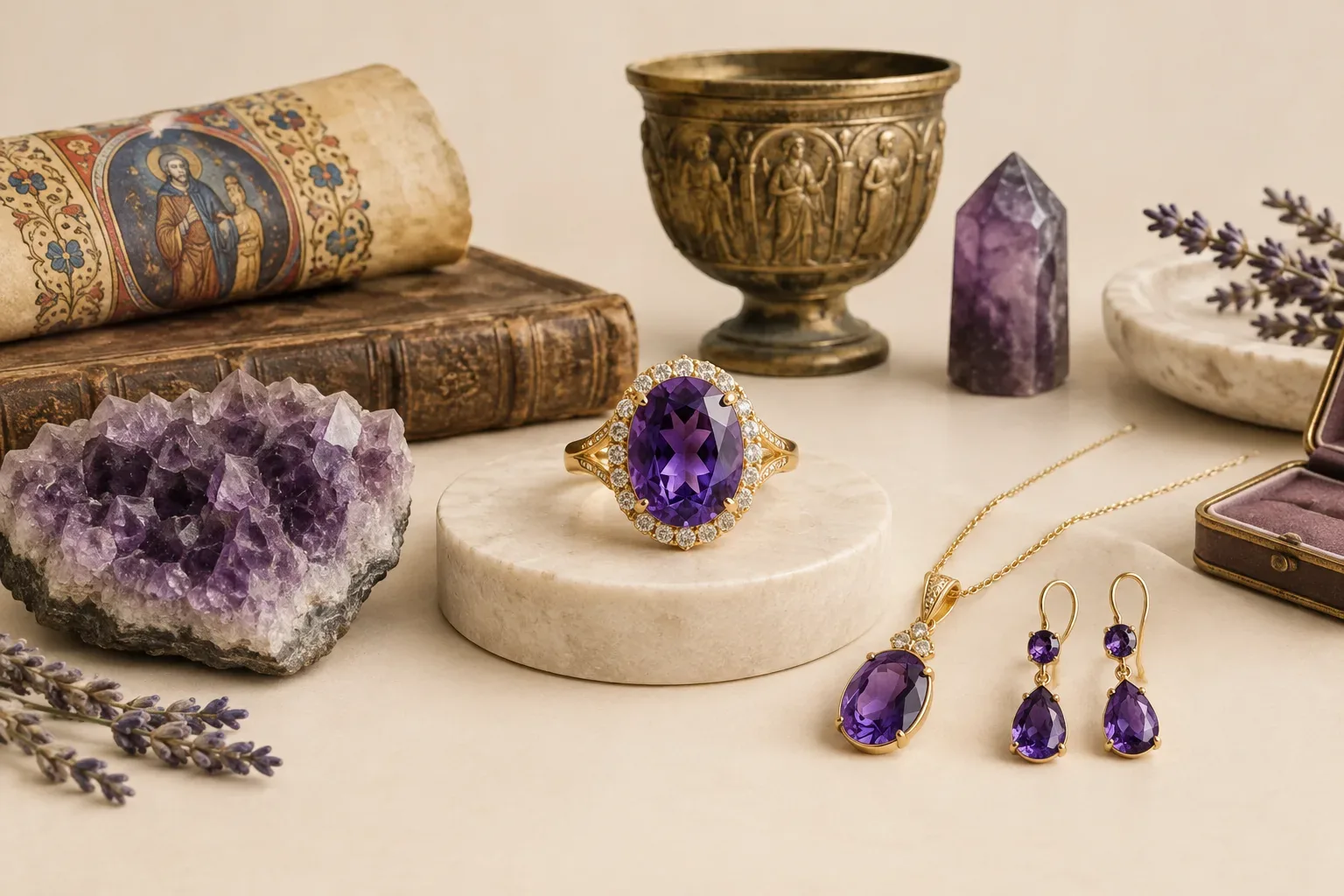
Amethyst appears in a broad range of jewellery types: rings, earrings, pendants, brooches, and bead strands. Historically and today it has been cut as cabochons, faceted stones, and carved gems. Museums document examples across periods from carved intaglios and signet-like pieces to Victorian and later faceted gems set in both fine and fashion jewellery.
Motifs and settings vary with era and fashion. In earlier collections, amethyst may appear in ecclesiastical or courtly contexts with complex metalwork and symbolic settings, while in later periods it commonly appears as a mounted faceted stone in simplified settings intended to show color. Contemporary designers use amethyst in everything from minimalist solitaires to ornate cluster settings. The Victoria and Albert Museum's overviews of gemstones and jewellery history illustrate these changes in use over time.
Quality factors that determine value
Color: The single most important factor for amethyst value is color. Rich, even purple hues with secondary flashes of red or blue generally command higher prices than pale or unevenly colored stones. Very dark stones that appear nearly black under low light are often less desirable than those with vivid medium-dark tones, because strong color saturation that remains bright in different lighting is preferred.
Clarity: Amethyst is typically eye-clean, meaning most good specimens show no visible inclusions to the naked eye. Stones with visible fractures, cloudiness, or inclusions that interfere with transparency will be less valuable. The way inclusions affect light return can be more important than minor internal features that do not affect appearance.
Cut: Cut determines how the stone displays color and brilliance. Well-proportioned faceting maximizes color and avoids windowing or dark zones. Cabochon cuts emphasize color and surface qualities rather than internal brilliance and are appropriate for certain historical or stylistic uses.
Carat and size: Larger amethysts occur and can be visually impressive because amethyst is relatively common compared with precious gems. Value per carat typically increases with good color and clarity, but oversized stones with poor color can be less desirable than smaller stones with ideal color.
Treatments and synthetics: Amethyst is sometimes heat-treated to alter color or improve tone, and synthetic or imitation stones exist. The Federal Trade Commission requires sellers to disclose material treatments, synthetics, or imitations to avoid misleading consumers. Ask for clear disclosure from the seller about any treatments or laboratory-grown origins.
Origin: Specific localities may be mentioned by sellers for marketing reasons, but origin seldom outweighs the four technical factors above. Museum commentaries and gem references document historical provenance for some notable examples, which can add interest but not replace basic quality assessment.
Practical buying guidance
Decide what matters most to you: color and overall appearance, historical or symbolic resonance, durability, or price. If you prize historical connection, buy from reputable dealers or auction houses that provide provenance or museum-style documentation. If visual impact is the priority, compare stones under different lighting to ensure the color reads well both in daylight and indoor light.
Ask sellers specific questions about treatments and origin, and request written confirmation. The Federal Trade Commission's consumer guidance emphasizes that material treatments, synthetics, and imitations must be clearly disclosed, so insist on transparency if a seller does not volunteer that information.
Inspect the setting and metalwork as well as the stone. A well-made setting protects the gem and suits the wearer's lifestyle. For ring purchases, consider the recipient's hand size and how the stone's height and prongs will handle daily wear. For heirloom or period-style pieces, examine the mounting to understand whether the gem has been re-set or altered.
Compare price per carat among pieces with similar color and clarity, remembering that amethyst is abundant relative to precious gems and that superb color and clarity are the main drivers of premium prices. For larger stones, ensure color remains even across the surface and that the cut displays the color attractively.
Obtain a return policy, certificate, or appraisal when appropriate. For higher-value purchases, a gemological report or independent appraisal can confirm identity and treatment status. For lower-cost fashion pieces, documented seller warranties and transparent descriptions are generally sufficient.
Gifting respectfully
Be mindful that historical or religious uses of amethyst in some cultures do not mean the stone carries that meaning universally. If you choose amethyst for symbolic reasons, tell the recipient why you chose it and whether that meaning is personal, historical, or both. This clarity avoids unintentionally assigning a cultural or religious significance that the recipient may not share.
Consider personal taste and lifestyle. Choose settings that match the recipient's wardrobe and daily activities. If you present a historically styled piece, include a note about the documented historical context from museum sources if you think the recipient will appreciate that background; a short explanation linking the piece to recorded uses in museum collections helps separate documented meaning from later personal attributions.
When gifting antique pieces, disclose any known restorations, re-settings, or repairs and offer to provide care advice. Antique amethyst jewellery may require different handling than modern pieces, and honesty about condition preserves trust between giver and recipient.
Care and maintenance
Amethyst is relatively durable but can scratch or chip with rough wear. Clean amethyst jewellery with mild soap, warm water, and a soft brush, and avoid prolonged exposure to intense heat or harsh chemicals that can fade or alter color. Store amethyst separately from harder gemstones to prevent surface scratches.
For long-term preservation of heirloom pieces, consider periodic professional cleaning and inspection. Well-made settings should be checked for loose prongs and secure mounts, especially for rings and frequently worn pendants.
Final thoughts
Amethyst quality and value factors are best approached in two parallel threads: understand documented historical contexts from reliable museum sources if provenance or cultural significance is important, and evaluate the gem by color, clarity, cut and carat plus any treatments or synthetic status for market value. Use the Federal Trade Commission's disclosure guidance to ensure transparency about treatments and lab-grown products, and choose or gift amethyst with attention to personal taste and cultural respect.
Frequently asked questions
What are the most important factors determining amethyst value?
Color, clarity, cut and carat weight are the principal factors that determine amethyst value, with color usually being the most important. Treatments, synthetic origin, and the quality of the mounting also affect price and desirability.
Are amethysts commonly treated or synthetic?
Amethysts can be heat-treated to alter tone, and synthetic or imitation purple stones exist. The Federal Trade Commission advises that sellers must disclose material treatments, laboratory-grown status, or imitations, so buyers should request clear written information from vendors.
Does the historical use of amethyst make it more valuable?
Historical use and provenance can increase interest and sometimes price for particular antique pieces, but documented provenance or historical significance is different from the gemological factors that generally determine market value. Museum-documented provenance adds cultural value but does not automatically set gem market prices.
How should I care for amethyst jewellery?
Clean amethyst with warm soapy water and a soft brush, avoid harsh chemicals and prolonged heat, and store it separately from harder gemstones to prevent scratches. Have settings professionally inspected periodically to ensure stones remain secure.
Is amethyst a good choice for everyday wear?
Amethyst is reasonably durable for regular wear when set securely, but like all quartz it can scratch or chip. Choose a protective setting for rings or pieces that will see heavy use and be mindful of hard knocks and abrasive surfaces.
Should I ask for a gemological report for an amethyst purchase?
For higher-value or historically significant purchases, a gemological report or independent appraisal is recommended to confirm identity, treatments, and origin where that information matters. For lower-cost fashion pieces, clear seller disclosure and return policies may be sufficient.
Sources and further reading
- Bedazzled: A History of Jewellery — Victoria and Albert Museum
- An A-Z of Gemstones — Victoria and Albert Museum
- Buying Gemstones, Diamonds, and Pearls — Federal Trade Commission