Meaning at a glance
Jormungandr jewelry refers to the World Serpent from Norse mythology, especially its role encircling Midgard and its conflict with Thor; contemporary themes such as cycles, boundaries, and resilience are modern interpretations rather than universal Viking beliefs.
Quick answer
Jormungandr jewelry meaning: it invokes the World Serpent of Norse myth — the great sea-serpent said to encircle Midgard and destined to clash with Thor. That is the documented narrative context for the motif. Modern wearers and makers often layer additional symbolic ideas (cycles, protection, boundaries, endurance), but those should be described as contemporary interpretations rather than proven Viking beliefs.
Historical evidence and cultural context
Our direct historical evidence for Jormungandr comes from Norse mythic narratives and the way museums summarize those narratives for modern audiences. The National Museum of Denmark explains that Jormungandr is the Midgard Serpent and that stories such as Thor’s fishing for the serpent are part of the Norse tradition. The Swedish History Museum likewise presents Jormungandr as the World Serpent and places the creature within the larger Ragnarok narrative. These museum accounts reflect the surviving textual and artistic tradition of medieval Norse literature rather than a single, unified folk belief recorded across all Viking communities.
When museums describe the Thor-and-serpent episodes and the serpent’s role in the end-times, they are drawing on saga and eddaic material that formed the medieval Norse mythic corpus and later cultural memory. The primary point supported by both the National Museum of Denmark and the Swedish History Museum is that Jormungandr is the Midgard Serpent and that its struggle with Thor is a recurring element of Norse narrative imagination. Museums and modern scholarship present these facts as part of the Norse myth tradition; they do not claim a single, universal set of ritual meanings held identically across all historical Norse communities.
Documented historical meanings versus modern interpretations
Documented historical meaning: according to the National Museum of Denmark and the Swedish History Museum, Jormungandr is explicitly the Midgard Serpent and figures in Thor’s mythic episodes and the Ragnarok narrative. That is the part supported by historical sources and museum summaries: a mythic creature, a narrative role, and specific stories such as Thor’s fishing episode.
Modern interpretations: contemporary jewelers, designers, and wearers often extend the serpent into additional symbolic domains. Many today treat the World Serpent motif like an ouroboros—a symbol of cycles, renewal, and the unity of beginning and ending—or as a representation of boundaries and resilience. Museums note this comparative use of ouroboros-like imagery when discussing how modern audiences understand serpent motifs, but they do not present such meanings as original Viking doctrine. In short, cycle and boundary metaphors are useful modern readings, not documented universal beliefs of Viking-age people.
How the Jormungandr motif appears in jewelry
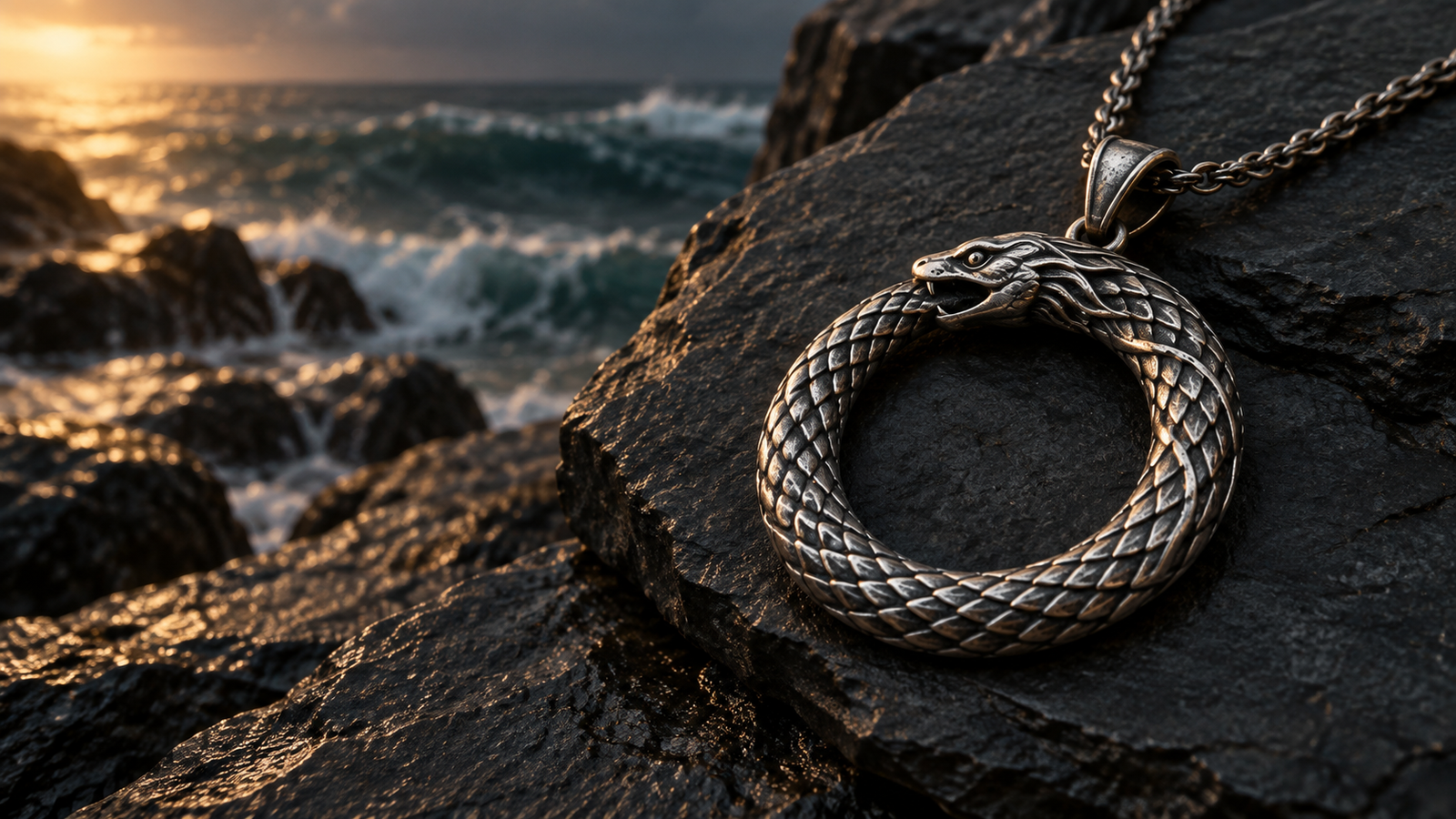
On modern jewelry, the Jormungandr motif appears in several recognisable forms. Popular designs echo the image of a serpent encircling an object or biting its tail (an ouroboros-like ring), sculpted serpent pendants that suggest a circled world, stylized rings or arm bands with interlaced serpent forms, and pieces that pair serpentine motifs with Thor-related imagery to reference their mythic antagonism. Museum summaries that highlight Thor’s fishing scene also inspire narrative pendants and engraved motifs that depict the struggle between Thor and the Serpent in simplified form.
Contemporary makers use a wide range of materials to render the World Serpent: silver and sterling silver are common because they suit fine detail and patina; bronze and brass give a warmer, antiqued look that some wearers associate with historical metalwork; stainless steel and mixed metals serve more durable, everyday styles. Gemstones are chosen for visual and symbolic contrast rather than historical precedent: dark stones such as black onyx or spinel emphasize the sea and the serpent’s somber power, while green stones such as peridot or green agate are sometimes used to suggest sea-water associations. These gemstone and metal choices reflect modern aesthetics and symbolic layering rather than statements about what Vikings actually wore.
Design language and authenticity claims
Because museums present Jormungandr as a mythic figure rather than a single archaeological motif, designers vary in how literally they represent the serpent. Some pieces aim for a historically inspired aesthetic by using knotwork, runic inscriptions, or stylized animal forms that echo Viking art styles. Others are explicitly contemporary, blending the serpent with geometric forms or modern metals. When a maker claims a design is 'authentic Viking' because it features a serpent, treat the claim cautiously: the museums’ accounts show the serpent is a narrative figure in Norse myth, but the specific jewelry designs found in any particular archaeological context are much more limited and regionally variable.
Choosing and gifting Jormungandr jewelry — practical and respectful guidance
Consider the recipient’s background and beliefs. If the person identifies as a practitioner of modern Heathenry or Norse-inspired spirituality, ask about their preferences and sensitivity to specific symbols. If the gift is for someone with ancestry from Norse regions, be thoughtful about whether they would appreciate cultural reference as heritage or prefer a more neutral design. Many people enjoy mythic motifs purely as storytelling and aesthetic devices; others attach spiritual weight to them. Respect the recipient’s relationship to Norse culture rather than assuming the symbol carries the same meaning for everyone.
Choose quality and clarity in symbolism. If your intent is to honour the mythic story, opt for a design that clearly references the World Serpent and, if desired, pair it thoughtfully with other motifs (for example: a pendant that suggests the encircling of a globe, or a small engraving referencing Thor’s fishing episode). If your goal is to gift a piece representing ideas such as endurance or cyclical renewal, select contemporary designs that explicitly state that interpretive intent so the wearer and giver share understanding.
Avoid appropriation and commercial stereotyping. Because Norse myth is meaningful to modern religious communities and to cultural heritage, avoid marketing or gifting pieces that treat sacred symbols as mere novelty without acknowledging their narrative origins or the range of modern meanings. When buying, prefer makers who credit sources or explain the design’s inspiration—this shows respect for context and reduces the chances of perpetuating misleading historical claims.
Care, materials, and ethical considerations
Basic metal and gemstone care applies: silver can tarnish and benefits from gentle polishing, bronze and brass may develop patina over time, and gemstone settings should be checked periodically to avoid loss. For pieces meant to be heirloom quality, look for reputable makers, hallmarks for metal content, and secure gemstone settings.
Ethical considerations include sourcing and maker transparency. If you value ethically sourced stones or recycled metals, ask sellers about materials and production practices. Supporting independent craftspersons who acknowledge the mythic source and avoid exploitative cultural shortcuts is one way to ensure your Jormungandr piece has both quality and context.
Frequently asked questions
Is Jormungandr a historically attested Viking symbol?
Jormungandr is a historically attested figure in Norse myth as the World Serpent that encircles Midgard and features in stories with Thor; museums such as the National Museum of Denmark and the Swedish History Museum present this narrative context. However, specific jewelry designs from the Viking Age using Jormungandr imagery are not documented as uniformly as the myth itself, so modern jewelry often reflects contemporary creative choices.
Does wearing Jormungandr jewelry mean I’m adopting a religious belief?
Not necessarily. Many people wear mythic imagery as cultural or aesthetic expression. Some wearers do attach spiritual meaning and others wear it for fashion or storytelling. If you intend the piece as a religious symbol for a community that uses Norse motifs in living practice, be mindful and respectful of those meanings.
What does it mean when a Jormungandr piece shows the serpent biting its tail?
That image is often read as an ouroboros-like symbol of cycles or unity in modern contexts. Museums note this comparative reading, but it is a contemporary interpretive layer rather than a documented Viking-age doctrinal meaning.
Which metals and stones suit Jormungandr-themed jewelry?
Modern makers commonly use silver, bronze, brass, and stainless steel, and pair the motif with dark stones such as black onyx or green-hued gems to suggest maritime associations. These are stylistic choices rather than historically proven materials specifically linked to Jormungandr in Viking artifacts.
How can I gift Jormungandr jewelry respectfully?
Ask about the recipient’s feelings toward Norse imagery, choose a design that matches their relationship to the motif (historical, spiritual, or aesthetic), prefer transparent makers who credit the mythical source, and avoid treating sacred symbols as mere novelty. Clear communication about your intent helps ensure the gift is respectful.
Are modern meanings like 'resilience' or 'boundaries' historically accurate?
Those are useful contemporary interpretations popular among designers and wearers, but they are not presented as universal historic Viking beliefs by the museums that interpret the mythic sources. Label such meanings as modern interpretations.
Sources and further reading
- The old religion — National Museum of Denmark
- Vikingarnas mytologiska varld — Swedish History Museum