Meaning at a glance
This article explains the documented history and changing contexts of sapphires and the factors that determine their quality and value, distinguishes historical cultural meanings from modern personal interpretations, describes how sapphires appear in jewelry, and gives practical guidance for selecting and gifting sapphire pieces while noting disclosure and testing issues consumers should watch for.
Historical evidence and the contexts in which sapphires mattered
The historical role of sapphire in jewelry and symbolism is well documented in museum surveys of jewellery. The Victoria and Albert Museum describes how gemstones, including blue stones identified as sapphires or sapphire-like stones, have been used across different cultures and periods for both decorative and symbolic purposes, from antiquity through medieval and later European court jewelry and into South Asian and other regional traditions. Museums record specific periods in which certain uses or meanings were prominent; for example, medieval European ecclesiastical and court contexts emphasized gemstones for religious or status display, while later ornament and portrait jewelry used gems to express rank and taste.
Those studies emphasize change over time: a gem that signified divine protection in one era could shift toward a marker of social rank or romantic sentiment in another, and practical market considerations such as supply, cutting technology and trade routes have repeatedly changed what qualities buyers and artisans prized. The V&A’s histories therefore treat sapphire qualities and their value as historically contingent rather than fixed.
Documented historical meanings versus modern personal interpretations
When citing historical meanings it is important to attribute them precisely and not to treat them as universal. The Victoria and Albert Museum documents specific associations in particular cultures and periods—such as religious or courtly symbolism in medieval and early modern Europe—based on surviving objects and written records. Those documented meanings belong to those contexts and should not be generalized to all peoples or times.
Modern interpretations—how an individual wearer or a modern culture reads a sapphire today—are often personal or commercially reinforced. Contemporary associations such as sapphire as a birthstone for September, or as an alternative to diamond in engagement rings, are modern conventions and preferences rather than single, documented historical truths. Treat historical meanings as context and modern interpretations as personal or cultural choices that can coexist without claiming universal significance.
How the sapphire motif and gemstone appear in jewelry
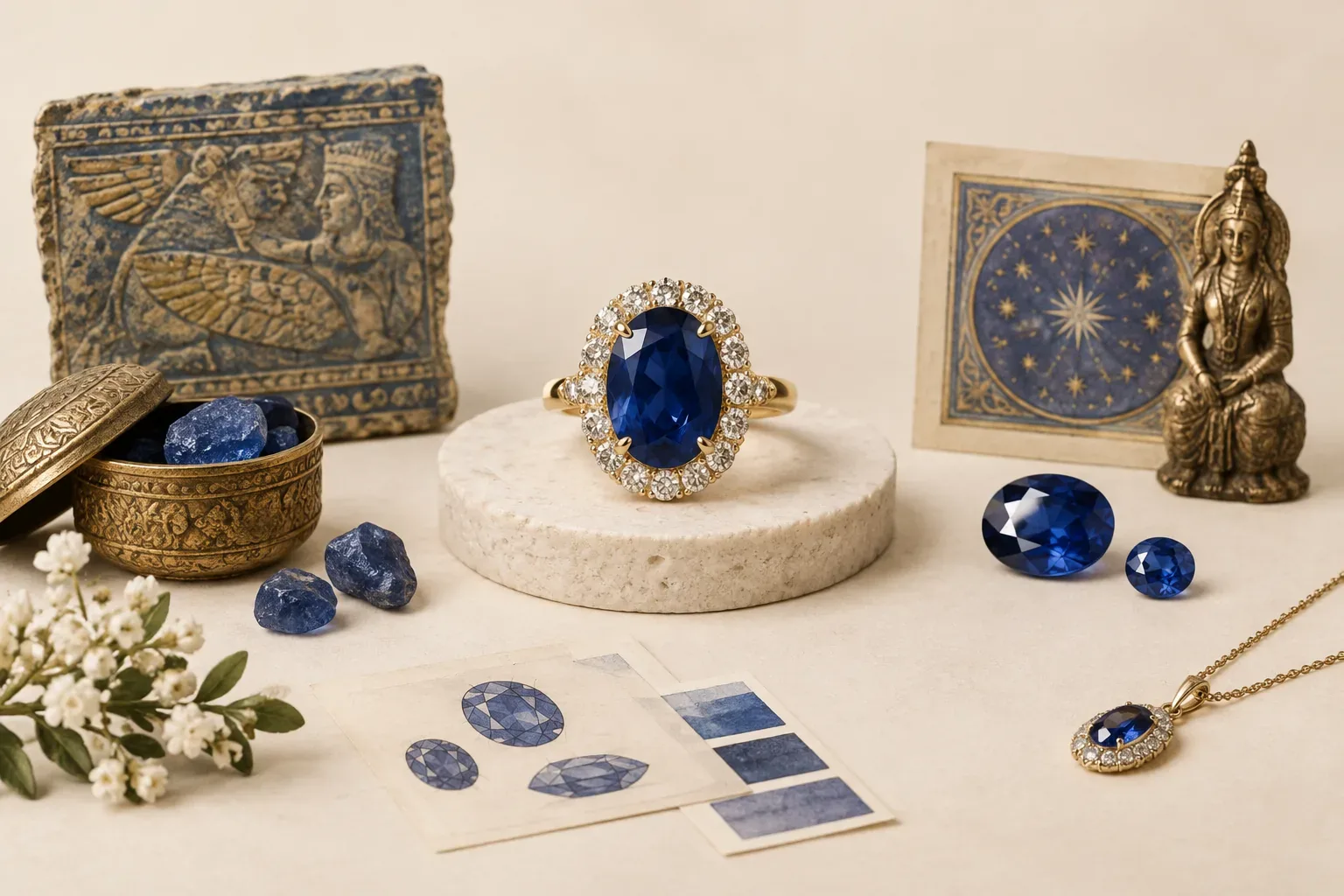
Sapphires appear in many forms of jewelry illustrated in museum collections: rings, brooches, necklaces, earrings and diadems. Historically, they were set in metalwork appropriate to the era—enamelled and gem-studded ecclesiastical fittings in medieval Europe, or richly jeweled court dress and portrait jewelry in later centuries, as the Victoria and Albert Museum documents in its historical surveys.
In modern jewelry the stone is used both as a focal center stone and in pavé or accent roles combined with diamonds and other gems. The precise setting, cut and accompanying stones influence how a sapphire reads visually and culturally: a single deep-blue cushion-cut sapphire in a solitary ring reads differently from a cluster brooch of mixed stones or a string-set of smaller sapphires in a contemporary bracelet.
Understanding the technical quality factors that affect value
Gem trade and museum guides frame sapphire quality using a set of standard descriptive attributes. The Victoria and Albert Museum’s gemstone reference treats color, transparency/clarity, cut, and weight as core ways to describe and compare gems in collections and commerce. Color is generally a primary attribute because it dominates visual impact; clarity and transparency influence brightness and the apparent depth of color; cut determines how light returns to the eye; and carat or weight affects relative price and proportion in a piece.
Beyond these intrinsic characteristics, origins (the geographic source) and treatments that alter appearance also influence market value. The Federal Trade Commission requires disclosure when a material treatment or imitation materially affects value or appearance, so origin statements and treatment disclosures are part of how modern markets convey value to buyers.
Material treatments, imitations, and what consumers should watch for
Treatments such as heat or surface enhancements can materially change a sapphire’s color and clarity. The Federal Trade Commission’s consumer guidance on buying gemstones emphasizes that sellers must disclose such treatments and any imitations or synthetics. Ask for clear, written disclosure of any known treatments, and be cautious of sales that omit this information.
Equally important is asking whether a stone is natural, synthetic, or an imitation. Museums such as the Victoria and Albert Museum distinguish among natural, treated, and man-made stones in their collections and labels, and that same precision is useful for buyers: a well-disclosed treated natural stone is a different product from a laboratory-grown sapphire or a glass imitation, and each category has different value expectations.
Practical guidance for choosing sapphire jewelry
Start with the wearer: consider their style, preferred jewelry types, metal choice and whether they prefer traditional or contemporary looks. Historical associations can add meaning—choose a cut or setting that echoes a period if that matters to the recipient—but do not assume a historical meaning will be received the same way by every person.
When assessing a specific stone, ask the seller for a description that covers color (hue, tone, saturation), clarity, cut, weight, origin if known, and any treatments. Request written disclosure about treatments or enhancements and any available certification or lab report. The Victoria and Albert Museum’s gemstone reference shows how institutions classify and describe gems; adopt the same precision for buying decisions.
For higher-value purchases, insist on independent laboratory reports from recognized gemological laboratories and confirm that any origin claims or treatment statements are in writing. The Federal Trade Commission’s guidance supports consumers’ right to accurate material disclosure, so do not accept vague or evasive answers about a stone’s treatment history.
Balance technical quality with design and wearability. Sapphires are hard and durable compared with many colored gems, but setting style, ring shank thickness and daily-wear considerations matter for longevity. Choose a setting that protects the stone and suits the recipient’s lifestyle.
Gift selection and respectful cultural considerations
If you are choosing or commissioning sapphire jewelry as a gift, be explicit about intent. A clear statement—spoken or written—that explains why you chose a particular stone or style helps the recipient understand your meaning without assuming historical symbolism. If you draw on a specific cultural or historical motif, do so with respect and accuracy: check museum resources such as the Victoria and Albert Museum for documented uses rather than relying on generalized claims.
When gift-giving across cultures, avoid assuming a single symbolic meaning for sapphires. Different communities and individuals may interpret the same gemstone differently; treat historical associations as informative background rather than prescriptive rules, and consider the personal taste and cultural background of the recipient.
Practical transaction checklist
Before buying, verify the seller’s reputation and ask for written disclosure of material treatments or imitations. For valuable sapphires, obtain an independent lab report and keep all paperwork. Confirm return, repair and warranty policies in writing.
When buying at auction or from private sellers, research comparable prices and be realistic about how provenance, rarity, and condition affect value. Museum surveys of jewelry history show that provenance and historical associations can add interest and sometimes value, but documentation matters—objects without verifiable provenance are harder to value historically or monetarily.
Care and maintenance
Sapphires are widely regarded as durable, but care still extends a piece’s life. Clean gently with mild soap and water and a soft brush, and avoid harsh chemicals or ultrasonic cleaners if the stone has been filled or otherwise treated in a way that manufacturers warn against. When in doubt, follow the care guidance provided by the seller and seek a professional jeweler for repairs or re-setting.
Document and store the jewelry with its paperwork. Museums’ object records show the value of provenance and condition records; your receipts, certifications and any lab reports form the modern provenance for an owned piece.
Frequently asked questions
How do I know if a sapphire has been treated?
Ask the seller for written disclosure of any treatments and request a report from an independent gemological laboratory for higher-value stones. The Federal Trade Commission requires sellers to disclose treatments or imitations that affect value or appearance, so clear written information is a reasonable expectation.
Are treated sapphires less valuable than untreated ones?
Treatment can affect market value, but value depends on the extent and type of treatment, the stone’s visual appeal, and market demand. A well-disclosed treated natural sapphire can be an excellent and appropriate purchase; the key is accurate disclosure and appropriate pricing.
Do sapphires have a single symbolic meaning?
No single symbolic meaning applies universally. Museums document varied meanings in specific cultures and periods—religious, courtly or personal uses in particular historical contexts—while modern wearers may assign personal significance such as birthstone or romantic meaning.
What are the basic quality factors to compare when shopping?
Use color, clarity/transparency, cut and weight as basic descriptive factors, and also consider origin and treatment history. Museum gemstone guides treat these attributes as standard ways to describe and compare gems, and they are practical for consumer comparisons as well.
How should I care for sapphire jewelry?
Clean gently with mild soap and water and a soft brush, avoid harsh chemicals, and follow the seller’s care instructions. If a sapphire has been filled or especially treated, ask whether ultrasonic cleaning or steam cleaning is safe before using those methods.
Sources and further reading
- Bedazzled: A History of Jewellery — Victoria and Albert Museum
- An A-Z of Gemstones — Victoria and Albert Museum
- Buying Gemstones, Diamonds, and Pearls — Federal Trade Commission