Meaning at a glance
Art Nouveau jewelry identification rests on recognizing sinuous natural motifs, techniques such as plique-à-jour enamel and mixed media, and the movement’s late‑19th to early‑20th century origins; museum documentation distinguishes these historical uses from later or personal reinterpretations, and consumer guidance on materials and disclosure helps buyers avoid mislabels and forgeries.
Direct answer (thesis)
Art Nouveau jewelry identification depends on three parallel facts: the movement’s documented historic period and design language, the specific materials and techniques used by makers, and the difference between historically recorded symbolism and modern personal meanings. In practice, use museum-documented motifs—sinuous lines, stylized natural forms, female and mythic figures, and characteristic enamelling and mixed media—as primary identification markers, and rely on consumer-protection guidance about materials and disclosure to judge modern claims and reproductions.
Historical evidence and precise cultural context
Art Nouveau is a cross‑European and transatlantic design phenomenon centered in the late nineteenth and early twentieth centuries; museum collections and scholarship, such as material presented by the Victoria and Albert Museum, place these objects in a particular historical moment when designers reacted against industrial repetition and academic historicism by emphasizing handcrafted, organic forms. Different countries developed local expressions—France and Belgium often emphasized flowing, asymmetrical lines; Germany and Austria produced related currents like Jugendstil and the Vienna Secession with local variations; Great Britain had its own aesthetic currents within the broader movement.
The Victoria and Albert Museum documents how jewellery must be read in the context of changing social tastes, workshop practices, and the materials available at the time. That historical context is the documented evidence for attribution: you identify period work by matching documented styles, common techniques, and the social-production contexts described by established museum research rather than by later popular labels or resale shorthand.
Motifs, techniques and how they show up in jewelry
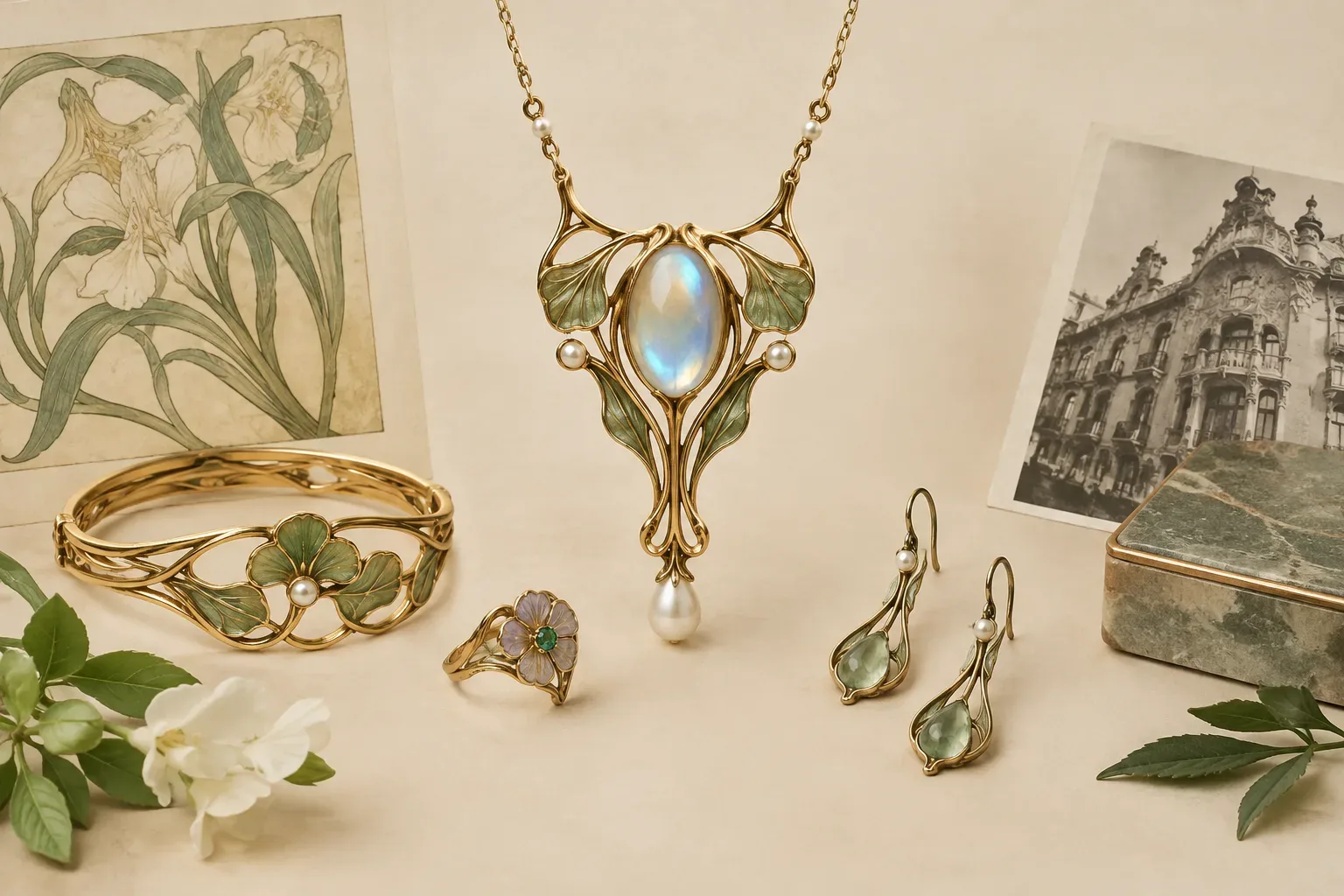
Common motifs associated with Art Nouveau are derived from plants, flowers, insects, and sensual female figures, rendered in flowing, asymmetrical compositions. Museum descriptions emphasize the movement’s preference for ‘whiplash’ curves and naturalistic, sometimes stylized forms. These appear in jewelry as pendants, brooches and rings where the design flows across the metal surface rather than adhering to rigid geometric repetition.
Technically, identifiable features include extensive use of coloured glass and enamelling (including plique‑à‑jour, a technique that produces stained‑glass-like translucent enamel), low‑profile settings that follow a composition rather than raise individual stones, mixed metals, and incorporation of unconventional materials such as horn, ivory, opals, and moonstone. The Victoria and Albert Museum’s gemstones guidance explains how certain gems and cuts were favoured for their optical effects and availability, and how these choices interact with decorative enamelling and metalwork.
Gemstones in Art Nouveau pieces are often chosen for colour and optical effect rather than carat perfection. Rose‑cut diamonds, cabochon moonstones, opals, and pearls are frequent; settings may be minimal so that the stone integrates with the overall natural motif. If you see elaborate prong elevations and perfectly matched modern brilliant cuts in a purported Art Nouveau piece, that should prompt further scrutiny.
Documented historical meanings versus modern interpretations
Museum documentation shows that many Art Nouveau motifs were decorative responses to contemporary aesthetics and philosophies—an interest in nature, individual craftsmanship, and new materials—rather than strict symbolic systems. The V&A’s historical treatments emphasize social and stylistic context: designers borrowed from folklore, literature and nature, but the primary recorded function was aesthetic innovation and artisanal craft.
Modern wearers often ascribe personal or revived symbolic meanings—for example, reading a butterfly as transformation, or a female figure as an explicit emblem of emancipation. These modern interpretations are valid as personal or cultural readings, but they are not the same as documented historical intent unless supported by period sources. Keep the difference clear: museum evidence tells us what designers and consumers of the time emphasized; contemporary meanings are layered on later and can vary widely by culture and individual.
Common mislabels and dating pitfalls
‘Art Nouveau’ is frequently applied today to any jewelry with flowing lines, natural motifs, or antique styling. Common mislabels include calling later revival pieces (mid‑20th century or contemporary) ‘Art Nouveau’, confusing Art Nouveau with Art Deco (a different, later movement generally favouring geometric symmetry), or attributing a piece to a prominent maker without provenance.
Other pitfalls include mistaking country variants: German Jugendstil, the French Art Nouveau and other regional terms are related but not identical, and sellers may conflate them. In addition, many reproductions and modern‑made items mimic Art Nouveau motifs with contemporary techniques and materials. The Victoria and Albert Museum’s approach to jewellery history underscores the importance of workshop practice, provenance and documented technique when dating and attributing pieces.
Material authenticity, treatments and consumer protection
When assessing materials and claims, follow consumer guidance about disclosure. The Federal Trade Commission highlights that sellers must disclose treatments, simulants and imitations for gemstones and pearls. For example, many opals, pearls and coloured stones can be treated or imitated; asking for written disclosure or a gemological report is an appropriate step.
Look for construction clues: hand‑worked solder joins, surface tool marks, patina consistent with age, and older enamelling techniques like plique‑à‑jour suggest period manufacture. Conversely, laser‑etched hallmarks, machine‑stamped motifs, or modern soldering methods can indicate later production. A professional appraisal or laboratory report will provide greater certainty for high‑value items.
How motifs and gemstones appear in specific forms
Brooches and pendants are the most common carriers of Art Nouveau motifs because they provide a canvas for flowing design. Brooches frequently take the shape of elongated female forms, sinuous plants, or insects; pendants echo these themes with enamel background panels or openwork metal that follows the motif’s curves.
Rings and earrings in the style usually employ cabochon stones and softer cuts that emphasize colour and light over brilliance. Enamel panels often complement gemstones by providing colour fields that integrate stone and metal. Be alert for combinations such as moonstone with plique‑à‑jour enamel or garnet set low within a flower motif—these pairings are consistent with documented practice and museum examples.
Practical and respectful selection or gifting guidance
Decide whether you want an authentic period piece or a modern item inspired by Art Nouveau. Both are legitimate choices, but they require different approaches. For period purchases, prioritize provenance, condition reports and professional verification. For modern commissions or reproductions, focus on maker quality, materials disclosure and how the piece meets the recipient’s style and lifestyle.
When gifting, respect the recipient’s aesthetic and any cultural meanings they may attach to motifs. Explain the piece’s provenance and the difference between historical meanings and present‑day symbolism if you think context matters to the recipient. If the item is vintage, include care instructions appropriate to materials and condition: avoid exposing delicate enamel and opal to extreme temperature changes, and recommend professional cleaning for pearls and fragile inlays.
Ask sellers for clear information: documented provenance, hallmarks, photographs of construction, and disclosure of any gemstone treatments. For high‑value items, request a written appraisal or a gemological report. These steps protect both buyer and recipient and honor the historical craftsmanship embodied in genuine Art Nouveau pieces.
Final identification checklist
Prioritize documented stylistic markers: sinuous, organic composition; enamelling techniques such as plique‑à‑jour; mixed materials and low‑profile stone settings. Cross‑check with provenance, maker’s marks and construction details. Use museum resources for stylistic comparison and follow consumer‑protection guidance for material disclosure and treatment verification. Treat modern interpretations as valid personal meanings but not as substitutes for historical evidence when attributing or dating a piece.
Frequently asked questions
How can I tell if a piece is genuine Art Nouveau or a modern reproduction?
Start with stylistic markers—sinuous, asymmetrical designs, enamel techniques such as plique‑à‑jour, mixed materials and low stone settings—then verify maker’s marks, provenance and construction details. Museum comparisons aid stylistic assessment, and for certainty obtain a professional appraisal or laboratory report that confirms age and materials.
What gemstones are typical of Art Nouveau jewelry?
Period pieces favour gems chosen for colour and optical effect rather than large, brilliant cuts. Cabochon moonstones, opals, pearls, rose‑cut diamonds and coloured garnets are common. The Victoria and Albert Museum’s gemstone resources explain how historical gem choices relate to optical and decorative aims.
Are the motifs in Art Nouveau jewelry symbolic in a religious or universal way?
Museum evidence indicates the motifs were primarily aesthetic and inspired by nature, literature and craft ideals of the time. Modern symbolic readings—such as butterflies meaning transformation—are contemporary interpretations and not universally documented as period intent.
What should I ask a seller before buying an Art Nouveau piece?
Request provenance, maker’s marks, high‑resolution images of construction details, a condition report, and disclosure of any gemstone treatments or restorations. For high‑value items, ask for a written appraisal or laboratory gem report.
How does the Federal Trade Commission guidance affect buying antique jewelry?
The FTC requires disclosure of treatments, imitations and simulants for gemstones and pearls. Sellers should inform buyers about any treatments and whether gems are natural, treated or synthetic; request written confirmation when buying valuable items.
Can I wear Art Nouveau jewelry every day?
Some pieces are robust, but many period items include delicate enamels, soft stones and fragile inlays. If you intend daily wear, choose a well‑made modern piece inspired by Art Nouveau or ensure a vintage piece is structurally sound and properly conserved by a professional.
Sources and further reading
- Bedazzled: A History of Jewellery — Victoria and Albert Museum
- An A-Z of Gemstones — Victoria and Albert Museum
- Buying Gemstones, Diamonds, and Pearls — Federal Trade Commission