Meaning at a glance
Explain the documented history and changing contexts of the victorian jewelry techniques motif, separate cultural or religious evidence from later popular interpretations, and give practical guidance for choosing and wearing the motif in modern jewelry.
Quick answer
Victorian jewelry techniques developed alongside industrial and social change and include handwork such as repoussé, enameling, hairwork, and setting methods alongside machine-assisted processes; the Victoria and Albert Museum documents these methods and links them to shifting tastes and uses, while modern wearers often reinterpret motifs for personal meaning rather than their original social functions. Choose and gift pieces with respect for original context and full material disclosure, and follow consumer guidance on treatments and imitations from the Federal Trade Commission.
What the historical evidence shows
The Victoria and Albert Museum frames Victorian jewellery as a story of evolving techniques and social meaning rather than a single style. Curators and catalogues at the V&A describe changes across the early, mid and late Victorian periods, showing how craft methods and available materials shifted with fashion and technology. Early Victorian tastes drew on Romantic historicism and handcrafted detail, the middle period saw a rise in mourning jewellery and symbolic sentiment, and the later period responded to broader international tastes and machine processes, all documented by the V&A as part of jewellery's changing social context.
When discussing specific techniques and materials, museum documentation names practices such as enameling, engine turning or guilloché, setting styles for faceted and portrait gems, use of paste stones and seed pearls, hairwork in lockets and brooches, and the use of jet and blackened materials for mourning jewellery. The V&A's resources on gemstones place particular stones in historical context—for example, the popularity of garnet clusters and pearls in certain designs—and explain how material choice affected both appearance and meaning.
Separating documented historical meanings from modern interpretations
Documented meanings: The V&A and related museum literature record that many Victorian pieces carried specific social or sentimental functions. Lockets and hairwork commonly served as tokens of memory and mourning; black materials such as jet were used for funeral dress and public displays of bereavement; symbolic motifs like clasped hands, forget-me-nots and ivy carried conventional sentimental messages in period pattern books and trade catalogues. These connections are matters of historical record as described by the Victoria and Albert Museum.
Modern interpretations: Today, people often wear these motifs for aesthetic reasons, personal symbolism, or fashion rather than following 19th-century social codes. For example, a modern wearer may choose a snake ring as a symbol of personal renewal rather than as a Victorian emblem of eternity, or wear a mourning-style brooch simply because they like its contrast and form. These contemporary meanings are valid personal interpretations but are not the same as the documented Victorian uses described by museum sources.
Techniques, motifs and gemstones: how they appear in jewelry
Enameling appears in Victorian pieces as colored enamel on gold or silver surfaces, used both for decorative scenes and to add durable color to small details. The V&A documents varied enameling techniques, from translucent enamel over engraved metal to painted enamel miniatures set into brooches or pendants.
Engine turning and guilloché produce fine repetitive patterns beneath translucent enamel or as visible metal texture; these machine-assisted techniques became more widespread as production methods evolved, and museums attribute their use to the later Victorian embrace of refined surface decoration. Repoussé and chasing provide raised reliefs often seen on lockets, hair receivers, and larger ornamental pieces.
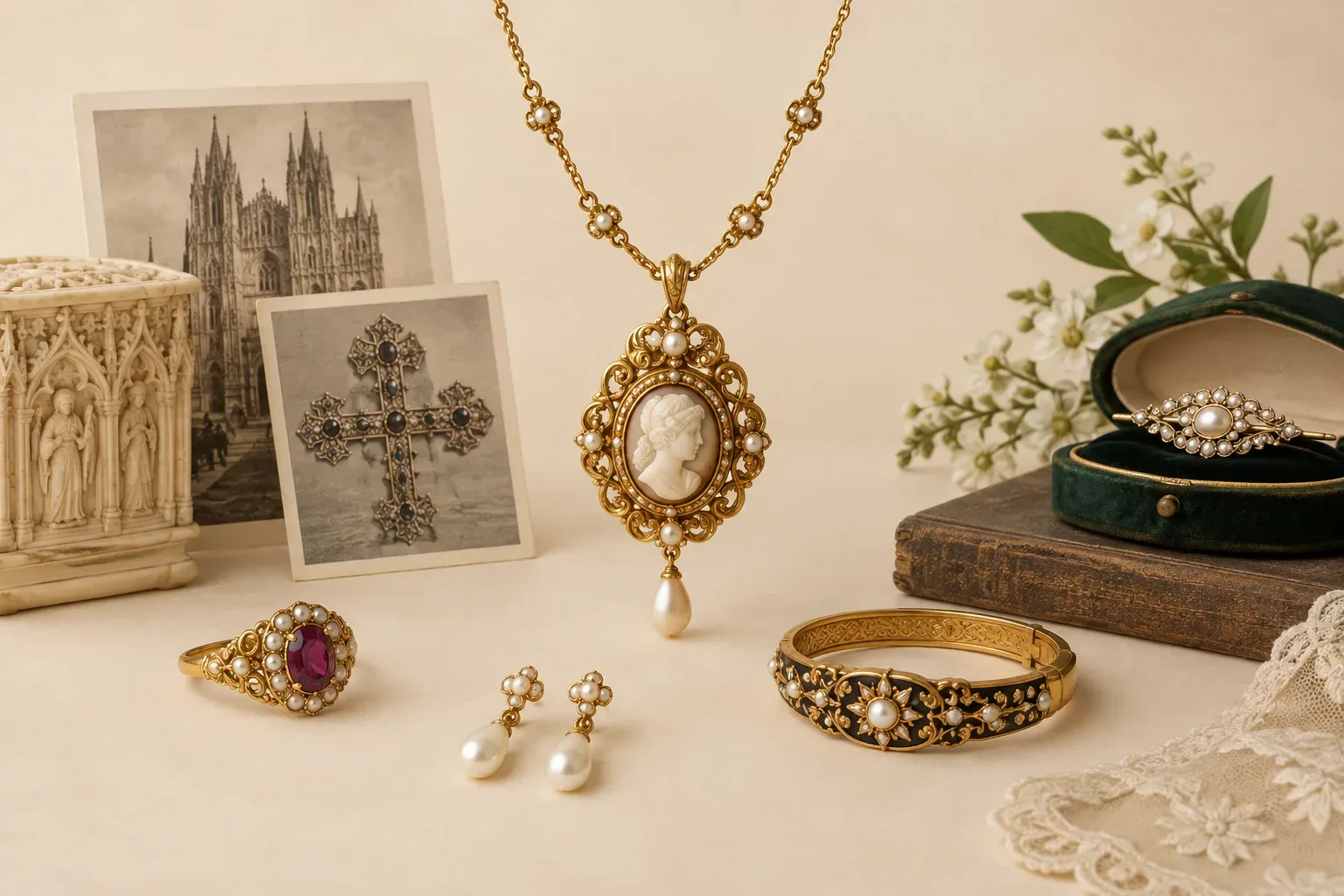
Setting styles and stone choices are central to look and meaning. The V&A explains that garnets frequently appear in clustered settings, pearls are used for framing and sentimental jewellery, and paste stones—glass imitations—were popular as affordable substitutes for more expensive gems. Jet and blackened materials are characteristic of mourning jewellery, while seed pearls and turquoise appear in lighter, sentimental pieces. Intaglios, cameos and micro-mosaic work demonstrate the continued influence of classical taste on Victorian design.
Hairwork—braiding, weaving and mounting human hair into brooches, pendants and watch chains—is a distinct Victorian technique recorded by museum collections. Hair was sometimes arranged into geometric patterns, floral motifs, or set behind glass in lockets, functioning as intimate tokens. The creation of hair jewellery required specialized hand skills and was often made by family members or specialist workshops.
Craft, trade and design: workshop practice and commerce
The trade in Victorian jewellery moved between bespoke workshop production and growing mass-market manufacture. The V&A emphasises that industrial advances increased the availability of machine-made components, which altered both price and design possibilities. Silversmiths, goldsmiths and enamelers continued to supply bespoke commissions while factories produced consistent parts, stamped metal fittings and paste stones for wide distribution.
Design sources included trade catalogues, pattern books and international exhibitions that circulated motifs. This diffusion meant that a popular motif could appear in both luxury and affordable variants, with differences in materials and finishing reflecting the purchaser's means. The V&A's overview of jewellery history connects these technical and commercial shifts to larger social changes in consumption and taste.
Practical guidance for selecting and gifting Victorian-style jewellery
Identify original purpose and respect context: Before buying or gifting a genuine Victorian piece, check whether it was originally a mourning token, a sentimental keepsake or a fashion accessory. Mourning jewellery often uses black jet, matte finishes or hairwork; gifting a piece that was made as a symbol of bereavement should be done thoughtfully and with awareness of the recipient's sensibilities.
Request provenance and disclosure: Ask sellers for provenance, condition reports and clear information about materials and treatments. The Federal Trade Commission recommends that consumers receive disclosure about gemstone treatments, imitations and whether a piece contains assembled or altered materials. For example, paste stones, modern glass replacements, or reconstructive repairs should be disclosed by reputable dealers.
Assess condition and restoration: Older jewellery may have delicate enamel, brittle hairwork, or weakened settings. Ensure any repairs are documented and that fragile areas are stable for wear. For pieces with hairwork or inset miniatures, demand secure glazing and appropriate conservation guidance from the seller.
Decide between original and reproduction: Victorian-style modern pieces capture the look without historical baggage and can be a safer gift for someone uncomfortable with actual mourning objects. Reproductions allow choice of durable modern alloys and standardized gemstone disclosures, while originals require care and context.
Choose appropriate motifs: If you are unsure about social connotations, prefer motifs that are broadly positive or clearly decorative. Floral spray, geometric guilloché, and simple cameo portraits are usually safe choices. Avoid giving an unmistakable mourning brooch as a celebratory gift unless the recipient has expressed interest in the history or aesthetics of such items.
Caring for Victorian and Victorian-style pieces
Handle older jewellery gently and store it flat where appropriate to protect enamels and hairwork. Keep humid or unstable materials, such as hair or glued-in stones, away from heat and strong light. For cleaning, follow conservator advice rather than generic polishing; aggressive cleaning products can remove patina, damage enamel or loosen fragile inlays. When in doubt, ask a professional conservator or a reputable jeweller experienced in antique work.
Frequently asked questions
What are the most distinctive Victorian jewelry techniques to recognize?
Look for enameling, guilloché or engine-turned surfaces, repoussé relief, hairwork set behind glass, clustered garnet and seed-pearl settings, paste stones, and the use of black materials such as jet in mourning jewellery; the Victoria and Albert Museum documents these techniques as common across different Victorian periods.
How can I tell if a piece is genuinely Victorian?
Ask for documented provenance, inspect construction details such as hand-finishing versus machine stamping, check for period-appropriate materials and wear, and obtain an expert appraisal when possible; museum references like those from the V&A help contextualize stylistic and technical markers.
Is it appropriate to wear or gift mourning jewellery today?
It can be appropriate if the recipient understands and appreciates the historical context, but be cautious: mourning pieces were originally linked to bereavement. For general gifting, consider Victorian-style reproductions or clearly decorative pieces if you are unsure about the recipient’s feelings.
What should I ask a seller when buying antique or vintage Victorian jewelry?
Request clear provenance, condition reports, disclosure of any gemstone treatments or replacements, and documentation of repairs. The Federal Trade Commission advises buyers should receive accurate information about treatments, imitations and assembled pieces.
How do I care for fragile Victorian materials like enamel and hairwork?
Avoid abrasive cleaners, keep pieces away from heat and strong light, store them flat or padded to prevent strain on settings, and consult a conservator or experienced antique jeweller for significant cleaning or repairs.
Are modern reproductions technically faithful to Victorian methods?
Some modern makers use traditional techniques such as hand-enameled surfaces or hand-setting, while others rely on contemporary processes to reproduce period appearance. If authenticity of technique matters to you, ask makers about their methods and request documentation.
Sources and further reading
- Bedazzled: A History of Jewellery — Victoria and Albert Museum
- An A-Z of Gemstones — Victoria and Albert Museum
- Buying Gemstones, Diamonds, and Pearls — Federal Trade Commission