Meaning at a glance
This article explains the documented history and shifting contexts of medieval European jewelry motifs, identifies which cultures and periods produced particular designs, separates what is recorded in museum collections from later popular meanings, describes how motifs and gemstones appear in surviving objects, and offers practical, respectful guidance for selecting and gifting pieces today.
Quick answer
Explain the documented history and changing contexts of the medieval european jewelry identification motif, separate cultural or religious evidence from later popular interpretations, and give practical guidance for choosing and wearing the motif in modern jewelry.
What the historical evidence can tell us
When you try to identify a medieval European piece, museum collections and published research at the Victoria and Albert Museum provide the best-documented baseline: they show that jewelry forms, materials, and decorations changed according to region, patronage and technology rather than following a single, uniform symbolism. The V&A’s surveys of jewellery history emphasize how political power, trade routes and devotional practices each shaped what people wore and why.
Broadly speaking, scholarship groups surviving objects into roughly chronological and cultural zones—early medieval/Insular work associated with the British Isles and Irish workshops; Viking and Norse-metalworking traditions of northern Europe; continental Carolingian and Ottonian high-medieval production; and later Romanesque and Gothic forms tied to urban workshops and courtly taste. Each of those contexts favored different techniques, motifs and gemstones, and the V&A collections illustrate those distinctions rather than a single iconography.
Identify the culture and period precisely
Insular (often called Hiberno-Saxon) work from the British Isles tends to display interlace, stylized animals and cloisonné-like inlay techniques. These features reflect Anglo-Saxon and Irish workshop traditions and appear in objects dated to the early to high medieval centuries in V&A holdings.
Viking-age jewelry commonly uses twisted-wire settings, animal-style ornament (the so-called animal interlace of Norse art), and pendants or brooches suited to layered garments. These objects reflect both local metalsmithing and contact with continental Europe.
Continental medieval jewelry—Carolingian, Ottonian and later Romanesque and Gothic pieces—shows more frequent use of religious imagery (crosses, reliquary forms) and gemstones set as focal devotional or status markers. The V&A highlights developments such as filigree, goldsmithing sophistication, and the increased use of cut gemstones as centers of devotional mounts and secular adornment.
Documented meanings versus later or modern interpretations
What is documented in museum records and medieval sources is often functional or social rather than explicitly symbolic. For example, a pendant that contains a relic or is worn on pilgrimage had a devotional and practical role recorded in inventories and chronicles; the V&A’s historical accounts link objects like reliquary pendants and token badges to specific religious practices and travel.
Later popular ideas about certain motifs—such as claiming that a particular animal motif always meant fertility or that every knot design was a secret love token—are frequently modern projections. While some motifs acquired layered meanings over time, it is important to separate what contemporaries left in archives and surviving objects (as cataloged by museums like the V&A) from romantic or nationalistic reinterpretations introduced centuries later.
How motifs, gemstones and techniques appear in medieval jewelry
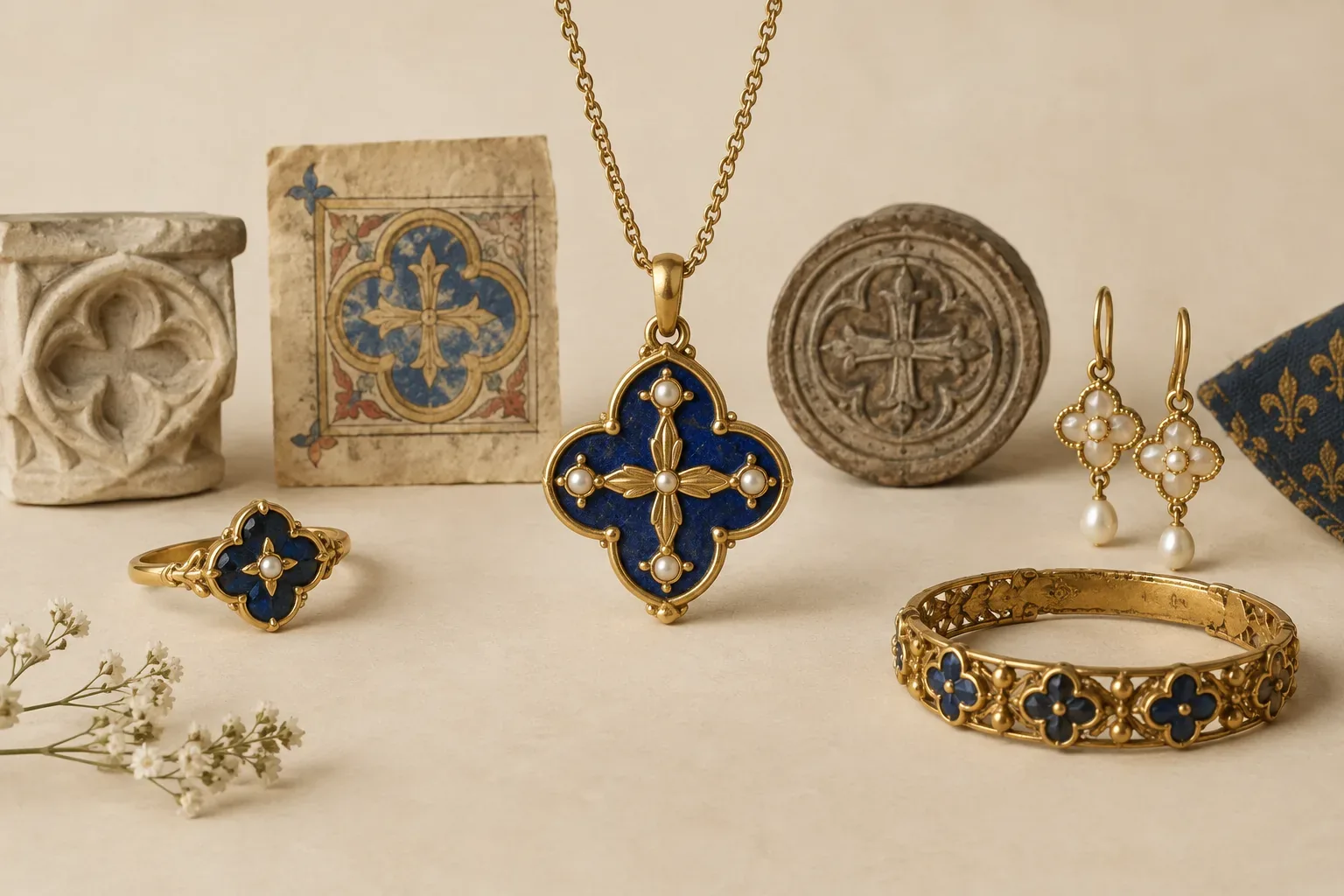
Motifs: Crosses, stylized animals, interlace patterns, heraldic devices and architectural forms recur in medieval jewelry. In many cases the motif is part of the object’s construction—openwork crosses, cloisonné cells filled with glass or enamel, and cast or repoussé panels. The appearance of a motif can therefore tell you about technique and origin as much as about intent.
Gemstones: The V&A’s resources on gemstones explain that medieval jewelry commonly uses garnet, almandine, emerald, sapphire and pearls among other materials. Gems appear either as inlays set in gold cells, as cabochons mounted in collets, or as table-cut stones in bezel settings. Because cutting styles and setting methods changed over centuries, the mounting technique is a key dating clue.
Techniques: Filigree, cloisonné, niello, enamel and stone inlay are hallmarks of particular periods and regions. For example, cloisonné and garnet inlay are strongly associated with earlier Insular and Migration-period work, whereas later medieval goldsmithing shows more sophisticated stone setting and enamel narrative scenes. The V&A’s notes underline how advances in toolmaking and workshop organization produced visible changes in finished pieces.
Common mislabels and how to avoid them
Mislabel: calling every simple cross 'Crusader' or every ring with an engraved name a betrothal token. The documented record shows many crosses were devotional or commemorative and not necessarily linked to crusade participation. Similarly, personal inscriptions on rings can mark ownership, guild affiliation or commemorative purposes rather than strictly romantic uses.
Mislabel: assuming a gem is medieval because it looks 'old' or is set in a period style. Gemstone cutting and mounting styles help date an object, and many later reproductions copy older designs. The Federal Trade Commission recommends asking about treatments, enhancements and disclosures for gemstones and pearls when buying, because modern treatments and imitations are common and must be disclosed.
Avoiding mislabels: look for provenance, maker’s marks where present, consistent wear and tool marks, and museum-grade cataloging language. When in doubt, consult museum references such as the V&A’s online articles on gemstones and historical jewelry; specialists use a combination of style, technique and material analysis to date and locate objects.
Practical and respectful guidance for selection and gifting
If you are choosing medieval-style or genuinely historic jewelry as a gift, first consider whether the motif has a specific religious or cultural meaning to the recipient. Many medieval motifs remain part of living faith traditions; selecting a cross, reliquary-style pendant, or pilgrimage badge as a novelty without sensitivity can feel disrespectful. Ask discreetly if the symbol matters to the person and be open about the piece’s origin—replica, inspired, or antique.
Prefer documented pieces or clearly labeled reproductions. If authenticity matters, request conditioned provenance and, for gemstones, written disclosure about treatments or whether the stone is a modern cut. The FTC advises buyers to seek clear information on material treatments and imitations; reputable dealers will provide this without hesitation.
For everyday wear: choose sturdy settings and wear replicas rather than rare historical originals. Originals belong in collections and museums; everyday handling exposes them to damage. If you buy an antique piece, consider professional conservation advice and insurance.
If you want a piece that evokes medieval forms but fits modern life, commission work from a jeweller who understands historic techniques and can adapt them into contemporary settings. This supports craft knowledge and avoids removing fragile historical objects from collections.
Final notes: reading objects with humility
Medieval European jewelry identification is an evidence-driven exercise. Museum documentation and scholarly catalogues, such as those maintained by the Victoria and Albert Museum, provide the most reliable grounding for dating and interpretation. Avoid universal claims about symbolism and recognize that objects moved between contexts and acquired new meanings over time.
When in doubt, seek specialist opinion, ask for documentation on provenance and material treatments, and choose gifts thoughtfully with respect for the cultural or religious significance a motif might still hold.
Frequently asked questions
How can I roughly date a piece of medieval European jewelry?
Use a combination of stylistic clues (interlace, animal style, Gothic vs Romanesque motifs), technique (filigree, cloisonné, stone setting), and gemstone cutting. Provenance and museum cataloguing provide the best confirmation; when purchasing, ask for documentation. For technical details and examples, consult museum resources such as the Victoria and Albert Museum collections.
Are all crosses from the Middle Ages linked to the Crusades?
No. Crosses in medieval jewellery served many devotional, commemorative and identity purposes. While some objects were associated with crusading, many crosses were personal devotional items, pilgrimage badges or symbols of office. Avoid assuming a single meaning without supporting provenance or documentation.
Which gemstones were common in medieval European jewelry?
Medieval pieces frequently incorporate garnet, pearls, emerald, sapphire and other stones, often set as cabochons or in inlaid cells. The Victoria and Albert Museum’s guides on gemstones explain historical usage and typical mounting methods, which help with identification.
How can I avoid buying a mislabelled or treated gemstone?
Ask the dealer for written disclosure about treatments, enhancements and whether the gem is a modern replacement. The Federal Trade Commission advises buyers to seek clear information on treatments and imitations; reputable sellers will provide certificates or documented provenance on request.
Is it appropriate to gift medieval-revival or historic religious jewelry?
Be mindful of the recipient’s faith and cultural background. If the symbol retains religious significance, ask or choose a neutral alternative. Prefer well-documented reproductions or newly made pieces rather than fragile originals when the item is meant for everyday wear.
Sources and further reading
- Bedazzled: A History of Jewellery — Victoria and Albert Museum
- An A-Z of Gemstones — Victoria and Albert Museum
- Buying Gemstones, Diamonds, and Pearls — Federal Trade Commission