Meaning at a glance
Medieval European jewelry techniques evolved across distinct regions and periods—Byzantine, Carolingian, Anglo‑Saxon, Viking, and Gothic—using methods such as cloisonné enamel, filigree, granulation, and varied gemstone settings; this article distinguishes documented historical meanings (religious devotion, status display, workshop traditions) from later popular interpretations and offers practical selection and gifting guidance, including provenance checks and gemstone-treatment disclosure.
What the historical evidence shows (and which cultures used which techniques)
Our knowledge of medieval techniques and styles comes largely from surviving objects, museum collections, and the interpretive work of institutions such as the Victoria and Albert Museum. The V&A frames jewellery as both craft and social indicator, showing how techniques and materials shifted with trade, patronage, and taste across regions.
In the eastern Mediterranean, Byzantine workshops sustained and refined enamel techniques—especially cloisonné enamel—producing richly coloured religious and courtly items. Western Europe drew on those workshops and on local traditions during the early medieval period, with metalworkers adapting enamel, gem inlay, and sheet‑metal techniques in a variety of contexts.
In the early medieval British Isles and northern Europe, Anglo‑Saxon and Viking makers are documented through surviving brooches, sword fittings, and small personal ornaments that often combine garnet or glass inlay with cloisonné, granulation and fine filigree work. These pieces show high levels of technical skill and the use of portable ornament that could travel with people and goods.
During the Carolingian and Ottonian periods, court patronage and ecclesiastical demand supported larger reliquary and pectoral objects that used goldsmithing techniques such as repoussé (shaping metal by beating from the reverse), chasing, and the careful setting of cut gems and cabochons. By the high and late medieval Gothic periods, jewellery forms and motifs continued to evolve alongside changes in fashion, devotional practice, and access to materials through expanding trade networks.
Key techniques explained
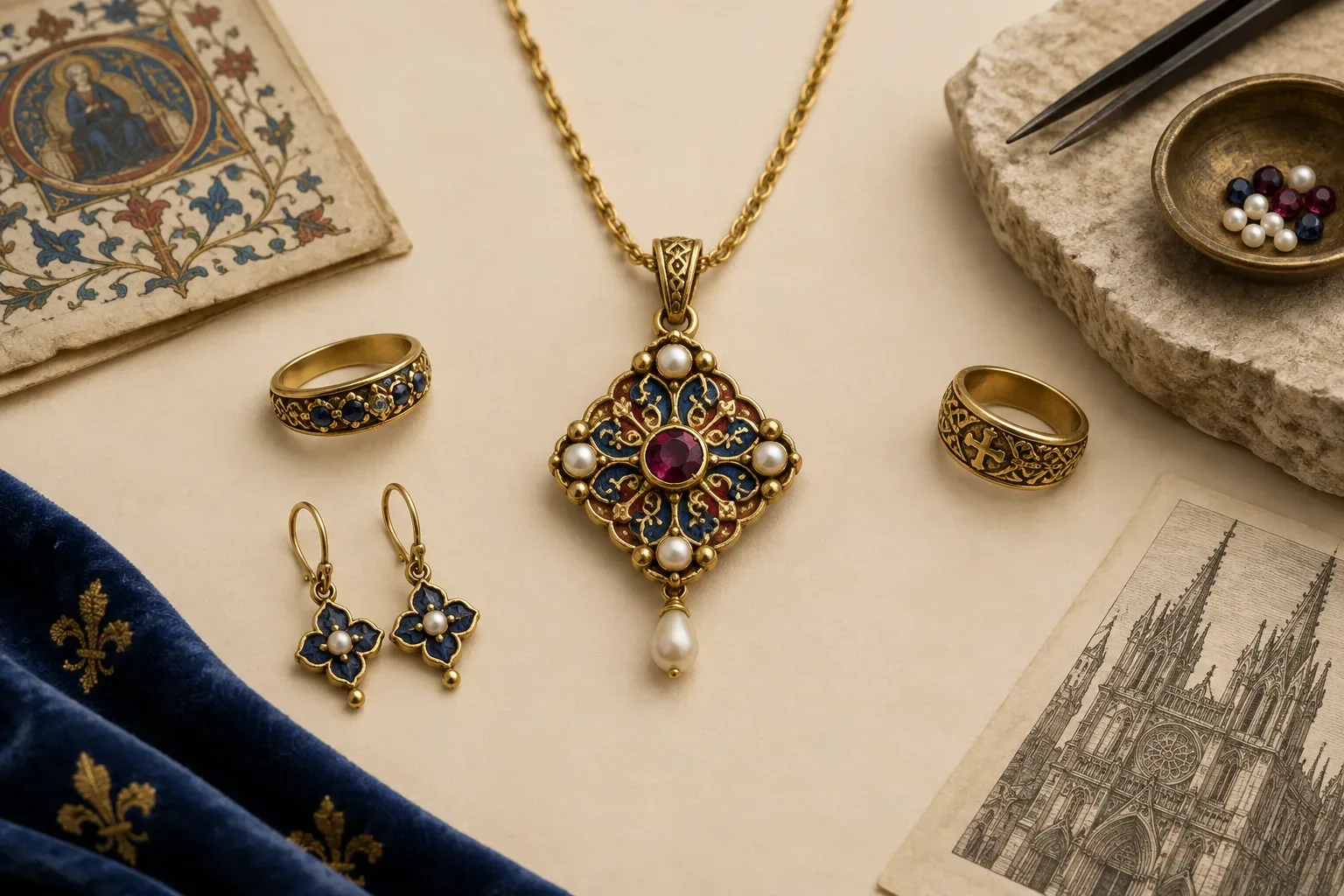
Cloisonné enamel creates partitioned cells (cloisons) of metal that are filled with glass-based enamel and fired, producing vivid colour fields that survive in many medieval ecclesiastical and personal items. The V&A’s historical treatment of jewellery highlights enamelling as a persistent luxury technique across medieval Europe.
Filigree and granulation are delicate wire and bead techniques that create lace-like surfaces and decorative texture; granulation—in which tiny metal spheres are fused to a background—was technically demanding and prized where it appears. Repoussé and chasing shape relief forms in sheet metal and were common for larger objects and decorative panels.
Gem-setting in the medieval period most commonly involved bezels or collets—metal walls that secure a stone—and inlay techniques that fixed glass, garnet or semi-precious stones into sockets. Surface ornament such as niello (a dark sulphide inlay) and punched decoration added contrast and definition to metalwork.
Documented historical meanings versus later or modern interpretations
Surviving medieval pieces often have clear contextual associations in the historical record: crosses, reliquary pendants and pilgrimage badges are connected with devotional practice; elaborate gem-studded objects and signet rings are connected with courtly identity and authority. Institutions such as the V&A emphasize that jewellery functioned within social systems—displaying piety, rank, or group identity—rather than as a single universal symbol.
Modern popular readings sometimes attribute consistent personal or psychological meanings to motifs—such as claiming that a particular animal always symbolised a virtue across medieval Europe. The evidence does not support universal meanings; the same motif could mean different things in different regions and periods, and many medieval designs were primarily decorative or workshop-specific.
How motifs, gemstones, and traditions appear in surviving jewellery
Motifs such as crosses, interlace, animals, and geometric patterns appear in a range of objects: pendants and pectoral crosses for devotional wear, brooches and belt fittings for dress, and reliquaries for the liturgy. Enamel panels, gem inlays and punched metalwork were used to enhance surface narrative or visual richness.
Gemstones in medieval jewellery were chosen for colour, rarity and availability. The Victoria and Albert Museum’s overview of gemstones explains that materials like garnet, pearl, amethyst and glass were used inlaid, set as cabochons, or strung as beads. Pearls, for example, became a standard luxury accent in later medieval fashions, while coloured stones and glass inlays provided eye-catching contrast in earlier portable ornaments.
Trade affected which materials appeared where: long-distance contacts supplied certain coloured glass and semi-precious stones, while local workshops developed characteristic combinations of technique and ornament. The physical appearance of a medieval piece—the enamel panels, the granulated borders, the bezel settings—provides tangible clues to the technique and geographic affinities of the workshop that made it.
Choosing, wearing, or gifting medieval-inspired pieces today
Decide whether you are looking for an authentic historic object, a museum-quality replica, or a contemporary piece inspired by medieval techniques. If authenticity or age matters, provenance and documentation are essential. Ask dealers or auction houses for documented history and, when available, condition reports. The V&A’s exhibitions and collection notes can help you recognise characteristic techniques and styles.
If you are buying gemstones or gems set into medieval‑style work, follow the consumer guidance offered by the U.S. Federal Trade Commission: ask about treatments, synthetic or imitation materials, and whether disclosures are provided for enhancements or recreations. The FTC’s buying guidance explains that treated, lab-grown, or assembled stones must be disclosed and that consumers should expect full information about material nature.
Be mindful of cultural and religious sensitivity when gifting or wearing motifs that have liturgical or communal associations. A cross pendant or a reliquary-style locket has an established history within Christian devotional practice; wearing such a piece can be appropriate as fashion, personal devotion, or heritage display, but it is respectful to acknowledge those origins and avoid claiming universal spiritual authority for the object.
Practical considerations also matter: choose materials and settings suitable for the recipient’s lifestyle. Medieval techniques can be fragile—fine enamel and filigree require careful wear—so if the wearer is active, prefer sturdier interpretations or modern reproductions designed for daily use. For conservation of historic pieces, consult a qualified conservator rather than attempting home repairs.
Research and further reading
Museum collections and curated articles are the best starting points when researching medieval techniques. The Victoria and Albert Museum’s resources are especially useful for comparative study of objects and gemstone histories. For consumer protection around gemstones and disclosure of treatments, consult the Federal Trade Commission’s guidance on buying gemstones, diamonds and pearls.
To learn how a motif’s meaning may have shifted through time, start with documented context—where an object was used, who commissioned it, and what accompanying inscriptions or liturgical associations appear—and then treat later romantic or symbolic interpretations as modern layers that reflect contemporary values more than medieval consensus. Our article on how to research jewellery symbols can help you evaluate sources and provenance when investigating a specific object or motif.
Conclusion
Medieval European jewellery techniques were diverse and regionally varied, shaped by workshop practice, trade networks, and social demand. The best approach to these objects is evidence-led: identify the cultural or workshop context through form and technique, distinguish documented historical uses from later reinterpretations, and make buying or gifting choices that respect both the material and its history.
Frequently asked questions
What were the most common medieval European jewellery techniques?
Surviving medieval objects show common techniques such as cloisonné and champlevé enamelling, filigree and granulation, repoussé and chasing, and bezel or collet gem settings. These techniques appear across different regions—Byzantine, Anglo‑Saxon, Carolingian and Gothic workshops—each with local variations, as discussed by the Victoria and Albert Museum.
Do motifs like crosses or animals always have the same meaning in medieval jewellery?
No. While certain motifs are often associated with religious or social uses—crosses commonly relate to Christian devotional practice—meanings varied by place, period, and context. The V&A emphasises that jewellery conveyed rank, piety, workshop identity and fashion; a single motif might serve decorative, symbolic, or practical purposes depending on the object.
How can I tell if a medieval-style piece is an authentic antique?
Authenticity requires provenance and expert assessment. Request documentation, condition reports and any conservation histories from the seller or auction house. Museums like the V&A provide comparanda to help identify stylistic and technical markers, but professional authentication by a qualified specialist is recommended for high-value purchases.
Are there guidelines for buying gemstones used in medieval-style jewellery?
Yes. The U.S. Federal Trade Commission advises that buyers should be told about treatments, synthetics or imitations. Ask the seller for full disclosure of any enhancements and for testing reports where relevant, and prefer reputable dealers who provide transparent information on the nature and origin of stones.
Can I wear medieval motifs respectfully if I’m not part of the original culture?
Wearing medieval-inspired jewellery is common and can be respectful if you acknowledge the object’s origins and avoid misrepresenting religious or communal significance as universally applicable. Consider the motif’s original context and select designs that suit the wearer’s values and lifestyle.
How should I care for enamel or filigree jewellery?
Delicate techniques like enamel and filigree are vulnerable to shocks, harsh chemicals and abrasion. For historic pieces, consult a conservator. For modern reproductions, follow the maker’s care instructions: store separately, avoid exposure to water and chemicals, and have settings checked periodically by a qualified jeweller.
Sources and further reading
- Bedazzled: A History of Jewellery — Victoria and Albert Museum
- An A-Z of Gemstones — Victoria and Albert Museum
- Buying Gemstones, Diamonds, and Pearls — Federal Trade Commission