Meaning at a glance
This article explains the documented history and shifting contexts of Viking‑Age Scandinavian jewelry motifs, distinguishes museum‑supported evidence from later popular meanings, and gives practical guidance for identifying, choosing, and gifting pieces in a respectful, well‑informed way.
What the historical evidence covers and how I use the terms
When I say 'Viking‑Age Scandinavian' I mean early medieval Norse‑speaking societies in the Scandinavian homelands and their contemporary settlements. Museums and curators typically identify objects by archaeological context, manufacturing technique, materials, and stylistic parallels rather than by a single 'meaning'. This article follows that evidence‑first approach and draws on museum documentation of jewelry history and gemstones.
The Victoria and Albert Museum frames jewelry as a changing social language that must be interpreted through manufacture, use, and deposition, not only through later folklore. Use of gemstones, changes in style, and the contexts in which objects are found are decisive: museum cataloguing and interpretation are the baseline evidence for dating and cultural attribution rather than modern storytelling.
How scholars and museums identify motifs and objects
Identification begins with object type and technique. Brooch shapes, arm rings, bead types, and sizes of metal fittings are compared with well‑dated archaeological finds. Museums and specialist catalogues use typology to place pieces within regional workshops and chronological horizons. For example, distinctive penannular and disc brooches, animal‑headed terminal keys, and interlace ornament are all treated as typological markers that help attribute objects to Norse contexts.
Findspot and burial context are essential. A brooch from a known Scandinavian cemetery or a bead string from a ship burial will be treated differently than a similar object recovered without secure context. Museum records emphasise that style alone cannot prove origin; secure context plus stylistic comparison gives the most reliable identification.
Common Viking‑Age motifs and what the evidence shows
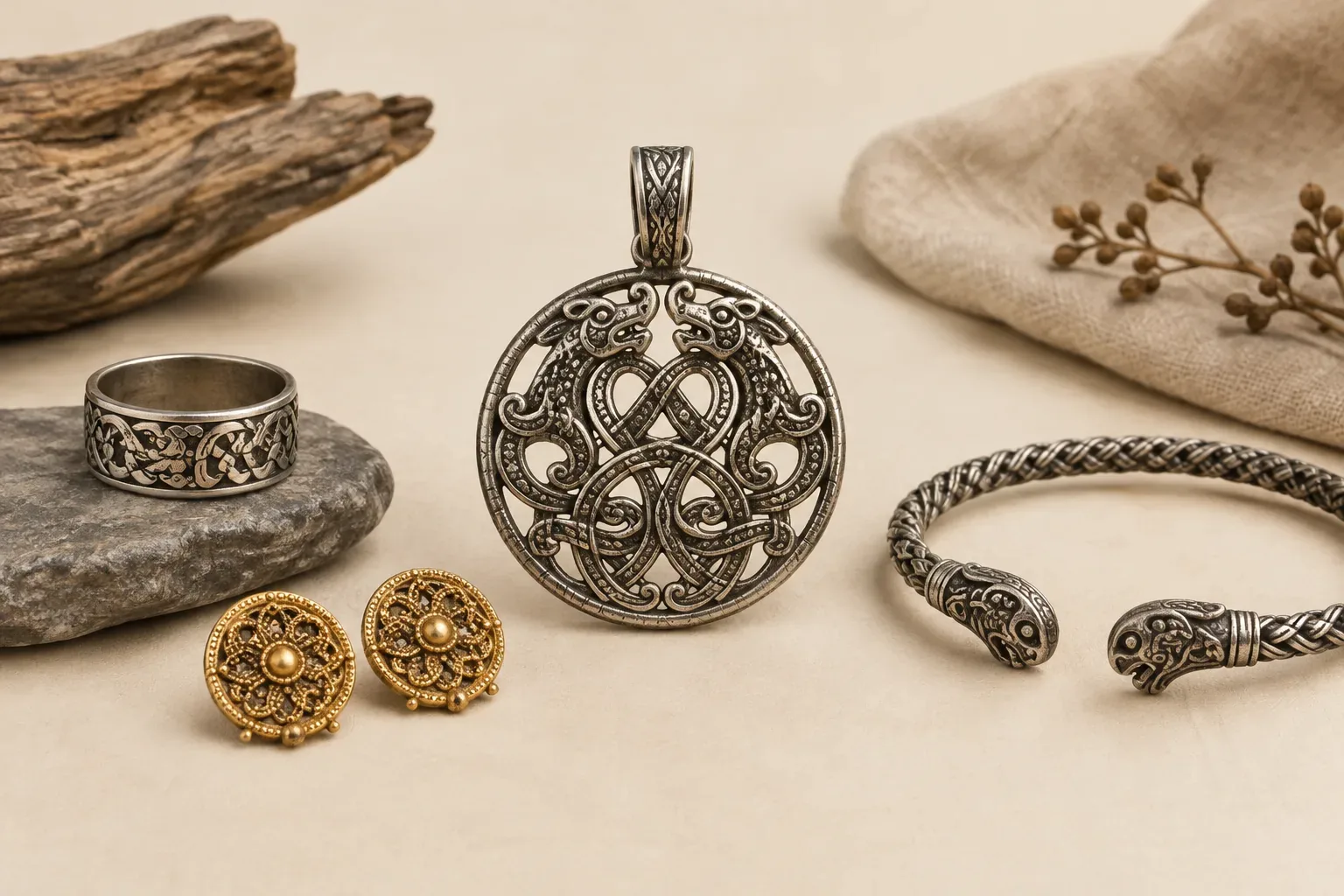
Animal interlace and stylised beasts appear across Iron Age and early medieval Northern Europe and are frequent on metalwork and carved objects. Museums attribute these designs to shared workshops and circulating patterns rather than to a single, universal symbolic vocabulary. Where inscriptions exist, they help anchor meaning, but not every animal form carries a clear religious message in the archaeological record.
Thor's hammer (modern Mjölnir pendants) is widely sold as 'Viking' jewellery today, and examples with that shape do occur in Norse contexts. Museum interpretation emphasises caution: some hammer‑shaped pendants are found in graves and hoards and may reflect specific cultural associations, but treating every modern hammer pendant as an authentic religious amulet is an interpretive step beyond basic typology. Context and dating matter for assessing original use.
Runic inscriptions are valuable when they appear. A legible, datable runic inscription can convey a name, maker's mark, ownership statement, or short dedication. Museums treat runes as primary evidence for literacy, language, and occasionally belief, but inscriptions are relatively rare compared with decorative motifs, so they cannot be assumed to be present on most pieces.
Glass and amber beads appear in large numbers in Scandinavian assemblages and are important for dating and trade interpretation. Museums document imported materials and local imitations; bead typology and composition are strong indicators of chronological and trade relationships.
Materials, gemstones, and documented uses
The Victoria and Albert Museum's overviews of gemstones and jewelry history explain that stones and materials have multiple histories: some were prized for colour, others for perceived rarity, and many circulated as trade goods. Archaeological finds show use of amber, glass, and imported semi‑precious stones in Scandinavian contexts, but attribution of a symbolic role to a specific gem usually requires supporting context such as burial goods or contemporary text.
Modern jewelry reproductions often use contemporary cuts, treatments, and imitations that were not available in the early medieval period. The Federal Trade Commission notes legal obligations around disclosing treatments and imitations; when you are assessing or buying a piece, insist on clear information about material, treatment, and provenance so you can distinguish a modern replica from an object with archaeological authenticity.
How motifs, gems, and traditions appear in original and modern jewelry
In the archaeological record, Norse metalwork appears as brooches, buckles, arm rings, finger rings, and bead strings, often worked in silver with techniques such as casting, lost‑wax, and inlay. Decoration may be inlaid, stamped, or chased; enamel as known in later medieval work is less common in early Norse contexts. Museums catalogue these technical details because they indicate workshop practice and date.
Modern pieces inspired by Viking designs typically borrow forms and surface motifs while using current jewellery techniques, contemporary metalworking standards, and modern gemstone cuts. If a piece shows factory finish, modern soldering marks, or contemporary stamped hallmarks, those are indicators it is a modern interpretation rather than an archaeological object.
Dating pitfalls and common mislabels
The label 'Viking' is frequently applied in marketing to anything with interlace, runes, or a hammer motif, but museum practice distinguishes 'Viking Age' objects with secure find context from 'Viking‑style' or 'Viking‑inspired' modern pieces. Many so‑called Viking items on the market are modern reproductions or later medieval pieces misdescribed for appeal.
Another common error is conflating Norse styles with contemporary Celtic or Anglo‑Saxon work without examining regional differences and cross‑channel influences. Museums emphasise careful comparison with dated finds rather than relying on visual similarity alone.
Documented historical meanings versus modern personal interpretations
Documented meanings are those supported by textual sources, inscriptions, or secure archaeological context and are the standards used in museum interpretation. For example, a runic dedication or a grave assemblage that includes ritual deposits provides stronger grounds for interpretation than a single decorative motif found without context.
Modern personal interpretations—such as claiming a particular pendant will confer protection or directly replicate ancient religious practice—are valid as contemporary meanings for the wearer but should be distinguished from historical claims. Museums and curators separate those layers of meaning; they describe what the object is and where it was found and avoid asserting fixed spiritual effects based solely on motif.
Practical and respectful selection or gifting guidance
Decide whether you want an authentic archaeological object, a historically informed reproduction, or a contemporary design inspired by Norse motifs. If you want historic authenticity, seek provenance and supporting documentation from reputable dealers or institutions and expect that genuine archaeological objects are scarce and often subject to legal and ethical restrictions on sale.
For reproductions choose makers who state clearly what is original and what is modern, who disclose materials and any treatments, and who respect cultural context. The Federal Trade Commission's guidance on buying gemstones and disclosures is a useful standard—ask for material certification and treatment history when gemstones are involved, and avoid sellers who obscure these facts.
When gifting, respect the recipient's background and beliefs. Offer context with the gift: explain whether the piece is a modern design inspired by Norse art, a faithful reproduction, or an archaeological object with provenance. This is both honest and considerate of the cultural and historical complexity behind these motifs.
Finally, if the recipient has ties to Scandinavian heritage or religious beliefs connected to Norse traditions, discuss the choice with them when possible. Wearing cultural symbols can be meaningful but can also raise questions of appropriation; transparent sourcing and sensitivity to personal and community perspectives help ensure gifts are respectful.
Further research and related resources
If you want to dive deeper into identification methods, museum catalogues and exhibitions provide typologies and high‑resolution photographs that make comparison easier. The Victoria and Albert Museum's material on jewelry history and gemstones is a recommended starting point for understanding how objects have been interpreted by curators and conservators.
For practical buying standards, consult guidance about gemstone treatments and disclosure from official sources such as the Federal Trade Commission. For more on choosing meaningful pieces and researching jewelry symbols, see the related pages in our Cultural & Historical Jewelry category and our practical gift guide.
Summary
Accurate 'Viking‑Age Scandinavian jewelry identification' rests on typology, technique, materials, and find context as used by museum scholarship rather than on popular or market labels. Distinguish documented meanings supported by inscriptions or contexts from modern personal or commercial interpretations, and choose or gift pieces with clear provenance, material disclosure, and cultural sensitivity.
Frequently asked questions
How can I tell if a piece is genuinely Viking‑Age or just inspired by Viking styles?
Ask for provenance and find context, request technical descriptions (metalwork technique, visible tool marks, wear patterns), and compare the object with museum catalogues and typologies. If the seller cannot show documentation or if the piece displays clearly modern finishing or hallmarks, it is likely a modern reproduction.
Do motifs like Thor's hammer always mean a religious object?
No. Museums treat such motifs as context‑dependent. A hammer pendant in a dated grave might suggest a cultural association, but motifs alone are not definitive proof of religious use without supporting archaeological or textual evidence.
Are gemstones in Viking‑Age jewelry the same as modern stones?
Some materials such as amber and certain semi‑precious stones were used historically, but modern gemstones are cut, treated, and marketed differently. Ask sellers for disclosure on treatments and provenance; the Federal Trade Commission recommends clear statements about imitation or enhancement.
Is it culturally insensitive to wear Norse‑inspired jewelry?
Wearing Norse‑inspired jewelry is not automatically offensive, but sensitivity matters. Prefer transparent sourcing, avoid appropriating sacred symbols from living communities without understanding, and when in doubt discuss the choice with those who have a direct cultural connection.
Where should I look for reliable reproductions or authentic pieces?
Start with museum shops, reputable historical reproductions makers, and dealers who provide documentation. Museum catalogues and specialist publications are useful for comparison. Avoid sellers who use vague terms like 'ancient' without supporting provenance.
What questions should I ask a seller before buying a piece marketed as Viking?
Ask for provenance, the findspot and documentation, the metal and gem identification and any treatments, whether the item is a modern replica, and for photos of any hallmarks or maker's marks. A reputable seller will provide clear answers or decline the sale if documentation is absent.
Sources and further reading
- Bedazzled: A History of Jewellery — Victoria and Albert Museum
- An A-Z of Gemstones — Victoria and Albert Museum
- Buying Gemstones, Diamonds, and Pearls — Federal Trade Commission