Meaning at a glance
Viking‑Age Scandinavian jewelry symbols show a range of regional motifs and uses in archaeological collections; museum research distinguishes their original social, religious, and decorative roles from later modern or romanticized meanings, and modern buyers should verify provenance, treatment and cultural context when choosing or gifting these motifs.
What the historical evidence actually shows
Our knowledge of Viking‑Age Scandinavian jewelry motifs comes mainly from archaeology, museum collections, and specialist cataloguing summarized in museum accounts. The Victoria and Albert Museum treats jewelry history as a record of changing social contexts and shows that motifs and materials vary across regions and over time. Archaeological finds recovered from burial and settlement sites preserve brooches, pendants, finger-rings, and beads bearing a range of decorative motifs that scholars document and classify in museum collections.
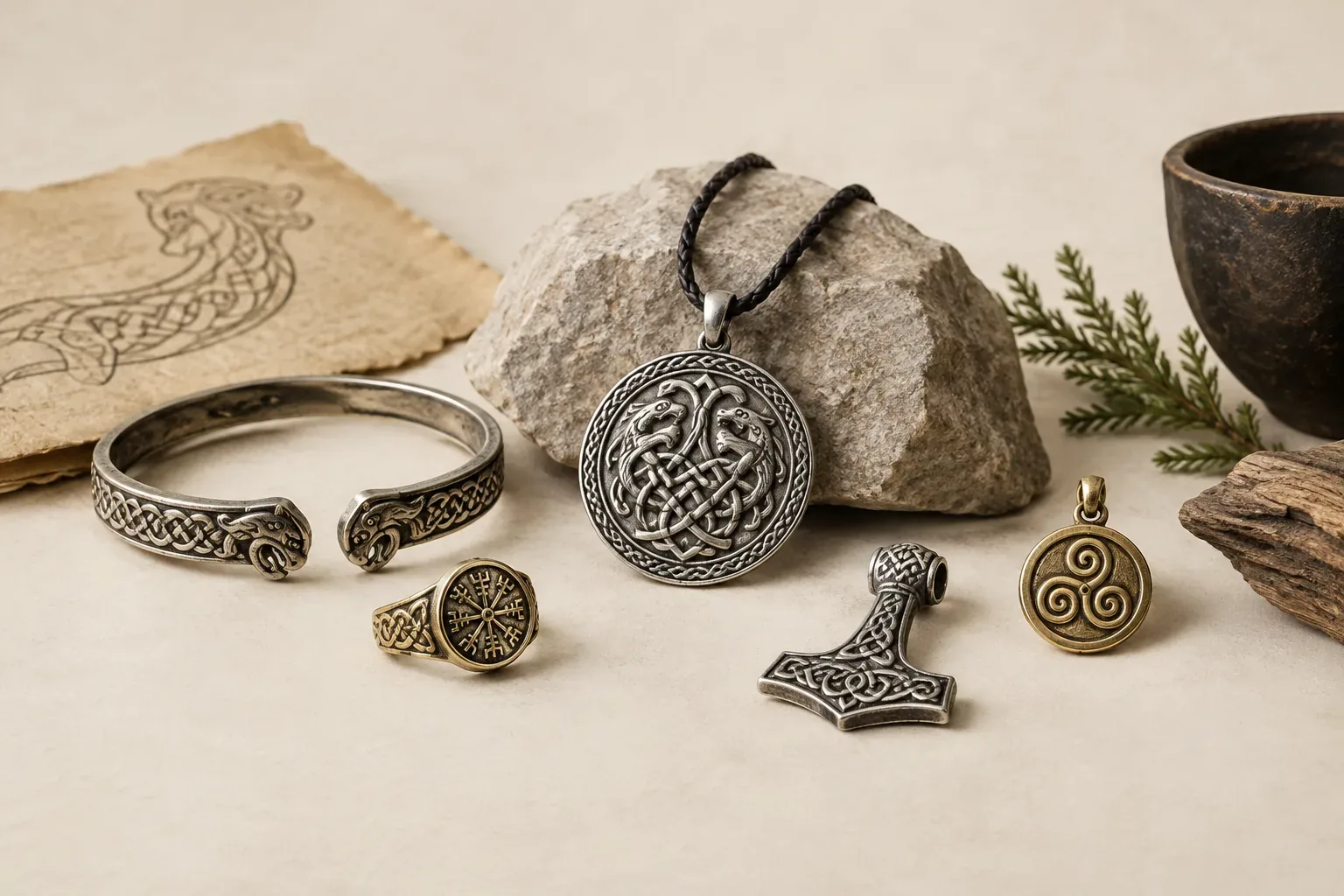
Those museum records and archaeological summaries identify recurring visual types—stylized animal interlace, geometric patterns, small hammer-shaped pendants frequently associated with the Norse hammer motif, and pieces bearing runic inscriptions or Christian crosses. The V&A frames such objects as expressions of social identity, craft practice, and sometimes religious affiliation, rather than as carrying one fixed meaning for every wearer or place.
Which cultures and periods are we describing?
When writers say “Viking‑Age Scandinavian,” they refer to material culture from Scandinavian regions and connected communities during the early medieval period commonly treated by archaeologists and museums as a distinct horizon of styles and object types. The motifs listed in museum overviews come from a range of Scandinavian contexts and related trading zones rather than from a single homogeneous culture. The V&A emphasizes that styles change with geography, social rank, faith, and contact with other cultures, so each motif should be placed within its local archaeological context when possible.
Because material and iconographic styles shift across space and time, avoid assuming that any single motif carried the same significance across all Scandinavian communities. Museum documentation is the best immediate source to determine where an object-type was found and how specialists interpret its context.
Documented historical meanings versus modern interpretations
Documented historical meanings for specific objects are often limited. Museum and archaeological reporting typically record find contexts, inscriptions, and associations with other objects rather than direct statements of belief. For example, some hammer‑shaped pendants are treated in museum literature as markers associated with Norse religious identity or personal protection in certain contexts, while runic marks can identify owners or contain short dedications. The V&A stresses that much interpretation rests on context and comparison rather than on a single definitive contemporary text.
Modern personal or commercial interpretations have layered additional meanings onto these motifs. Contemporary wearers may adopt hammer pendants as symbols of heritage, strength, or neopagan religious identity; designers may use interlace purely for its decorative appeal; and runic characters are sometimes used as aesthetic glyphs in ways that differ from their archaeological function. These modern readings are valid personal meanings but are not equivalent to documented historical usage unless supported by archaeological or textual evidence cited by museums or scholars.
How motifs, gemstones, and techniques appear in jewelry
The museum record shows Viking‑Age jewelry made in metals such as silver and bronze with techniques including casting, hammering, and in some cases inlay or gilding. Motifs appear as cast pendants, stamped or engraved decorations on brooches and rings, and as bead strings assembled from glass, amber, or semi‑precious stones. The V&A’s general surveys of jewelry history detail how craftsmen used available materials and techniques to make both display pieces and everyday objects, and how gemstones and beads were integrated into necklaces and strung adornments.
Gemstones and beads in Viking contexts included locally available materials such as amber and traded stones; museum guides to gemstones place each material in its wider historical context, explaining how certain stones were valued or traded. In modern reproductions, the same motifs may be rendered in sterling silver, bronze, or gold and paired with contemporary gemstones or synthetic alternatives; if a piece claims to use a specific historic material, verify that claim through the seller.
Selecting or gifting Viking‑Age motifs: practical and respectful guidance
Decide whether you want a historically informed reproduction, a contemporary design inspired by Viking motifs, or a piece that combines old and new elements. If historical authenticity is important, ask the maker or seller for clear provenance and whether the design is a direct copy of a specific archaeological find or an interpretation inspired by a style. Museum catalogues and displays are useful references for confirming the source forms and contexts of motifs.
When gemstones or beads are part of the item, use the Federal Trade Commission’s guidance to ask about treatments, imitations, and lab‑grown alternatives. The FTC recommends that sellers disclose treatments and imitations so buyers can make informed choices; request written confirmation for higher‑value purchases. Also ask about metal content (for example, sterling silver vs. plated base metal) and any conservation considerations for wearable historic pieces.
Consider cultural sensitivity. Some motifs are reused by contemporary religious or cultural groups; others are widely adopted as heritage symbols. Respect the beliefs and contemporary uses attached to some symbols and avoid claiming that a motif bears a single universal meaning. When gifting, explain whether the piece is a historical replica, a contemporary reinterpretation, or a commercial design, so the recipient understands the context and intended meaning.
Finally, prioritize ethical sourcing. If the piece contains natural gemstones, seek information about origin, treatment, and certification. If artisan-made, ask about the maker’s labour practices and whether fair pricing, cultural consultation, or community benefit were part of the production.
How to research further
Start with museum collections and interpretive materials to ground your understanding in documented finds and scholarly contexts. The Victoria and Albert Museum provides accessible overviews linking objects to changing social meanings and to material and stylistic development. For gemstones, the V&A’s A–Z of Gemstones is a practical reference for historical context and identification. For consumer protections and disclosure about treatments and imitations, consult federal guidance such as the Federal Trade Commission’s advice on buying gemstones, diamonds, and pearls.
If you need authentication for a high‑value object, seek an independent specialist or institutional assessment. For those interested in the cultural meanings of motifs in contemporary communities, look for sources that represent those communities’ own voices rather than assuming meanings from modern commercial use.
Final note
Viking‑Age Scandinavian jewelry symbols are best approached as historically situated designs: powerful as expressions of identity, affiliation, or decoration in their original contexts, and continuing to inspire modern wearers. Treat museum documentation as the baseline for historical claims, distinguish that evidence from personal or modern interpretations, and make buying or gifting choices with clear questions about provenance, materials, and cultural respect.
Frequently asked questions
Do Viking‑Age jewelry symbols have fixed meanings?
No. Archaeological and museum records show that motifs served different roles—decorative, social, or religious—depending on place and context. Museum summaries stress that meanings are inferred from find contexts rather than recorded as fixed, universal definitions.
Is a hammer pendant always a religious symbol?
Not necessarily. While some hammer‑shaped pendants appear in contexts interpreted as connected to Norse religion or protection, museums and archaeologists caution that interpretation depends on context and is not uniform across all finds.
How can I tell if a gemstone in a piece is natural or treated?
Ask the seller for written disclosure about gemstone treatments, origin, and whether the stone is lab‑grown or an imitation. The Federal Trade Commission recommends that sellers clearly disclose treatments and imitations so buyers can make informed decisions.
Is it cultural appropriation to wear Viking‑style jewelry?
Wearing such jewelry is not automatically appropriation, but it becomes problematic if the wearer dismisses contemporary cultural meanings or commercializes sacred symbols without understanding or respect. Learn the modern contexts and, when possible, support makers who have engaged with relevant communities.
Where should I look to confirm the historical source of a motif?
Consult museum catalogues and object records, which document archaeological provenance and specialist interpretation. The Victoria and Albert Museum’s exhibitions and articles provide accessible starting points for understanding the provenance and context of historical jewelry motifs.
Should I buy a historical original if I want authenticity?
Authentic historical pieces can be fragile, valuable, and ethically complex to trade. If you want historical accuracy without those issues, choose reputable reproductions or commission a historically informed piece and ask the maker for references to specific finds or museum catalogues.
Sources and further reading
- Bedazzled: A History of Jewellery — Victoria and Albert Museum
- An A-Z of Gemstones — Victoria and Albert Museum
- Buying Gemstones, Diamonds, and Pearls — Federal Trade Commission