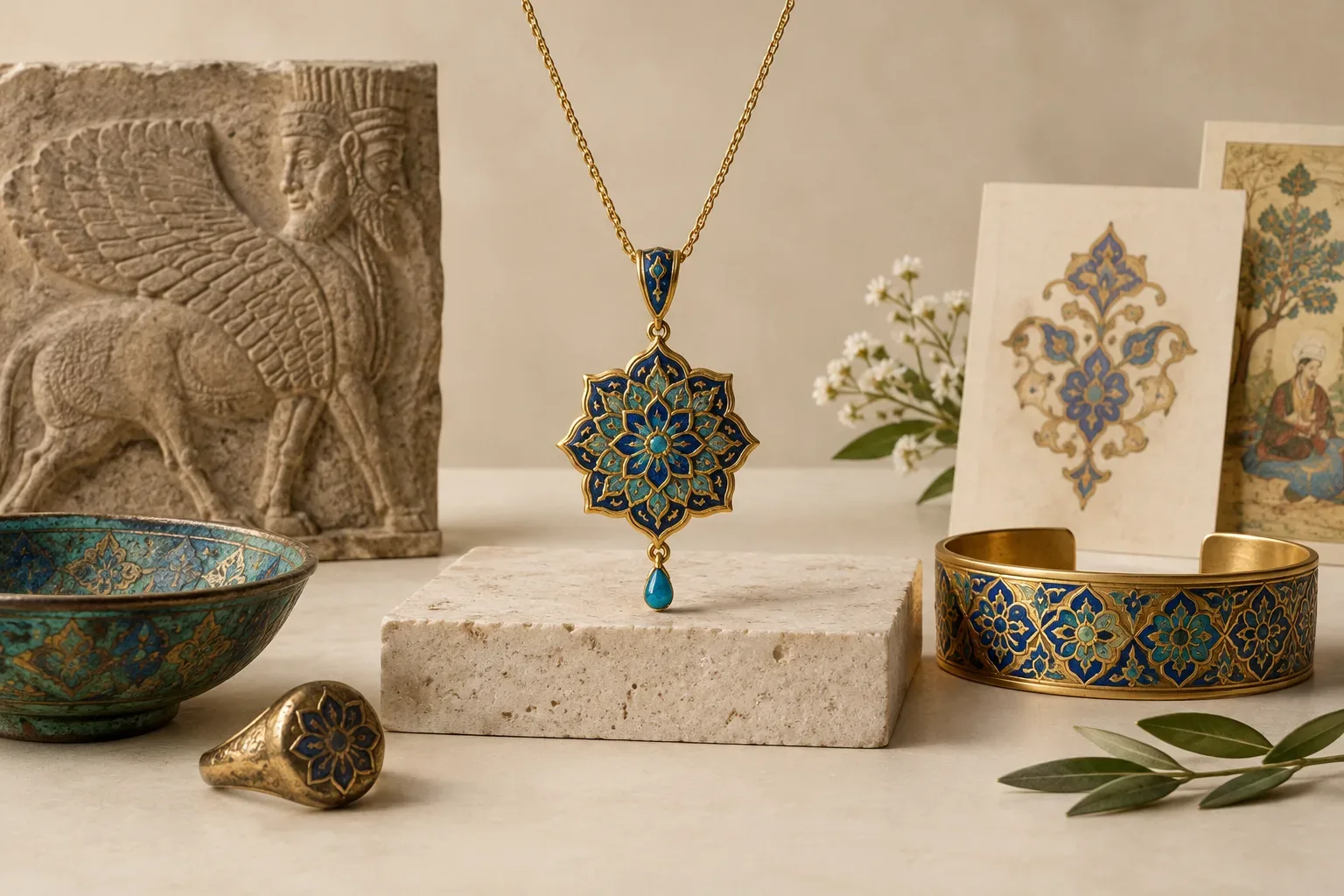
Meaning at a glance
Use visual motifs, construction techniques, materials, and documented provenance together to identify Persian jewelry; separate museum-documented uses from modern personal meanings; and guard against common mislabels for motifs and gemstones by checking sources and disclosures.
Direct answer — what to look for
Concise answer: Persian jewelry identification depends on three linked kinds of evidence: the motif and design vocabulary, the making techniques and materials, and documented provenance or comparison with museum examples. Where museum research exists, use that documented context to separate historical meanings from later interpretations; for materials and treatments rely on consumer-protection guidance about disclosure. Combining visual analysis with credible provenance and laboratory or vendor disclosures gives the most reliable identification.
Historical evidence and the cultures or periods involved
When identifying Persian jewelry you are examining a long, overlapping artistic area often called Persianate or Iranian. Museum research shows that motifs and styles circulated across many courts, workshops, and craftspeople over centuries, and that what we now call “Persian” jewelry can include objects made for different social uses and patrons. The Victoria and Albert Museum frames jewellery within changing social and material contexts, demonstrating that the same ornament can have different meanings at different times.
Because motifs moved between textiles, metalwork, and architecture as well as jewellery, a motif alone is not a definitive chronometer. Museum collections and catalogues remain the best single tool for placing an object in time and place: match your piece to well-documented examples in museum records and exhibition catalogues. If a piece closely resembles an item in a reputable museum collection or publication, that resemblance helps date and localize it, but it does not prove provenance without supporting documentation.
Documented historical meanings versus modern interpretations
Documented historical meanings come from contemporaneous records, inventory lists, court documents, inscriptions, or conserved objects interpreted by curators and historians. Museum scholarship typically distinguishes function (ceremonial, funerary, courtly, everyday), social status, and symbolic use, and treats these as historically contingent rather than universal. Rely on such scholarship when you want to claim a historical meaning.
Modern personal interpretations and commercial narratives — for example, describing a motif as guaranteeing love, protection, or a specific spiritual quality — are valid as personal or marketing claims but are not the same as recorded historical meaning. Many contemporary wearers choose motifs for personal reasons unrelated to the original cultural or social uses; these contemporary uses are real but should be described as modern adaptations rather than as documented historic meanings.
Common Persian motifs: identification and provenance cues
Boteh or paisley shape: A teardrop with a curved tip (commonly called paisley or boteh) appears widely in Persian decorative arts. In jewellery it may appear as an enamel panel, repoussé or chased gold element, or a stone-inset pendant. Museums show the boteh moving from textiles and carpets into jewellery designs over time, so its presence suggests Persianate influence but not a precise date or social function by itself.
Floral and vegetal motifs: Stylised cypress, tulip, and palmette motifs are frequent. In metalwork these may be chased, engraved, or cast; in jewellery they are often used as openwork, insets, or repeated borders. Museum documentation links many of these plant motifs to broader decorative programs rather than single symbolic meanings.
Calligraphic elements and inscriptions: Persian calligraphy may appear as poetic verses, names, or blessings on lockets, rings, and plaques. When present, inscriptions can strongly aid identification and dating, but they require specialist reading and authentication.
Gemstone use: Historically, Persian jewellery used a wide range of gemstones; museum resources provide context for how stones were valued and set. The visual presence of certain stones (for example, extensive use of spinel, turquoise, or emerald) can suggest regional preferences, but identifying a gemstone visually is not definitive. Use gemological testing and vendor disclosures to confirm identity and treatments.
How motifs, gemstones, and traditions appear in jewellery
Motifs appear across jewellery types: pendants, bracelets, rings, hair ornaments, and amulets. The same decorative vocabulary used on metalwork and textiles was adapted to smaller formats; for example, an architectural tile pattern might become an enamelled pendant. The Victoria and Albert Museum emphasises that jewellery should be read in the context of other craft forms because artisans frequently worked across media.
Gemstones are incorporated as cabochons, faceted stones, inlays, or bead strings. The way a gem is cut and set can indicate date and place: earlier periods favored cabochons and relatively simple settings, while later workshops adopt faceting and imported mounting styles. However, accurate identification of gem material and treatment requires gemological analysis or clear vendor disclosure.
Dating techniques and common mislabels
Dating by style alone is risky because revival styles and modern reproductions deliberately mimic historic forms. Look for makers’ marks, assayer marks, documented provenance, wear consistent with age, and construction techniques that match museum examples. Provenance documents, auction records, or museum-comparable catalogues strengthen a date attribution.
Common mislabels include calling later revival pieces “antique Persian” without provenance, attributing every boteh or floral design exclusively to a single era, and misidentifying simulated or treated stones as natural without disclosure. For gemstone authenticity and treatment information, follow government consumer guidance: the Federal Trade Commission requires sellers to disclose treatments, lab-grown stones, and imitations. When a seller cannot provide independent testing or clear disclosure, treat material claims with caution.
Practical guidance for selection and respectful gifting
When choosing or gifting Persian-inspired jewellery, be explicit about whether the piece is an antique, a modern artisan piece, or a modern reproduction. Accurate labelling respects buyers and the culture that inspired the design. If the object is a genuine antique, request written provenance and condition reports; if it is a modern piece inspired by Persian motifs, describe it as such.
Consider cultural sensitivity: motifs drawn from religious or funerary contexts should be chosen thoughtfully. If you are unsure about a motif’s religious or ceremonial significance, consult museum publications or specialists before wearing it in contexts where it could offend. Museum research and curatorial notes often identify motifs that were used in devotional contexts versus courtly or decorative ones.
For gemstone purchases, ask for a gemological report or a clear vendor disclosure that follows FTC guidance about treatments and imitations. If you are buying as a gift and provenance or testing is unavailable, select modern pieces from reputable dealers with transparent return policies rather than claiming historical authenticity.
If you need a technical evaluation
For legal or high-value questions get a professional appraisal and independent gemological testing. Museums and their publications are invaluable comparators for design vocabulary and historical context, but only laboratories and qualified appraisers can confirm material identity and age. The FTC’s consumer guidance explains what kinds of disclosures reputable sellers should make about gemstones and treatments.
Where to research further
Start with reputable museum collections and catalogues that document comparable objects and their contexts. The Victoria and Albert Museum provides accessible material on jewellery history and gemstones and is a sound first reference for comparative research. Use museum databases, auction-house research, and published conservation reports to build a case for attribution.
Frequently asked questions
How can I tell if a piece is genuinely antique Persian jewelry?
Genuine antique attribution rests on multiple factors: reliable provenance or ownership records, makers’ or assay marks, construction techniques consistent with dated museum examples, and professional material analysis. Compare the piece with museum-documented examples and get an independent appraisal and gemological testing for high-value objects.
Is the paisley (boteh) motif always Persian and always 'meaning' the same thing?
The boteh motif is strongly associated with Persian decorative arts but migrated across media and regions. Museums document it chiefly as a decorative motif rather than a single fixed meaning; any contemporary symbolic meaning worn today should be described as a modern interpretation unless you can cite historical sources.
What are common gemstone mislabels I should watch for?
Common mislabels include calling treated stones natural, lab-grown stones natural unless disclosed, or glass and composite materials described as the genuine gem. The Federal Trade Commission requires sellers to disclose treatments and imitations, so ask for written disclosure or lab reports if authenticity matters to you.
Can construction or setting style help date Persian jewelry?
Yes. Setting types, metalworking techniques, and stone-cut styles change over time and can indicate date ranges, but they are not definitive on their own. Use them with provenance, condition, and comparison to museum examples for a more reliable dating.
Is it appropriate to gift Persian-inspired motifs to someone from that culture?
Gifting is appropriate when done respectfully and transparently. Be clear whether the item is historic or a modern design, avoid using motifs tied to religious or funerary practices without understanding their significance, and consider asking or researching beforehand if you are unsure.
Where should I go for authoritative information about a piece?
Start with museum catalogues and databases for comparative imagery and historical context, then consult a qualified appraiser and an accredited gemological laboratory for material authentication. Museums like the Victoria and Albert provide accessible scholarship to frame your research.
Sources and further reading
- Bedazzled: A History of Jewellery — Victoria and Albert Museum
- An A-Z of Gemstones — Victoria and Albert Museum
- Buying Gemstones, Diamonds, and Pearls — Federal Trade Commission