Meaning at a glance
Explain the documented history and changing contexts of Babylonian jewelry motifs, separate cultural or religious evidence from later popular interpretations, and give practical guidance for choosing and wearing Babylonian-inspired jewelry responsibly.
Short answer
If you want Babylonian-style jewelry, prioritize pieces that are honest about their inspiration and provenance, check materials and treatments, and wear or gift them with awareness of historical context. This guide explains what the archaeological and museum record documents about ancient Mesopotamian (including Babylonian) jewelry, distinguishes documented meanings from modern interpretations, describes how motifs and gemstones appear in revival pieces, and gives practical, respectful buying and gifting advice.
What the historical and museum record actually shows
Archaeological finds from ancient Mesopotamia, often summarized in museum resources, show a long tradition of metalwork, beads, and inlaid gemstones made from local and imported materials. The Victoria and Albert Museum presents an overview of jewellery history that treats ancient Near Eastern and Mesopotamian material as part of a broader narrative of changing social uses and techniques for personal adornment. Using published museum collections and summaries helps avoid overreading later meanings into the objects themselves.
Museum accounts emphasize material practice and social context rather than single, universal symbolic readings. For example, surviving pieces and fragments document techniques such as bead stringing, inlay, and the use of precious and semi-precious stones, but the original uses of individual motifs or items could vary by community, owner status, or function. The museum perspective is useful because it focuses on craft, trade, and shifting social roles of jewellery over time rather than modern symbolic claims.
Identify cultures and periods precisely
When people say “Babylonian” they are referring to a set of cultures and polities in ancient Mesopotamia rather than one static style. Material labelled Babylonian in museums is usually part of the broader Mesopotamian cultural sphere, and objects in that category may come from different city-states, workshops, and centuries. Use museum labels and academic catalogues to identify whether a piece is from Old Babylonian contexts, Neo-Babylonian contexts, or another Mesopotamian period when provenance is available.
If a seller or maker calls a design “Babylonian,” ask what evidence they mean: is the design copied from a specific archaeological object in a museum collection, adapted from a known motif, or simply inspired by general Mesopotamian aesthetics? The Victoria and Albert Museum’s historical overviews are a useful starting place to compare claims about style and technique against documented examples.
Documented meanings versus modern interpretations
Museums and archaeological reports focus on what the objects are and how they were made and used; they rarely support single, universal symbolic meanings for motifs. Where the museum record documents ritual or funerary uses, it will identify those contexts explicitly. Absent that direct contextual evidence, assigning a fixed meaning to a motif is a modern interpretive step.
Modern makers and wearers often layer new meanings onto ancient designs—for example, reading a rosette, stylized animal, or geometric pattern as a symbol of protection, prosperity, or personal identity. Those contemporary associations can be meaningful to the wearer but are not the same as documented historical meaning. Be clear, both for yourself and when gifting, whether your understanding of a motif is based on museum-documented context or on later personal or popular interpretation.
How motifs, gemstones, and traditions appear in modern jewellery
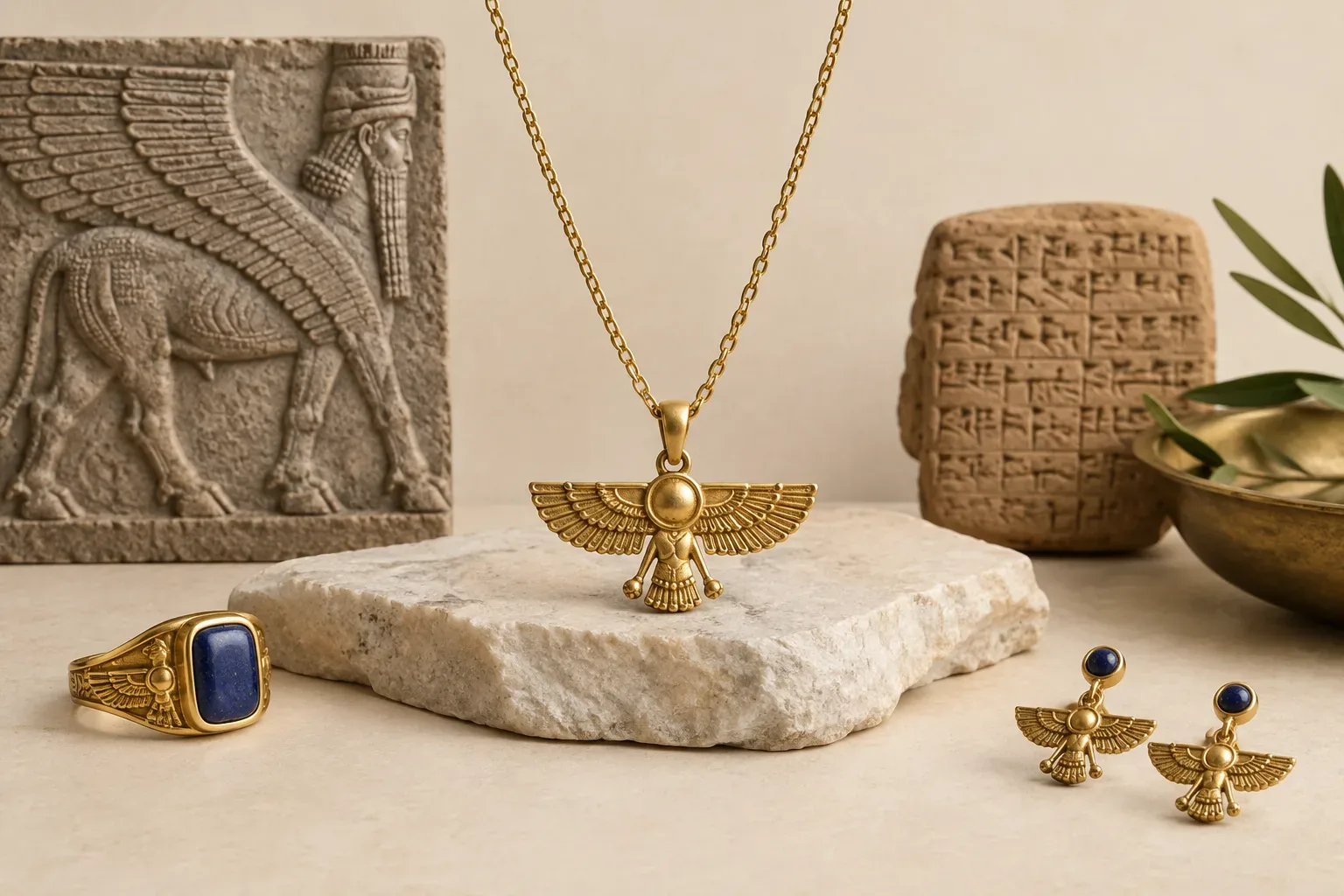
Revival and revival-inspired jewellery commonly use simplified versions of Mesopotamian motifs—linear rosettes, stylized animals, and repeated geometric bands—reworked for modern production methods. Makers may quote ancient forms directly, interpret them in contemporary design language, or combine them with other historical elements. Look for makers who document the specific source or inspiration if historical fidelity matters to you.
Gemstones historically associated with ancient Near Eastern trade and ornament—such as lapis lazuli, carnelian, agate, and various glass imitations—appear frequently in revival pieces. The Victoria and Albert Museum’s A–Z of Gemstones explains historical contexts for many gem materials and can help you identify which stones are historically attested and which are modern substitutes or treatments. Many contemporary designers also use modern materials (treated stones, glass, or synthetic substitutes) to achieve the color and appearance of ancient materials at lower cost.
Material and disclosure considerations when buying
Modern buyers should pay attention to materials, treatment disclosures, and provenance. The U.S. Federal Trade Commission provides consumer guidance to ask sellers about stone treatments, whether gems are natural, laboratory-grown, or imitations, and to obtain written disclosures when requested. Sellers should disclose common treatments such as dyeing, heat treatment, stabilization, and whether settings are plated or solid metal.
If historical authenticity is important to you, ask for clear provenance and documentation. Reproductions made for the market should be labelled as such. When a piece is presented as “antique” or “original,” verify the chain of custody, the seller’s expertise, and whether the object has been assessed by a qualified conservator or archaeologist. Museum websites and catalogues are valuable comparators for evaluating such claims.
Responsible buying: cultural sensitivity and context
Wearing or gifting a design inspired by ancient Mesopotamia can be respectful when it comes with honest labelling and a willingness to acknowledge complex histories. Describe pieces as “inspired by” or “after” Mesopotamian motifs unless you have direct evidence the object is an authenticated antique. Avoid marketing or gifting language that claims a single sacred or cultural meaning without supporting historical evidence.
Consider the social and political contexts of antiquities: reputable sellers should not traffic in illegally excavated objects. If a purchase is described as an archaeological find, request proof of legal export and provenance. Supporting ethical makers and museum-authenticated reproductions helps reduce demand for illicit antiquities and respects the cultural heritage of the region.
Practical selection and gifting guidance
Decide what matters most: historical accuracy, aesthetic reference, wearability, or price. If accuracy is the priority, seek pieces made by established makers who cite specific museum examples or who produce museum-replica lines. If the look and daily wearability are primary, contemporary interpretations in durable metals and modern settings may be more suitable.
For gifting, include context. A short note that explains whether the piece is a reproduction, inspired design, or incorporates historically significant stones can make the gift more meaningful and prevents misinterpretation. If the recipient values cultural authenticity, consider a museum shop reproduction or a piece from a jeweller who documents sources and materials. If you choose a piece with treated or imitation stones, make that clear so the recipient understands care and value.
Care, repair, and long-term stewardship
Consider how the piece will be cared for. Historic techniques and fragile inlay work do not always translate well to everyday wear. Ask sellers about stone hardness, setting durability, and recommended cleaning methods. If a piece is framed as a faithful reproduction, expect it may require specialist repair if damaged; ask whether the maker or a known conservator can advise on repairs.
Document your purchase. For high-value pieces, keep written statements of authenticity or provenance and any treatment disclosures. This documentation helps maintain value and supports responsible stewardship should you or future owners wish to donate or sell the item.
Frequently asked questions
Is it appropriate to wear jewellery called 'Babylonian'?
Yes, provided the piece is honestly presented as inspired by Mesopotamian motifs or an authenticated antique. Avoid claims of universal sacred meaning; instead, acknowledge whether the design is a modern interpretation or a documented historical form. Be mindful of provenance and avoid items that could be illicit antiquities.
How can I tell if a gemstone in a Babylonian-style piece is authentic or treated?
Ask the seller to disclose whether gems are natural, laboratory-grown, dyed, heat-treated, or imitations. The Federal Trade Commission recommends getting written disclosures for treatments and is a good consumer reference for common practices and terminology.
Should I buy reproductions from museum shops?
Museum shop reproductions are often well-documented and labelled, making them a strong option if you want historically grounded designs without ambiguity about source or legality. Compare the reproduction with museum catalogues or labels if accuracy is a priority.
What motifs were typical in ancient Mesopotamian jewellery?
Museum overviews indicate that geometric bands, stylized rosettes, and animal or hybrid figures appear in Mesopotamian material culture, but the exact appearance and use varied across time and place. Use museum resources to compare motifs rather than assuming a single meaning.
How should I gift a Babylonian-inspired piece respectfully?
Include a note explaining whether the item is a reproduction, inspired by ancient designs, or an antique with provenance. Avoid asserting unverified cultural or sacred meanings, and choose sellers who are transparent about materials and origins.
What questions should I ask a seller before buying?
Ask for the piece’s provenance, whether gems have been treated, the metal’s karat or plating status, and any documentation of archaeological sourcing if claimed. Request written disclosures for treatments and authenticity claims where possible.
Sources and further reading
- Bedazzled: A History of Jewellery — Victoria and Albert Museum
- An A-Z of Gemstones — Victoria and Albert Museum
- Buying Gemstones, Diamonds, and Pearls — Federal Trade Commission