Meaning at a glance
Explain the documented history and changing contexts of Sumerian jewelry motifs, separate museum-supported cultural evidence from later popular interpretations, and give practical guidance for selecting and wearing modern Sumerian revival pieces respectfully and responsibly.
What the historical evidence can — and cannot — tell us
Archaeological finds from ancient Mesopotamia, including objects associated with the Sumerian city-states, survive in museum collections and form the primary evidence for how people made and used jewelry in that region. Museums and major exhibitions frame these objects within changing social, political, and ritual contexts; for a general overview of how jewelry’s meanings shift over time, the Victoria and Albert Museum’s exhibition and commentary on jewelry history is an important modern reference for understanding context rather than assuming fixed ancient meanings.
That said, physical objects alone rarely provide a complete picture of what a specific motif meant to a particular community at a particular moment. Provenance, find context, inscriptions, and contemporary textual records are what allow scholars to assign functions or likely meanings to objects, and these data vary widely between finds. When museums present Mesopotamian jewelry, they interpret artifacts using a mix of archaeology, comparative material culture, and curatorial judgment; those interpretations are valuable but not synonymous with definitive statements about belief systems or individual intentions.
Distinguishing documented historical meanings from modern interpretations
Documented historical meanings are statements grounded in archaeological context, ancient texts, or consistently demonstrated ritual use. Where such evidence exists, museums and scholarship present it with qualifiers and provenance details. For readers, the Victoria and Albert Museum’s materials on jewelry history are a useful model for how institutions phrase claims about past meanings and changing social uses of jewelry.
Modern interpretations include revivalist or commercial readings that ascribe new or simplified symbolic meanings to ancient motifs. These can be meaningful to the wearer but are contemporary projections and should be framed as personal or modern cultural interpretations rather than direct continuations of ancient Sumerian belief. Treat revivalist symbolism as a living practice inspired by the past, not as a literal preservation of ancient religious or social systems.
How Sumerian motifs and materials appear in modern jewelry
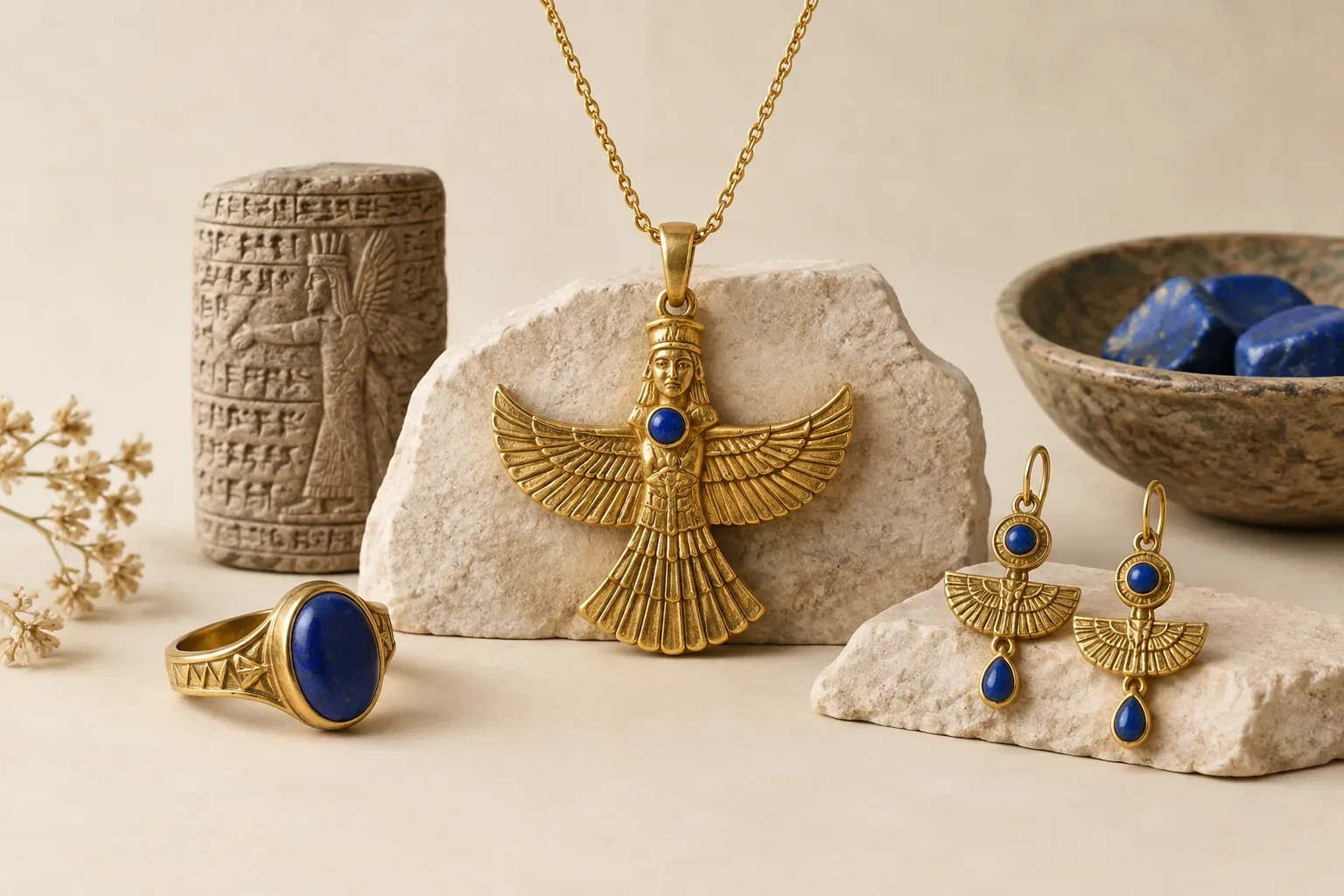
Contemporary makers and brands working in a 'Sumerian' aesthetic draw on museum collections, archaeological publications, and images of artifacts. That inspiration can take many forms: simplified geometric patterns, references to cylinder-seal designs, animal or deity figures stylized from ancient art, or the use of materials associated with ancient Mesopotamia. When these motifs are used, designers usually interpret them through modern design languages, which changes scale, materials, and context.
Materials that evoke ancient Mesopotamian jewelry are commonly cited in descriptions of revival pieces. Museums' gemstone guides provide context for historical materials and techniques and can help buyers understand the visual and material references designers are making. Whether a modern piece uses bronze, gold, faience, or a modern metal alloy, or substitutes historically associated gemstones with contemporary alternatives, the modern object is a contemporary artwork informed by history rather than an archaeological artifact.
Practical guidance for selecting Sumerian revival jewelry
Ask the seller for clear information about provenance and materials. The Federal Trade Commission advises consumers to request disclosure about treatments, imitations, and the country of origin for gemstones and precious metals. Sellers should state whether a piece is an original antique, a museum-licensed reproduction, or a modern design 'inspired by' Sumeria, and whether gemstones are natural, treated, or synthetic.
Prefer pieces that provide context. Reputable pieces will explain which artifact or motif inspired the design and will note whether they are direct reproductions, reinterpretations, or purely modern creations. Museum shops, accredited museums' reproductions, and makers who cite specific catalogue entries or collection numbers offer clearer traceability than anonymous listings.
Consider materials and craftsmanship. If the goal is historical fidelity, look for makers who use traditional techniques or materials documented by museums and conservation literature. If the goal is wearable modern jewelry, prioritize secure settings, hypoallergenic metals, and disclosures about plating thickness or alloys so you know how a piece will age and how to care for it.
Value ethics and cultural respect. Learn the basic history behind a motif and credit the culture and time period when you wear or gift a piece. If a design reproduces religious iconography or artifacts closely associated with funerary or ritual functions, consider whether a secular adaptation might be more appropriate for everyday wearing or gifting.
Where possible support communities and craftspeople connected to the region or traditions being referenced. Buying from makers who collaborate with local artisans, fund conservation work, or donate proceeds to cultural heritage initiatives helps offset the risks of cultural appropriation and supports ethical continuation of craft skills.
Respectful gifting and wearing advice
When gifting Sumerian-inspired jewelry, be explicit about what the piece is: an inspired design, a licensed reproduction, or a genuine antique. This prevents misunderstandings about authenticity and avoids unintentionally claiming to confer ancient meanings that are not documented.
Avoid presenting revival pieces as having prescriptive spiritual or protective powers tied to historical practices unless you can point to firm documentary evidence. Instead, offer the piece as a thoughtful design inspired by a historical culture and explain what it symbolizes for you or the designer today. This approach honors the past without claiming authority over it.
If the recipient has a personal, familial, or community connection to the culture being referenced, ask before gifting. Some motifs that are public and decorative in museums may be sensitive in living cultural contexts, and personal engagement before gifting shows respect and awareness.
Care, documentation, and resale considerations
Document the purchase. Keep receipts, any authenticity statements, and photos of the piece and its tags. These records are useful for insurance, resale, and provenance-building. If a seller gives a catalogue or source reference, retain that information.
Know how to care for the materials used. Modern alloys, plated metals, and treated gemstones require different care than antique gold or stone inlays. Sellers should provide guidance; if they do not, consult general gemstone and metal care resources and conservators referenced by museums.
If you plan to resell, understand that 'inspired by' pieces have different market expectations than verified antiques. Clear documentation about materials and the nature of the piece preserves value and avoids misrepresentation.
Final note on responsible context
Buying and wearing jewelry inspired by ancient Sumerian art can be a meaningful way to engage with history, but responsible engagement requires transparency about provenance and materials, sensitivity to cultural contexts, and an understanding that modern meanings often differ from historical ones. Use museum resources to ground your understanding of the objects and the Federal Trade Commission’s consumer guidance to ensure fair, informed purchases; combine those practices with respectful attribution and ethical purchasing to create a responsible approach to Sumerian revival jewelry.
Frequently asked questions
How can I tell if a piece is an authentic Sumerian antique or a modern revival?
Ask the seller for provenance documentation and any catalogue references. Genuine antiques have archaeological provenance, conservation records, or museum accession numbers. If the seller labels the piece as a reproduction or 'inspired by' design, that should be clearly stated. Museum shops and accredited dealers typically provide clearer provenance than informal marketplaces.
Should I assume motifs on Sumerian artifacts carried the same meaning for everyone in antiquity?
No. Motifs may have had different meanings for different communities and uses over time. Museums and scholarship present interpretations when archaeological context or texts allow, but many meanings remain uncertain. Treat modern symbolic claims about ancient motifs as contemporary interpretations unless they are supported by documented archaeological or textual evidence.
What material disclosures should I demand when buying Sumerian-style jewelry?
Request details about metal type, plating thickness (if any), gemstone identity and treatments, and country of origin. The Federal Trade Commission recommends that sellers disclose treatments, whether gemstones are synthetic or imitation, and any enhancements that affect value or care.
Is it culturally insensitive to wear Sumerian-inspired designs?
Wearing such designs is not inherently insensitive, but sensitivity depends on how the item is presented and used. Credit the cultural source, avoid claiming ancient religious authority for the item, and be cautious with designs that reproduce sacred or funerary iconography. When in doubt, seek guidance from scholars or communities connected to the heritage.
Where can I find reliable reproductions or ethically made revival pieces?
Look to museum shops selling licensed reproductions, reputable makers who cite specific museum references, and artisans who disclose materials and manufacturing processes. Supporting craftspeople with ties to the region or conservation initiatives also helps ensure ethical engagement with the source material.
Sources and further reading
- Bedazzled: A History of Jewellery — Victoria and Albert Museum
- An A-Z of Gemstones — Victoria and Albert Museum
- Buying Gemstones, Diamonds, and Pearls — Federal Trade Commission