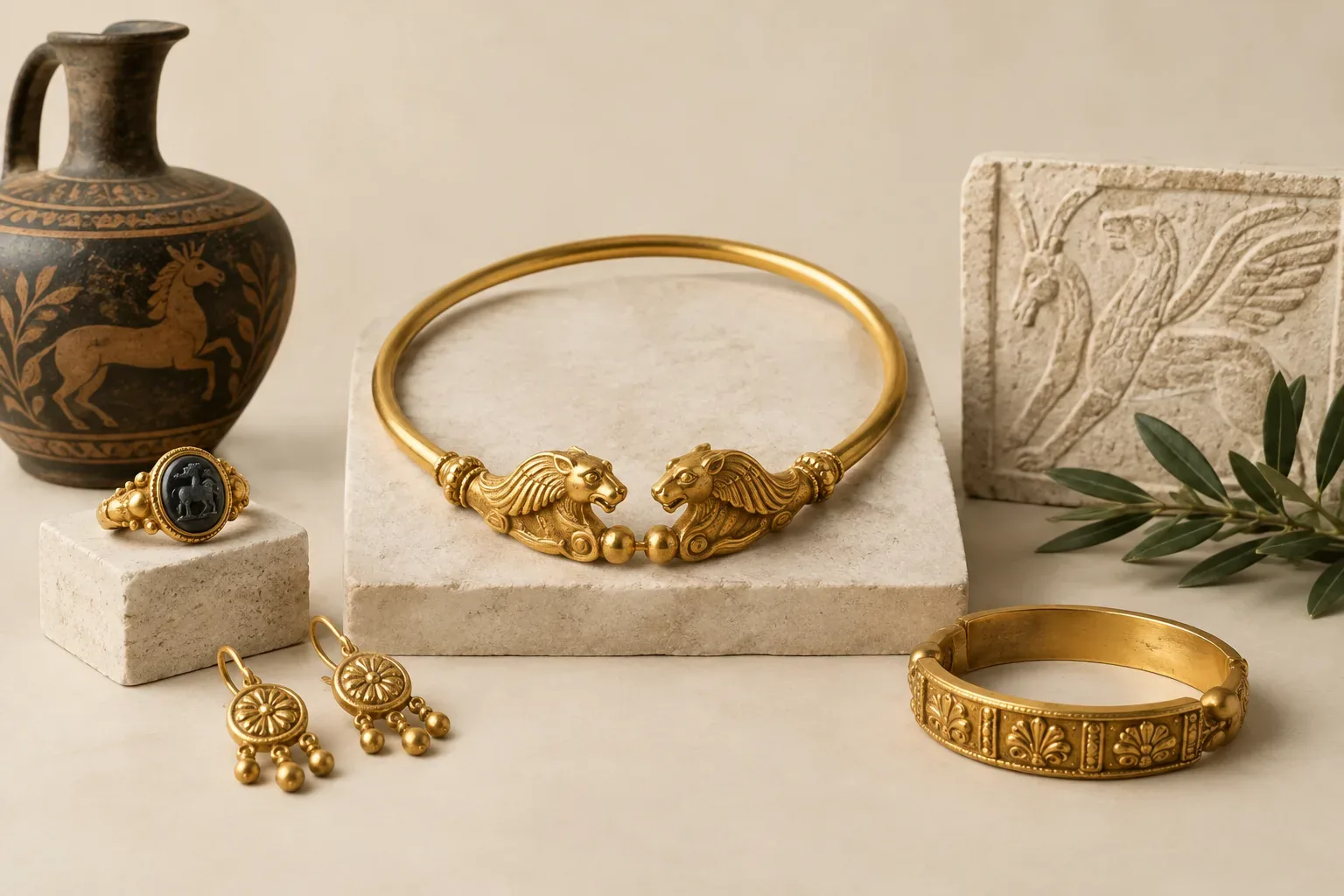
Meaning at a glance
Explain the documented history and changing contexts of the etruscan jewelry identification motif, separate cultural or religious evidence from later popular interpretations, and give practical guidance for choosing and wearing the motif in modern jewelry.
Quick answer
Etruscan jewelry identification is best done by matching documented museum descriptions of ancient Etruscan goldwork and gem use with careful provenance and material evidence; many items sold as “Etruscan” are revival pieces or modern reproductions, and contemporary symbolic meanings are usually modern attributions rather than recorded Etruscan beliefs. The Victoria and Albert Museum frames ancient jewelry as part of changing social contexts, and the U.S. Federal Trade Commission recommends clear disclosure of treatments and imitations for gemstones and materials.
Historical evidence and precisely identifying cultures or periods
What we call “Etruscan” jewelry refers to objects associated with the Etruscan culture of ancient Italy as described in museum collections and scholarship. Museum presentations place Etruscan work as part of the broader ancient Mediterranean material record and emphasize its distinctive goldworking techniques and social uses within that culture, rather than a single uniform symbolism for every object (Victoria and Albert Museum).
Because the label “Etruscan” can be applied in different ways, it helps to separate three things when identifying an object: archaeological provenance or museum documentation tying the piece to Etruscan contexts; technical features and materials that match museum-documented Etruscan examples; and later uses of “Etruscan” as a stylistic label in revival jewelry. The Victoria and Albert Museum’s historical overview highlights how jewelry styles are reused and reinterpreted over time, so a piece described as “Etruscan-style” in later European jewelry may not be ancient.
Documented historical meanings versus modern interpretations
Museum documentation generally treats the function of ancient jewelry—status display, funerary inclusion, votive offering, or dress accessory—as the most secure kinds of evidence. The Victoria and Albert Museum emphasizes social context and changing meanings across time rather than single, universal symbolic readings.
Where modern sellers, designers, or wearers assign spiritual or personal meanings to Etruscan motifs today, those are contemporary interpretations. They may be meaningful to an individual or a community, but they are not the same as documented religious or cultural beliefs recovered from archaeological or museum records unless explicitly supported by such records. Distinguishing the two—what the object was used for historically and what it signifies to someone today—is important when identifying and explaining Etruscan jewelry.
How motifs, gemstones, and traditions appear in jewelry
Museums describe Etruscan and other ancient jewelry in terms of techniques and materials as much as motifs. Descriptive labels in museum collections and reference materials often note goldworking methods, the presence of gemstones, and how pieces were worn or deposited, because these physical details are primary evidence for identification (Victoria and Albert Museum).
In practice, an object identified with Etruscan connections may display fine goldwork techniques such as minute applied granules, delicate wire decorations, and carefully soldered elements, and may include set or inlaid stones. The specific gemstones and the ways they were cut or set are part of how curators and conservators date and contextualize jewelry. For guidance on identifying and understanding gemstones—their cuts, treatments, and historical uses—museum resources such as the Victoria and Albert Museum’s gemstone primer are useful for comparing a stone’s appearance and treatment history.
Because later makers have copied ancient forms, you will also encounter Etruscan-style jewelry that deliberately reproduces ancient motifs or surface treatments. Those revival pieces often combine historical-looking ornament with modern manufacturing marks or contemporary materials; museum histories highlight that jewelry styles move in and out of fashion and are frequently revived with new meanings (Victoria and Albert Museum).
Common mislabels, imitation materials, and how to spot them
The term “Etruscan” is frequently used as a marketing label for revival or inspired work, so buyers should be cautious. Common mislabels include calling Victorian-era revival pieces “Etruscan,” describing modern gold-plated or gold-filled jewelry as ancient, or implying an archaeological provenance that is not documented. Museums caution against conflating style-inspired work with authentic archaeological objects (Victoria and Albert Museum).
For materials and gemstone claims, the Federal Trade Commission outlines clear principles: sellers should disclose treatments, synthetics, imitations, and whether a gem has been enhanced. If a piece is offered as an ancient Etruscan original, ask for supporting provenance, laboratory reports, or a condition report from a recognized authority. If the seller states a gemstone is untreated, natural, or original to the setting, request written confirmation and lab documentation where possible. The FTC’s consumer guidance explains the kinds of disclosure you should expect for gemstones and metals.
Practical checks include looking for documented provenance or museum accession numbers, visible modern maker’s marks or hallmarks that date the piece to a later period, consistency of wear and corrosion with archaeological finds, and whether technical construction matches museum-described ancient techniques. When in doubt, seek an independent specialist or laboratory analysis rather than relying solely on seller claims.
Practical and respectful selection or gifting guidance
If you are choosing or gifting a piece described as Etruscan or Etruscan-style, first decide whether you want an authentic ancient object, a high-quality reproduction, or a modern piece inspired by Etruscan aesthetics. Each choice carries different expectations for price, care, and ethical considerations. Museum writing stresses that objects change context and meaning over time, so clarify what the label means in the listing before you buy (Victoria and Albert Museum).
For actual ancient pieces, confirm provenance, condition, and legal export status; many reputable dealers and auction houses will supply documentation. For reproductions or revival pieces, focus on maker reputation, material disclosures, and craftsmanship. Ask whether gemstones are natural, treated, or synthetic, and request written confirmation in line with FTC guidance. If the piece is vintage or antique but not ancient, look for hallmarks and an independent appraisal.
When gifting an Etruscan-style item with symbolic intent, explain the distinction between historical uses and your personal meaning. Present the piece with a note explaining whether it is an inspired modern design, a documented historical object, or a styled reproduction; recipients often appreciate transparency about origin and meaning.
Finally, care and conservation differ by material and age. Museum descriptions underline that ancient goldwork and gemstones require specialist conservation approaches. Consult a conservator for long-term care of authentic antiquities, and follow standard jewelry care for modern pieces.
Where to go next for verification and research
Begin with reputable museum descriptions and catalogs to compare stylistic and technical details; institutions such as the Victoria and Albert Museum provide contextual histories and gemstone primers useful for comparison. Use the FTC’s consumer information on buying gemstones and pearls to understand required seller disclosures and the limits of marketing claims about treatments and imitations.
For contested or high-value items, obtain an independent technical report from a qualified laboratory or a written opinion from a specialist in ancient Mediterranean jewelry. Cross-reference any claims of archaeological provenance with museum accession records or published excavation reports when possible. If you want practical advice on choosing meaningful pieces, see our related guides on selecting jewelry and researching jewelry symbols.
Frequently asked questions
How can I tell if a piece is genuinely ancient Etruscan?
Request written provenance, museum or auction house documentation, and independent technical reports. Compare construction techniques and materials with museum-described examples and consult an expert in ancient Mediterranean jewelry; sellers should be able to explain the chain of ownership.
What does “Etruscan-style” mean on a jewelry listing?
“Etruscan-style” usually indicates the piece is inspired by forms or ornament associated with Etruscan artifacts but is not an ancient object. Museum histories note that styles are often revived and repurposed, so verify whether the piece is a modern reproduction, a vintage revival, or an archaeological original.
Are gemstones in old jewelry likely to be the original stones?
Not necessarily. Gemstones may have been replaced or retouched over time. Ask for documentation and treatment disclosures; the Federal Trade Commission advises sellers to disclose enhancements, synthetics, and imitations, and buyers should request lab reports for valuable stones.
What should I ask a seller when buying an item labeled as Etruscan?
Ask for provenance, any laboratory or conservation reports, hallmarks or maker’s marks, condition reports, and full disclosure of gemstone treatments or substitutions. If the seller cannot provide documentation, seek an independent appraisal before purchasing.
Is it appropriate to gift Etruscan-style jewelry with symbolic meaning?
Yes, but be transparent about the origin. Explain whether the piece is an ancient artifact, a period revival, or a modern interpretation, and be clear about whether the symbolic meaning you attribute is a historical claim or a personal sentiment.
Sources and further reading
- Bedazzled: A History of Jewellery — Victoria and Albert Museum
- An A-Z of Gemstones — Victoria and Albert Museum
- Buying Gemstones, Diamonds, and Pearls — Federal Trade Commission