Meaning at a glance
This article explains the documented history and changing contexts of Etruscan jewelry techniques, separates historical evidence from later interpretations, and gives practical guidance for choosing and wearing Etruscan-inspired jewelry in the modern era.
What the historical evidence shows (and which cultures or periods are meant)
When this piece refers to Etruscan jewelry techniques it means the metalworking and gem-setting practices associated with the Etruscan civilization of ancient Italy, distinct from later Roman or medieval goldsmithing. The Victoria and Albert Museum frames these practices as part of a broad historical development in jewellery and changing social contexts, and museum collections are a principal source for understanding how objects were made and used in their original environments.
Museum scholarship identifies Etruscan work by its technical features and stylistic vocabulary in surviving objects preserved in collections. These items are archaeological and museum artefacts rather than living religious objects, and interpretation is anchored to the physical evidence in museum holdings and catalogues, not to modern folklore or modern national narratives.
Documented techniques and materials
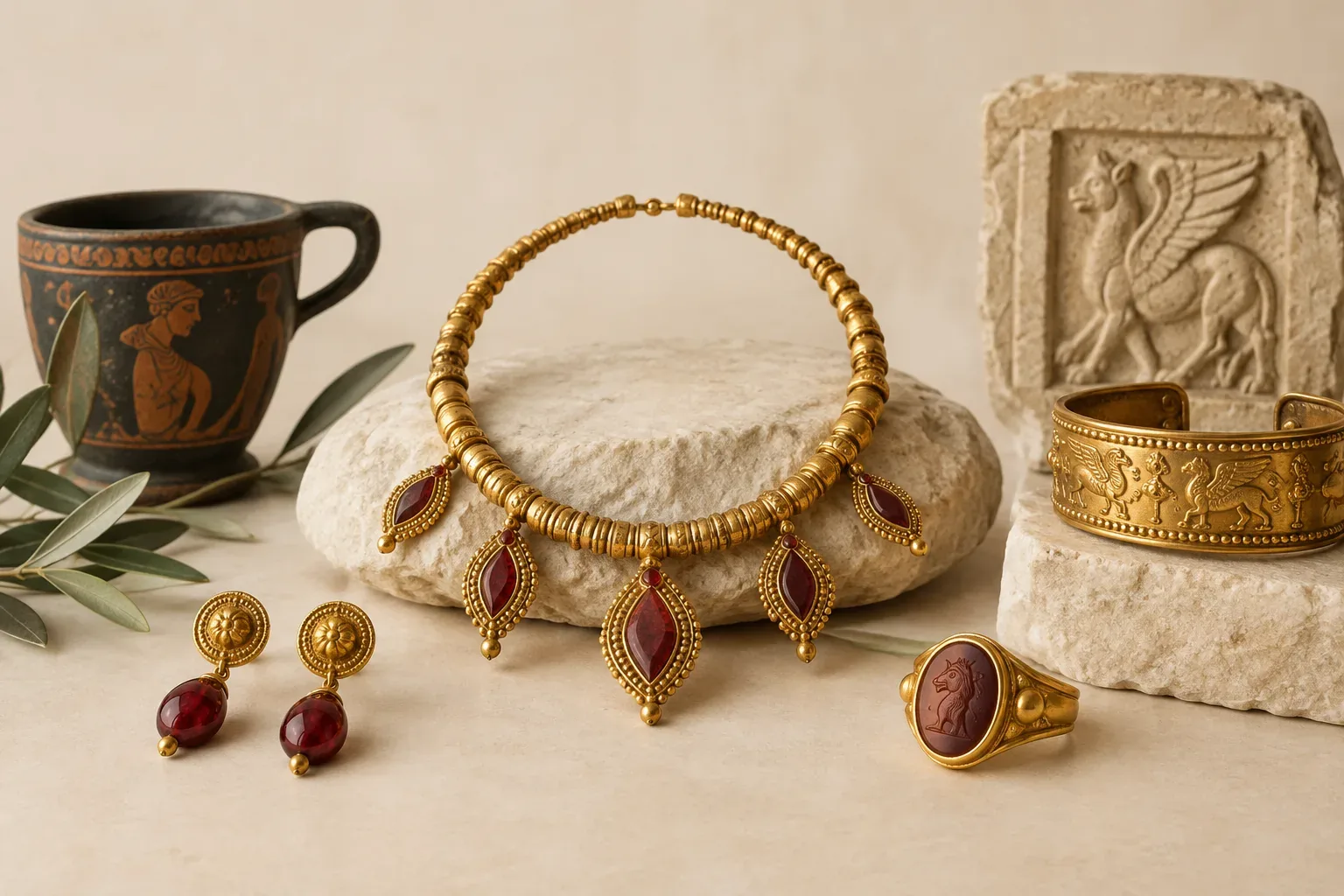
Museum literature attributes several recognizable crafts to Etruscan goldsmiths. Surfaces built from tiny gold granules, delicate wirework, and patterned metalwork are recorded across multiple objects in museum collections. These features reflect a high level of control over gold and soldering techniques, which allowed artisans to build dense, textured surfaces and to set stones with fine bezels and settings.
Reports and displays at institutions such as the Victoria and Albert Museum place these techniques within the longer story of jewellery history and changing social meaning, noting how technical choices — for example, the use of granulation or detailed filigree — produce a distinctive visual language that collectors and later craftsmen have associated with Etruscan style.
Trade, workshops, and the movement of objects
Museum curators and historians use the material evidence of manufacturing quality and imported materials to reconstruct aspects of trade and workshop practice. The presence of certain gemstones and stylistic parallels found across regions indicate that Etruscan jewellery was part of wider exchange networks for both finished objects and raw materials. The Victoria and Albert Museum highlights jewellery as a socially visible category of material culture whose forms and materials changed as they circulated and were adapted by different owners and markets.
Archaeological finds and museum collections also show that jewellery functioned in multiple contexts: as personal display, as grave goods, and occasionally as objects that changed hands across cultural boundaries. These changing contexts are important when explaining technique, because the way a piece was made is often linked to how it was meant to be seen, worn, or exchanged.
Separating documented historical meanings from modern interpretations
The surviving archaeological and museum record documents the physical techniques and contexts of Etruscan jewellery but rarely preserves a full account of the beliefs and personal meanings those objects had for their original owners. Museum-based histories therefore distinguish between technical and visual evidence and the symbolic or religious significance that scholars sometimes infer. The Victoria and Albert Museum cautions that meanings assigned to motifs or items emerge from interpretation of the object within its archaeological context and later scholarly debate, not from a single authoritative textual source.
Modern writers and makers often attach new, personal, or romantic meanings to Etruscan motifs—associating them with notions of antiquity, continuity, or particular spiritual ideas—but those contemporary associations are not the same as documented ancient beliefs. When discussing significance, keep the archaeological evidence and the modern reception separate: one is a record of manufacture and use grounded in material culture studies, and the other is a later cultural reworking or personal interpretation.
How motifs, gemstones, and techniques appear in jewellery
The visual vocabulary associated with Etruscan technique in museum collections includes patterned gold surfaces built from tiny granules, joined wirework that creates open lace-like effects, and settings that emphasize the polished play of gold as much as the colour of stones. Gemstones appear as accents within bezels or cabochon settings rather than as the sole dramatic centrepiece; museum resources on gemstones provide helpful guidance on how certain stones were used historically and how they are identified today.
In museum displays and in modern revivals, these techniques are applied in a range of object types: necklaces and torcs, earrings, fibulae (pins), and brooch-like ornaments. Contemporary jewellery makers who reference an 'Etruscan' look commonly replicate the granular textures and wirework to evoke a handcrafted, ancient aesthetic, but the modern pieces are modern constructions that reinterpret rather than replicate specific ancient meanings.
Practical guidance for choosing, wearing, and gifting Etruscan-inspired pieces
When selecting or gifting jewellery inspired by Etruscan techniques, consider whether you want an original ancient piece, a museum-quality reproduction, or a contemporary design that references the style. Originals require specialist provenance and should be bought only from reputable dealers or auction houses that provide clear documentation; museums and specialist catalogues can help you learn how to assess authenticity. For modern pieces, examine construction quality: fine granulation and delicate filigree require careful craftsmanship and are visible in close inspection.
Pay attention to gemstone disclosure and treatment. The Federal Trade Commission's guidance on buying gemstones, diamonds, and pearls explains that sellers should disclose treatments and imitations; insist on transparent information about any heat treatments, dyeing, composite stones, or adhesives if the stone’s history matters to you. The Victoria and Albert Museum's resources on gemstones are also useful for identifying historical contexts and typical uses of particular stones.
Respect cultural context. If you are buying an original archaeological object, be aware of legal and ethical considerations around provenance and export. If you choose a modern piece inspired by Etruscan techniques, acknowledge the design source in gifting or labeling and avoid presenting modern items as ancient artefacts. For gifting, choose a form and scale that suits the recipient’s style—small studs or a pendant for daily wear, a more substantial collar or statement piece for special-occasion use—and include a note explaining whether the object is an ancient original, a reproduction, or a contemporary design inspired by Etruscan techniques.
Caring for these techniques and materials
Delicate granulation and filigree demand gentle care. Clean pieces using mild, non-abrasive methods and avoid ultrasonic cleaners or harsh chemicals without advice from a professional conservator—especially for pieces that combine soft gold with fragile stones or adhesives. For historic objects, rely on a conservator or museum guidance rather than home cleaning methods.
For gemstone purchases, consult the seller about stability and care and follow recommended cleaning practices. The Federal Trade Commission recommends clear disclosure about treatments and synthetic materials so buyers can make informed decisions about durability and care.
Frequently asked questions
What are the defining technical features of Etruscan jewellery?
Museum collections and scholarship highlight features such as fine granulation where tiny gold spheres form textured surfaces, delicate filigree or wirework, and close-set bezels for stones. These technical traits are documented in museum holdings and exhibitions as part of the documented craft vocabulary.
Does an Etruscan motif always have a religious meaning?
No. The archaeological and museum record documents how objects were made and used but rarely provides a single authoritative account of meaning. Museums note that some motifs may have had symbolic significance in their original contexts, while others served decorative or status functions; modern spiritual or romantic readings are later interpretations rather than documented ancient beliefs.
How can I tell if a piece is an original ancient object or a modern reproduction?
Authenticating ancient objects requires provenance, specialist documentation, and ideally expert examination. For buyers, reputable dealers, auction houses, and museum catalogues provide the most reliable information. If in doubt, ask for written provenance and condition reports and consider seeking an independent appraisal.
Are gemstones in Etruscan jewellery treated or synthetic?
Modern treatments and synthetics are common in today’s market, and sellers should disclose them. The Federal Trade Commission advises transparency about treatments such as heat, dye, or composite construction; always request written disclosure about a stone’s treatment history from the seller.
How should I care for jewellery with fine granulation or filigree?
Clean gently with mild soap and water and avoid ultrasonic cleaners or harsh chemicals unless a conservator or trusted jeweller advises otherwise. For historic or fragile items, consult a professional conservator rather than using home-cleaning methods.
Is it respectful to wear or gift jewellery inspired by Etruscan techniques?
Yes, provided you are honest about the object’s origins—whether it is an ancient original, a reproduction, or a modern design inspired by Etruscan aesthetics—and you avoid misrepresenting provenance. A short note explaining the influence can be an appropriate and respectful way to acknowledge the source.
Sources and further reading
- Bedazzled: A History of Jewellery — Victoria and Albert Museum
- An A-Z of Gemstones — Victoria and Albert Museum
- Buying Gemstones, Diamonds, and Pearls — Federal Trade Commission