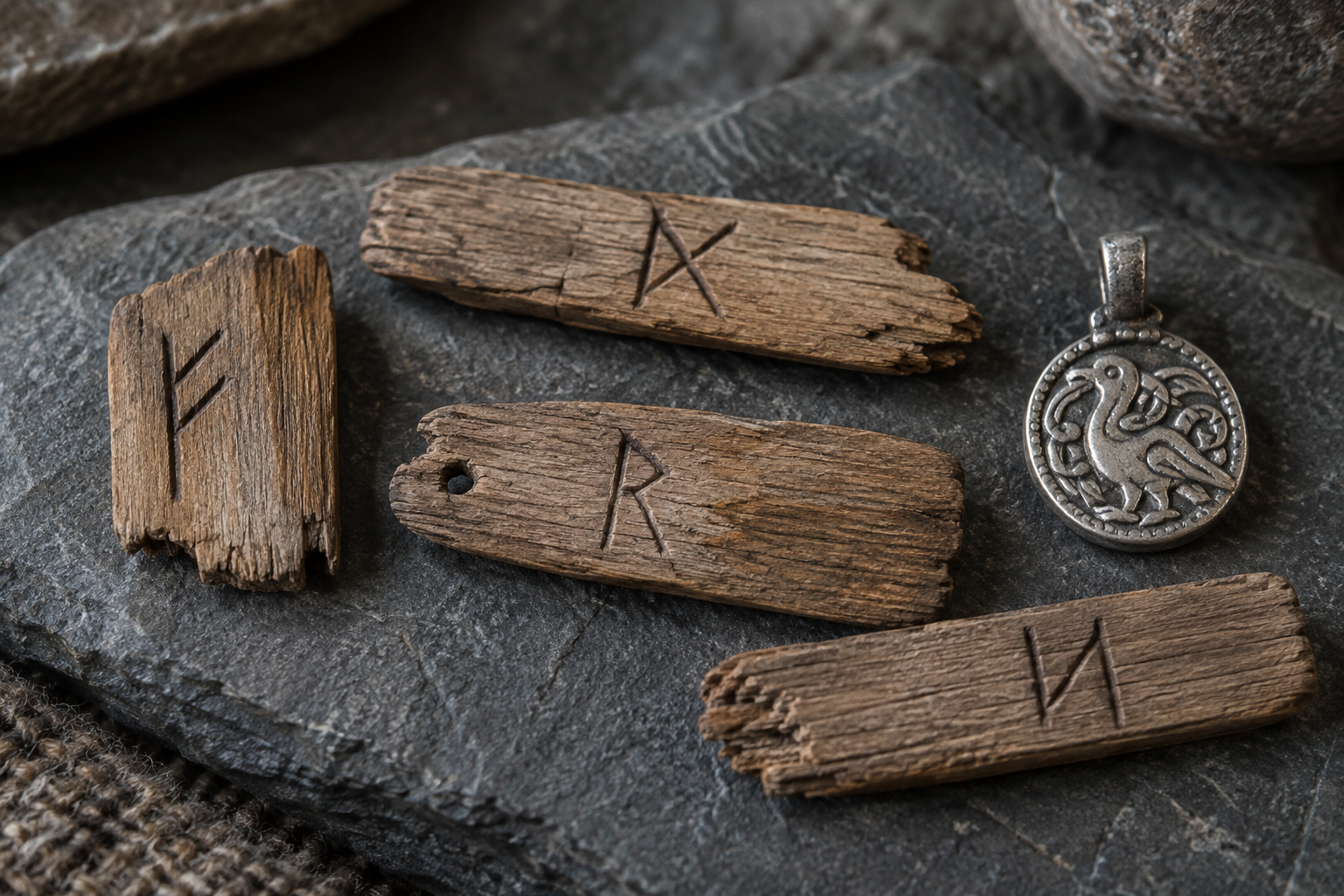
Meaning at a glance
Younger Futhark was the principal Viking Age rune row with sixteen characters; historically it functioned as a writing system, so modern spiritual assignments and mixing rune rows should not be treated as historically fixed.
Quick answer
Younger Futhark was the principal Viking Age rune row and consisted of sixteen signs; historically grounded Viking inscriptions should therefore use this shorter rune row rather than assuming the older twenty-four-character Elder Futhark or applying fixed modern spiritual meanings to each sign.
Historical evidence and cultural context
Archaeological and museum records identify the Younger Futhark as the dominant runic alphabet in Viking Age Scandinavia. The Swedish History Museum documents that the Younger Futhark had sixteen signs and was used across Viking Age Scandinavian contexts. The National Museum of Denmark likewise lists the Younger Futhark as the active rune row in Viking Age sources.
When scholars and museums refer to the Younger Futhark, they mean the runic inventory used in the Viking Age rather than earlier or later systems. The term 'Elder Futhark' refers to an older twenty-four-character row; the reduced sixteen-sign system is the historically attested form that appears in dated Viking Age inscriptions. Because one rune in Younger Futhark could cover several sounds, the runes are best understood as letters used in a phonetic writing system rather than as one-to-one icons with fixed symbolic meanings, a point emphasized by the Swedish History Museum.
It is important to keep cultures and periods distinct. The Younger Futhark is Scandinavian and Viking Age in provenance; other Germanic rune rows, later medieval rune variants, or modern neo-pagan systems are different cultural phenomena and should not be conflated with Viking Age inscriptions without explicit evidence.
Documented historical usage versus modern personal interpretations
Museum documentation treats runes primarily as elements of a writing system. The Swedish History Museum stresses that runes functioned as writing and that one rune could represent multiple sounds, which affects how inscriptions are read and understood. That means historical runic inscriptions are linguistic evidence, not a catalogue of universal symbolic formulas.
Modern practices have layered new interpretations onto runic signs. Contemporary spiritual and symbolic uses—assigning specific talismanic powers to particular runes, treating each rune as a fixed 'meaning', or combining runes into modern bindrunes with intended magical effects—are modern interpretations, not direct continuations of a single, uniform Viking belief. These modern meanings can be meaningful and legitimate for wearers today, but they are interpretive choices rather than historical certainties.
For clarity: the existence of carved runes on objects does not by itself prove that every rune carried a prescriptive magical function in the Viking period; museum evidence supports reading runes as writing, and care is needed when moving from historical inscription to contemporary symbolic use.
How Younger Futhark motifs appear in jewelry
Younger Futhark runes and rune-inspired designs are common motifs in contemporary jewelry. Designers use single rune characters on pendants, rings, bracelets, and engraved metalwork, and they sometimes create composite 'bindrunes' by overlaying characters to form a single decorative symbol. These treatments are largely modern design choices: they reference historical forms but are adapted for aesthetics, wearability, and personal meaning.
Gemstones and materials are chosen more for style and durability than for any documented historical association with a particular rune. Bronze, silver, and gold are used to evoke historical metalwork; leather and woven cords echo textile traditions. Some designers pair runes with particular stones because the stone’s modern symbolic associations match the buyer’s intent, but that pairing is a contemporary convention rather than a historically attested Viking practice.
When museums reproduce rune forms on modern objects, they tend to prioritize accurate shapes drawn from inscriptions. Outside museum contexts, creators vary: some use authentic Younger Futhark signs, others mix Elder Futhark characters or invent stylized forms. If historical accuracy matters to you, look for pieces that specify they use the Younger Futhark forms and reference archaeological sources.
Practical and respectful selection or gifting guidance
If you or the person you are gifting to care about historical accuracy, choose pieces that explicitly identify the rune row as Younger Futhark and, where possible, cite the inscription forms or a reputable reference. Makers who provide images of reference inscriptions or explain their design decisions allow you to check whether the rune shapes match the historical sixteen-sign row documented by institutions such as the Swedish History Museum and the National Museum of Denmark.
Respect personal and cultural considerations. Ask the recipient whether they prefer a historically faithful object, a modern symbolic interpretation, or a purely decorative piece. Some people appreciate an explanatory card that notes whether the rune is a historically attested form or a modern adaptation and clarifies any contemporary meaning the giver intends to attribute.
Avoid making definitive historical claims about magical powers or fixed spiritual meanings when presenting a gift. Because museums and runological scholarship treat runes as writing with varied phonetic values and uses, it is more accurate to frame rune jewelry as meaningful either linguistically, aesthetically, or personally rather than as objects with guaranteed ancient magical properties.
Practical factors matter too. Choose durable metals for daily wear, check workmanship at bezel settings if the piece includes stones, and select a size and style appropriate to the wearer’s life and dress. If buying from a craftsman, ask about their research and whether they follow Younger Futhark forms or blend traditions; transparent makers are easier to evaluate for historical fidelity.
Takeaway
Younger Futhark is the historically attested sixteen-sign rune row of the Viking Age and should be treated as the appropriate rune inventory for Viking Age inscriptions. Museums such as the Swedish History Museum and the National Museum of Denmark document the Younger Futhark’s use and emphasize that runes were a writing system where one sign could represent multiple sounds. Modern spiritual and decorative uses of runes are valid personal choices but are interpretive overlays rather than direct historical continuations, so select and gift rune jewelry with accuracy, respect, and clear communication about what the piece is meant to represent.
Frequently asked questions
What is the Younger Futhark?
Younger Futhark is the sixteen-sign rune row documented as the principal runic inventory used in Viking Age Scandinavia, according to the Swedish History Museum and the National Museum of Denmark.
How many runes are in the Younger Futhark?
The Younger Futhark contains sixteen characters; museum records note this reduction from the older twenty-four-character Elder Futhark.
Were Younger Futhark runes used as magical symbols in the Viking Age?
Museum evidence treats runes primarily as a writing system, and the Swedish History Museum emphasizes that runes were used for writing and could represent several sounds; assigning fixed magical meanings to each rune is a modern interpretive practice rather than a uniform historical fact.
What is the difference between Elder Futhark and Younger Futhark?
Elder Futhark is an older twenty-four-character rune row, while Younger Futhark is the shorter sixteen-sign row that became dominant in Viking Age Scandinavian inscriptions; they are different historical systems.
Can I wear Younger Futhark runes as jewelry?
Yes. Many contemporary pieces use Younger Futhark forms for pendants, rings, and bracelets. If historical accuracy matters, choose makers who identify their rune forms as Younger Futhark and explain their sources.
How can I gift rune jewelry respectfully?
Ask whether the recipient prefers historically accurate or modern symbolic pieces, choose a reputable maker who explains their use of Younger Futhark shapes if you want accuracy, and avoid presenting the item as carrying guaranteed ancient magical powers; offer context about whether the meaning is historical or a contemporary interpretation.
How do I know a rune sign is historically accurate?
Look for pieces where the maker cites a source or shows images of the runic forms they used. Museums such as the Swedish History Museum and the National Museum of Denmark document Younger Futhark forms and usage which can serve as references for comparison.
Sources and further reading
- Runes in everyday life — Swedish History Museum
- Sources of the Viking Age — National Museum of Denmark