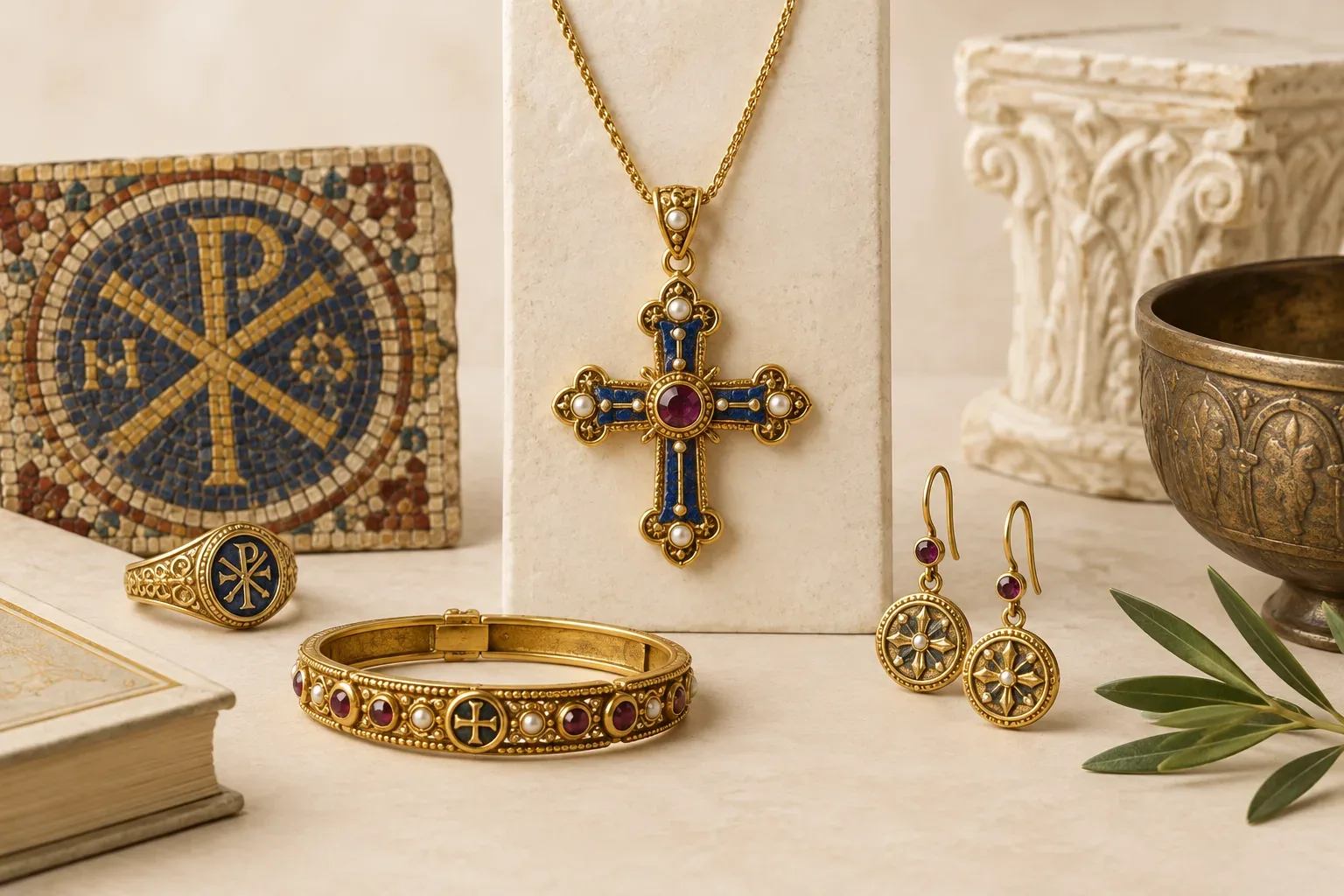
Meaning at a glance
This article explains the documented history and shifting contexts of Byzantine jewelry symbols, distinguishes period-specific evidence from later personal meanings, shows how motifs and gemstones appear in jewelry, and offers respectful buying and gifting guidance.
Quick answer
Explain the documented history and changing contexts of the byzantine jewelry symbols motif, separate cultural or religious evidence from later popular interpretations, and give practical guidance for choosing and wearing the motif in modern jewelry.
What the historical evidence shows
When we speak of "Byzantine jewelry symbols" we mean motifs and ornament associated with the Byzantine world as recorded in museum collections and scholarship: religious signs tied to Eastern Christianity, imperial imagery, and classical motifs reused in late antique and medieval ornament. The Victoria and Albert Museum frames these developments as part of a long history of jewellery that shifts with social, religious, and political change, and its material collections and interpretive notes are the basis for the broad historical claims in this article.
Museum evidence demonstrates that jewellery from Byzantine contexts was often made to convey identity and status as well as piety. Objects conserved and described by institutions such as the Victoria and Albert Museum show that pendants, rings, and textiles were used to display Christian symbols, monograms, and portrait-like devices in ways that aligned with public and private roles. The V&A's history of jewellery highlights how styles and materials—gold, gem inlay, pearls, and enameled surfaces—were chosen for their visual impact and social meaning rather than for any single universal symbolic code.
It is important to note the limits of surviving evidence. Most of what museums present as "Byzantine" comes to us through a mix of archaeological finds, portable objects kept as relics or heirlooms, and later attributions. Museum catalogs and exhibitions reconstruct likely uses and meanings from context, manufacture technique, and comparisons with contemporary texts and art. The V&A's work emphasizes changing social contexts and the material culture approach rather than asserting that any single motif carried the same meaning for every wearer across the Byzantine world.
Which motifs are documented and how they were used
The motifs most commonly associated with Byzantine jewellery in museum descriptions include Christian symbols such as crosses and Christograms, images and monograms that reference imperial authority, and reused classical ornament like vine scrolls or stylized animals. The V&A's overview of jewellery history explains that these motifs appear across object types—pendants, crosses, rings, and reliquary-like containers—where they functioned as public statements of faith, markers of rank, or protective emblems depending on context.
Museum objects frequently show these motifs executed in precious metal with gem inlay or enamel to increase legibility and value. Documentation emphasizes that the choice of motif often worked together with the object's form: a pendant cross read differently from the same cross set into a belt buckle or a ceremonial diadem. The combination of image, material, and wear-location is what offered meaning to contemporary viewers, according to the V&A's narrative of jewellery's social function.
Documented historical meanings versus later and modern interpretations
The V&A's history-based approach helps distinguish what the historical record supports from later re-interpretations. Historically documented meanings tend to be contextual and variable: a cross on a pendant is reliably a Christian marker in many Byzantine contexts, but whether it was primarily devotional, protective, or status-bearing depended on who wore it, where, and when. Museums infer these roles from object context, inscriptions, and parallels in contemporary art and texts rather than from a single fixed meaning.
By contrast, modern interpretations often project contemporary values onto Byzantine motifs. Collectors today might wear a stylized Byzantine cross as a heritage signifier, as a fashion statement, or as a talisman for personal protection. Those modern uses are legitimate personal meanings but they are not the same as the specific, documented uses reconstructed by museum scholars. In short, documented historical meanings come from object context and material analysis as described by the Victoria and Albert Museum; modern personal meanings arise from present-day identity, aesthetic preference, or spiritual practice and need not match the object's original social function.
How Byzantine motifs, gemstones, and techniques appear in jewellery today
Contemporary jewellers and vintage markets borrow Byzantine motifs in several recognizable ways. Designers may reproduce pendent crosses, medallion-like icons, and stylized classical ornament inspired by museum pieces, translating them into necklaces, rings, and brooches. The V&A's resources on jewellery history and gemstones explain that the visual language—use of gold, colored stones and pearl accents, and richly worked metal—remains an appealing source for makers who want a sense of weight and history.
Gemstones and materials commonly associated with Byzantine-influenced pieces today include warm-color stones and pearls, which museums note were historically prized for their luster and color. The V&A's A–Z of Gemstones provides background on how particular gems were valued in European and Mediterranean contexts, and how color and material were part of a jewel's communicative register. In modern pieces, the same visual effects are achieved with historically resonant stones, simulants, or treated gems, and consumers should take note of material disclosures when purchasing.
Authenticity, materials, and disclosure — a practical note
When buying Byzantine-style jewellery or objects described as "Byzantine," consider provenance and honest material disclosure. The Federal Trade Commission advises buyers to expect clear information about gem treatments, imitations, and lab-grown versus natural materials. If a seller claims an object is ancient or of a specific historic provenance, ask for documentation and for the seller to explain how that provenance was established. Museums such as the V&A document objects with careful provenance notes; private sales and reproductions may not.
Technical details matter for both value and care. Historically inspired jewellery may use modern techniques and treatments to achieve looks similar to museum pieces. Ask whether gems have been heat-treated or otherwise modified and whether metals are hallmarked. The FTC guidance on buying gemstones, diamonds, and pearls is a useful baseline for what sellers should disclose and what buyers should request when evaluating a piece.
Respectful selection and gifting guidance
Selecting Byzantine-inspired jewellery for yourself or as a gift benefits from attention to context and the recipient's values. If the motif has religious connotations—an Eastern Christian cross, for example—be mindful that it may carry spiritual significance for believers. A respectful approach is to learn what the symbol means to the intended wearer and, if the item is represented as antique, to confirm its age and provenance rather than assuming authenticity.
For gifts, consider the occasion and the recipient's style. A small pendant inspired by Byzantine medallions can be a meaningful token of shared heritage or appreciation for historic craft without claiming formal religious intent. When in doubt, choose pieces described clearly as "inspired by" or as modern interpretations rather than claiming direct continuity. Finally, include care and authenticity information with the gift: a short note about the motif's historical inspiration and any material disclosures will make the present both beautiful and informed.
Wearing and caring for Byzantine-inspired jewellery
Wearability is practical as well as symbolic. Heavier, richly worked pieces modeled on historical prototypes are visually striking but may be more fragile or require special settings to protect stones and enamel. Museum commentary emphasizes that materials determine both appearance and maintenance: pearls and certain gemstones need different care than modern simulants or treated stones. Ask about cleaning recommendations and storage before purchase.
If you plan to wear a historically styled piece often, prefer sturdy modern construction and clear material disclosure. For heirloom or antique pieces, consult a conservator or a reputable jeweller experienced with historical objects so cleaning and repairs do not damage original materials. Museums and professional jewelers can advise on conservation-friendly methods for long-term preservation.
Final considerations
Byzantine jewellery symbols have layered meanings: they are at once historical objects with specific social contexts and adaptable motifs for contemporary expression. The Victoria and Albert Museum offers the most relevant museum-backed framing used here: motifs must be read in object and cultural context, and jewellery history is a record of changing functions and tastes. Practical buying guidance comes from established consumer protection guidance such as the Federal Trade Commission's information on gem disclosure.
Approach Byzantine-inspired jewellery with curiosity about its history, attention to material truth, and respect for the cultural or religious significance it may hold today. That balance allows you to appreciate museum-informed authenticity while also making room for meaningful modern interpretations.
Frequently asked questions
Are Byzantine jewellery symbols always religious?
No. Museum evidence shows that many Byzantine motifs had religious significance in some contexts, but others functioned as markers of imperial authority, social status, or were decorative borrowings from classical art. The meaning depended on the object's context and the wearer.
How can I tell if a "Byzantine" piece is genuinely old?
Ask the seller for provenance documentation and for specific information about how age was determined. Museums provide careful provenance details for objects; private sellers should be able to explain the object's history and any conservation reports. If a claim of antiquity is important to you, consider an independent appraisal.
Do gemstones in Byzantine-style jewellery differ from modern gems?
Historically prized materials such as pearls and certain colored stones appear in museum collections, but modern pieces may use treated, lab-grown, or simulated gems to achieve similar looks. The Victoria and Albert Museum discusses historical gemstone contexts, and the Federal Trade Commission recommends asking sellers about treatments and the nature of the material.
Is it appropriate to gift a Byzantine cross to someone of another faith?
Be mindful: crosses and other explicitly religious motifs can carry spiritual meaning. If you know the recipient values the motif as cultural or aesthetic, a gift can be respectful. If you are unsure, choose a piece described as historically inspired rather than explicitly religious, or discuss it with the recipient first.
How should I care for a historically styled piece?
Care depends on materials: pearls and enamel require gentler handling than many modern settings. Ask the seller or a conservator about cleaning and storage recommendations. For antique items, consult a professional to avoid damaging original materials.
Where can I learn more about the history and materials of Byzantine jewellery?
Museum resources like the Victoria and Albert Museum's history of jewellery and its A–Z of Gemstones are good starting points, and consumer guidance from the Federal Trade Commission explains how to ask about gem treatments and authenticity.
Sources and further reading
- Bedazzled: A History of Jewellery — Victoria and Albert Museum
- An A-Z of Gemstones — Victoria and Albert Museum
- Buying Gemstones, Diamonds, and Pearls — Federal Trade Commission