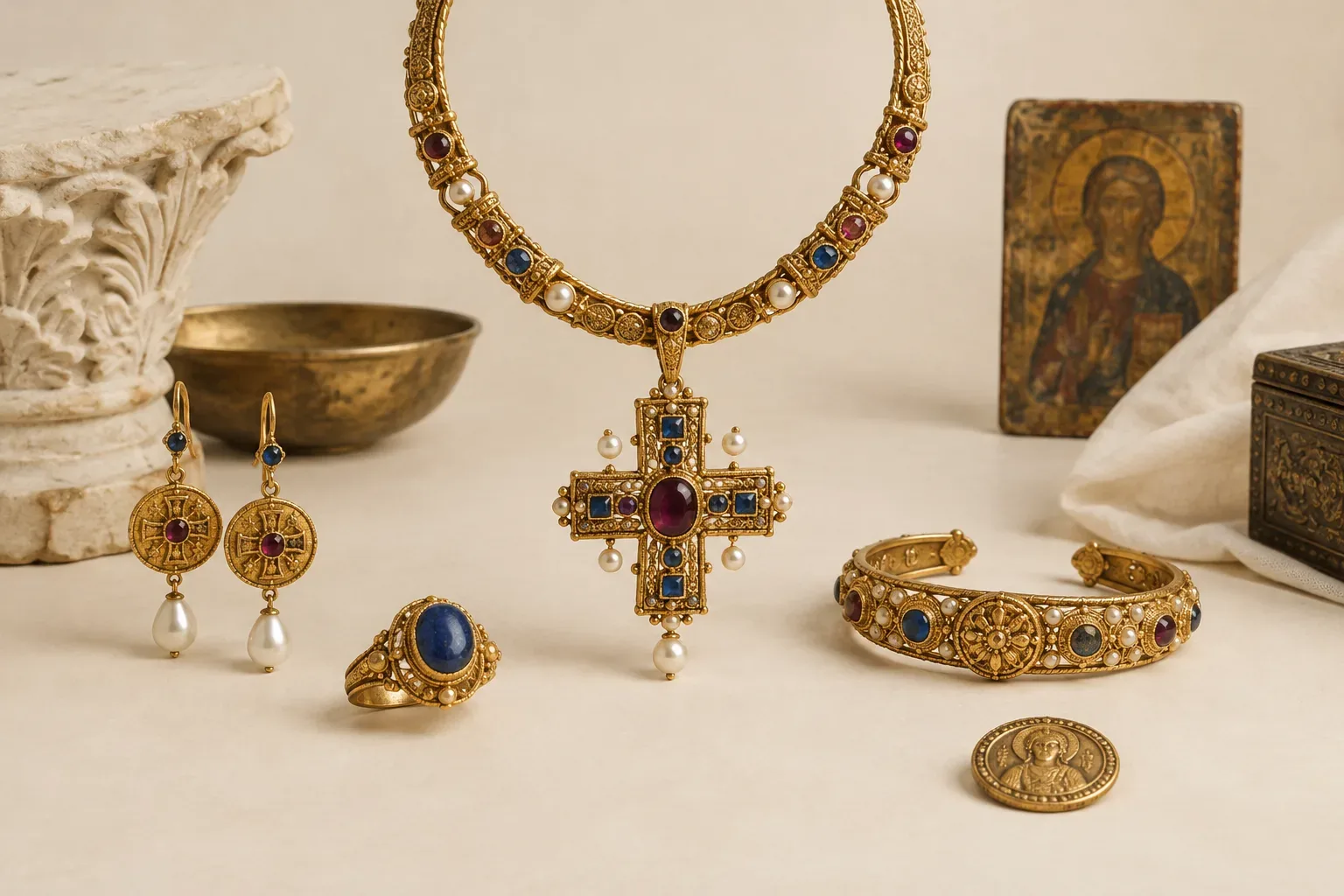
Meaning at a glance
Explain the documented history and changing contexts of the byzantine jewelry history motif, separate cultural or religious evidence from later popular interpretations, and give practical guidance for choosing and wearing the motif in modern jewelry.
What the historical evidence shows (and which cultures or periods it represents)
Our picture of Byzantine jewelry comes largely from objects preserved in museum collections, church treasuries, and archaeological assemblages, together with curatorial and scholarly work that interprets those finds. The Victoria and Albert Museum frames this broader narrative of changing social contexts and material use in its survey of jewellery history, and museum collections around Europe record pieces attributed to Eastern Roman or Byzantine contexts as examples of that period’s material culture. When I refer to “Byzantine” here I mean the style and social practices associated with the Eastern Roman courts, churches, and provincial elites documented by museum collections and scholarship, rather than a single unchanging set of practices across many centuries and regions.
Museum evidence shows continuity and change: some techniques and motifs derive from late Roman precedents, others reflect local workshop traditions across the eastern Mediterranean and beyond. Objects recovered in grave contexts, ecclesiastical settings, and court inventories (as presented in museum catalogues and exhibitions) provide primary evidence for how jewelry functioned in public, ceremonial, and private life. The Victoria and Albert Museum’s overview of jewellery history underscores that the social meanings of adornment change over time and between communities; what a particular brooch, pendant, or gemstone signified in a Byzantine court is not the same as modern fashion interpretations.
Materials and techniques documented in museum collections
Museum collections attributed to Byzantine or Eastern Roman contexts commonly show a small set of core materials and techniques. Gold is the dominant precious metal in the curated record because it survives well and was a visible marker of wealth and status. Workmanship documented in those collections includes fine filigree and granulation, use of enamel, inlaid stones, and settings that emphasize surface ornamentation as much as the gem itself. The Victoria and Albert Museum’s historical accounts of jewellery note how technical practices and decorative tastes are recorded across periods and collections, making the V&A an accessible reference for these materials and techniques.
Gemstones and organic materials appear repeatedly in the material record. Pearls, glass imitations, and a range of colored stones are visible in museum objects and in V&A teaching material about gemstones. The V&A’s A–Z of Gemstones is a practical resource for identifying common gem materials and understanding their historical contexts and trade. That guide helps explain how certain stones were valued or imitated, and why museums examine provenance and technique when attributing an object to a Byzantine context.
Surviving pieces also demonstrate conventional workshop practices: beads strung on threads, pendants with suspension loops for necklaces, and signet or intaglio rings made for personal wear. Enamel work and stone inlay are recurring features in public and religious objects, indicating both aesthetic priorities and technical capabilities in the workshops that served Byzantine elites.
Status, function, and daily wear in historical context
The curated evidence suggests Byzantine jewelry served multiple social functions. In museum descriptions and exhibitions, jewellery is consistently interpreted as a marker of wealth and social position, and as part of courtly display and ecclesiastical ornament. Items in cathedral treasuries and church settings are often richly decorated and used in liturgical display; non-liturgical jewelry from domestic or funerary contexts tends to show a wider range of quality and complexity, indicating different levels of access to luxury.
That said, museum collections also reveal objects that are clearly for everyday personal use: simple beads, small pendants, and rings that show wear. The presence of both ceremonial and everyday pieces in the record indicates that jewelry was woven into daily life as well as ceremonial dress. The Victoria and Albert Museum’s broader history of jewellery emphasizes that the same techniques and materials can circulate across contexts—highly ornate pieces for court or church and simplified versions for personal daily wear.
Documented meanings versus modern personal interpretations
It is important to separate the meanings supported by historical and archaeological evidence from later or modern meanings. Museum documentation can demonstrate that a specific object was used in a church, buried with a person, or listed in an inventory—these are concrete contexts that help historians infer intended function and status. For example, crosses and Christian iconography on jewelry are documented in ecclesiastical and devotional contexts in museum records, and scholars use that provenance to interpret religious function.
By contrast, many contemporary claims about symbolic powers (for instance, that a particular gem confers specific spiritual benefits rooted in Byzantine practice) are modern interpretations or part of retail narratives unless a contemporaneous textual or archaeological source supports them. The Victoria and Albert Museum’s scholarship encourages readers to read objects in their changing social contexts and cautions against projecting modern beliefs directly onto historic pieces.
How motifs, gemstones, and traditions appear in Byzantine jewelry
Motifs in the museum record linked to the Byzantine sphere include Christian symbols such as crosses and stylized iconography, imperial monograms and motifs associated with court display, geometric patterns, and stylized animals or vine patterns derived from late antiquity and Mediterranean decorative repertoires. These motifs can appear as inlaid enamels, engraved gems, pendants, and settings that make a surface visually complex.
Gemstones and organic materials appear in a variety of ways. Pearls are often shown as strings or as single droplets on pendants; colored stones may be cabochon-set or inlaid with metal partitions; glass was also used to imitate more costly gems in some pieces. The Victoria and Albert Museum’s A–Z of Gemstones explains historical usages and identification, and that resource is helpful when trying to understand how a stone’s material properties relate to appearance and durability in surviving objects.
Techniques such as cloisonné enamel, inlay, granulation, and filigree create distinct looks that recur in museum collections and later revival pieces. The physical presentation—how a motif or stone is framed, suspended, or combined with other elements—shapes both the object's visual impact and its social reading in historical sources.
Practical and respectful guidance for choosing or gifting Byzantine-style or historic pieces
When selecting or gifting a piece that draws on Byzantine motifs or is marketed as “Byzantine” style, be clear about whether the object is an original antique, a modern piece inspired by historic forms, or a reproduction. Provenance, documentation, and expert assessment are essential for antiques; museums and reputable dealers will provide contextual information. For general guidance on buying gemstones and disclosure of treatments or imitations, consult the Federal Trade Commission’s consumer advice, which recommends asking about treatments, lab reports, and return policies.
Respect religious and cultural meanings. If a piece prominently displays sacred symbols such as crosses, Byzantine iconography, or items clearly intended for devotional use, consider the recipient’s beliefs and the occasion. In some contexts such pieces are appropriate as meaningful gifts; in others, they may be more suitable for collectors or as decorative items rather than personal devotional objects. If in doubt, ask the recipient or choose a design that references aesthetic features without appropriating sacred forms.
For antiques, condition and conservation matter. Avoid aggressive cleaning or repair at home; consult a conservator or an experienced jeweler for assessment. For modern jewellery inspired by Byzantine motifs, examine materials and workmanship, and ask whether stones are natural, treated, or imitations. The FTC’s guidance explains why disclosure matters and what questions consumers should pose when assessing gemstones, diamonds, and pearls.
Finally, consider scale and usability. Historic pieces were sometimes made for specific dress or ceremonial contexts; a highly ornate pendant or heavy collar may be striking but impractical for daily wear. If you intend the piece for everyday use, select items with secure settings, comfortable weight, and repairable construction.
Closing thoughts
Byzantine jewelry history is best read through the surviving objects and the careful contextual work of museums and scholars. The Victoria and Albert Museum’s materials and guides offer a reliable starting point for understanding how materials, techniques, and motifs functioned in historical contexts. Separating what the objects themselves document from later or modern interpretations helps preserve both historical accuracy and contemporary respect for cultural and religious meanings. When buying or gifting, use provenance and material disclosure as practical checks, and choose pieces with sensitivity to the recipient’s beliefs and lifestyle.
Frequently asked questions
What did Byzantine jewelry signify historically?
Museum records indicate that jewelry associated with Byzantine contexts often signalled wealth, rank, and religious identity. Objects in ecclesiastical treasuries appear in liturgical or devotional contexts, while secular pieces in court and funerary contexts function as visible markers of social status. These interpretations derive from the object provenance and curatorial study rather than a single fixed symbolic code.
Which materials are documented in Byzantine jewelry collections?
Curated objects attributed to Byzantine contexts commonly include gold, enamel, pearls, glass, and a range of colored stones. The Victoria and Albert Museum’s A–Z of Gemstones is a useful reference for identifying and understanding the historical use of particular gem materials in museum collections.
How can I tell if a piece is a genuine antique or a modern reproduction?
Ask for provenance, documentation, and condition reports from the seller or a qualified appraiser. Reputable dealers and museums will provide context for an object’s origin. For gemstones and treatments, consult laboratory reports and the Federal Trade Commission’s guidance on disclosure of treatments and imitations.
Is it respectful to wear jewelry with Byzantine religious motifs?
Respect depends on context and the wearer’s intent. Items with clear devotional iconography may carry specific religious meaning; consider the recipient’s beliefs and the social setting before gifting or wearing such pieces. When in doubt, choose designs that reference historic aesthetics without appropriating sacred forms.
How should I care for an antique Byzantine-style piece?
Avoid aggressive cleaning or amateur restoration. For any antique or delicate item, seek advice from a conservator or an experienced jeweler. Proper storage, gentle cleaning under professional guidance, and documented condition assessments help preserve historic pieces.
Sources and further reading
- Bedazzled: A History of Jewellery — Victoria and Albert Museum
- An A-Z of Gemstones — Victoria and Albert Museum
- Buying Gemstones, Diamonds, and Pearls — Federal Trade Commission