Meaning at a glance
Explain the documented history and changing contexts of the celtic jewelry symbols motif, separate cultural or religious evidence from later popular interpretations, and give practical guidance for choosing and wearing the motif in modern jewelry.
Quick answer
Celtic jewelry symbols are a set of motifs—knotwork, spirals, triskele-like forms, the so-called Trinity knot, and related designs—that appear in early medieval Insular art and later revival jewellery. The documented historical record shows these designs in a range of secular and Christian objects, and their meanings have shifted between centuries and cultures. Modern meanings commonly attached to those motifs are often personal or revival-era inventions rather than directly documented ancient beliefs. This article separates what the surviving material evidence supports from later popular interpretations, explains how motifs and gemstones appear in jewellery, and offers practical advice for choosing and gifting these pieces respectfully.
What the historical evidence actually shows
Material evidence for many motifs now called "Celtic" is primarily archaeological and art-historical: decorative patterns appear in Insular art—manuscripts, stone carving, and metalwork—created in the early medieval British Isles and Ireland. The Victoria and Albert Museum frames these changes in style and use as part of jewellery's long social history, where meanings and functions shift depending on context and period.
The surviving corpus includes objects made in different cultures and periods: Insular (early medieval) metalwork and illuminated manuscripts from the British Isles; later medieval Christian monuments and crosses where similar motifs were sometimes reused; and much later, 19th- and 20th-century pieces produced during the Celtic Revival and in modern popular crafts. Each of these contexts is distinct, and the same motif can mean different things in each setting. The material record rarely preserves a single, fixed symbolic vocabulary across those centuries.
Which cultures and periods should you distinguish?
Early medieval Insular art: This is the origin point for many knotwork and spiral patterns now labeled "Celtic." These designs appear in illuminated manuscripts, metal fittings, and ornamented stone, and were created within monastic and workshop cultures across Ireland and parts of Britain.
Medieval Christian reuse: In later medieval contexts, some motifs were incorporated into crosses, reliquaries, and liturgical objects. In these cases the surrounding Christian iconography gives clearer evidence for a religious reading, but that does not automatically apply to all designs or earlier contexts.
Celtic Revival and modern craft: From the 19th century onward, designers, antiquarians, and popular makers adopted and adapted early designs. The Revival period and subsequent popular jewellery traditions produced many explicit symbolic readings and sentimental uses for motifs that are not directly attested in the early medieval record.
Documented historical meanings versus modern interpretations
Documented historical meanings are limited and context-dependent. Where motifs appear on Christian objects with textual or iconographic accompaniment, such as crosses or liturgical metalwork, contemporary makers and users are more likely to have intended known religious meanings. The Victoria and Albert Museum emphasises that jewellery’s social role and the meanings assigned to objects change over time, which means explicit ancient glosses are rare.
Modern personal or popular interpretations—ideas such as "knotwork equals eternal love" or that a particular spiral guaranteed fertility—often come from revival-era symbolism, modern marketing, or individual sentiment. These interpretations can be meaningful for the wearer, but they should be presented as contemporary readings rather than documented ancient beliefs. No single symbolic meaning is universal across the historical record.
How motifs, gemstones, and traditions appear in jewellery
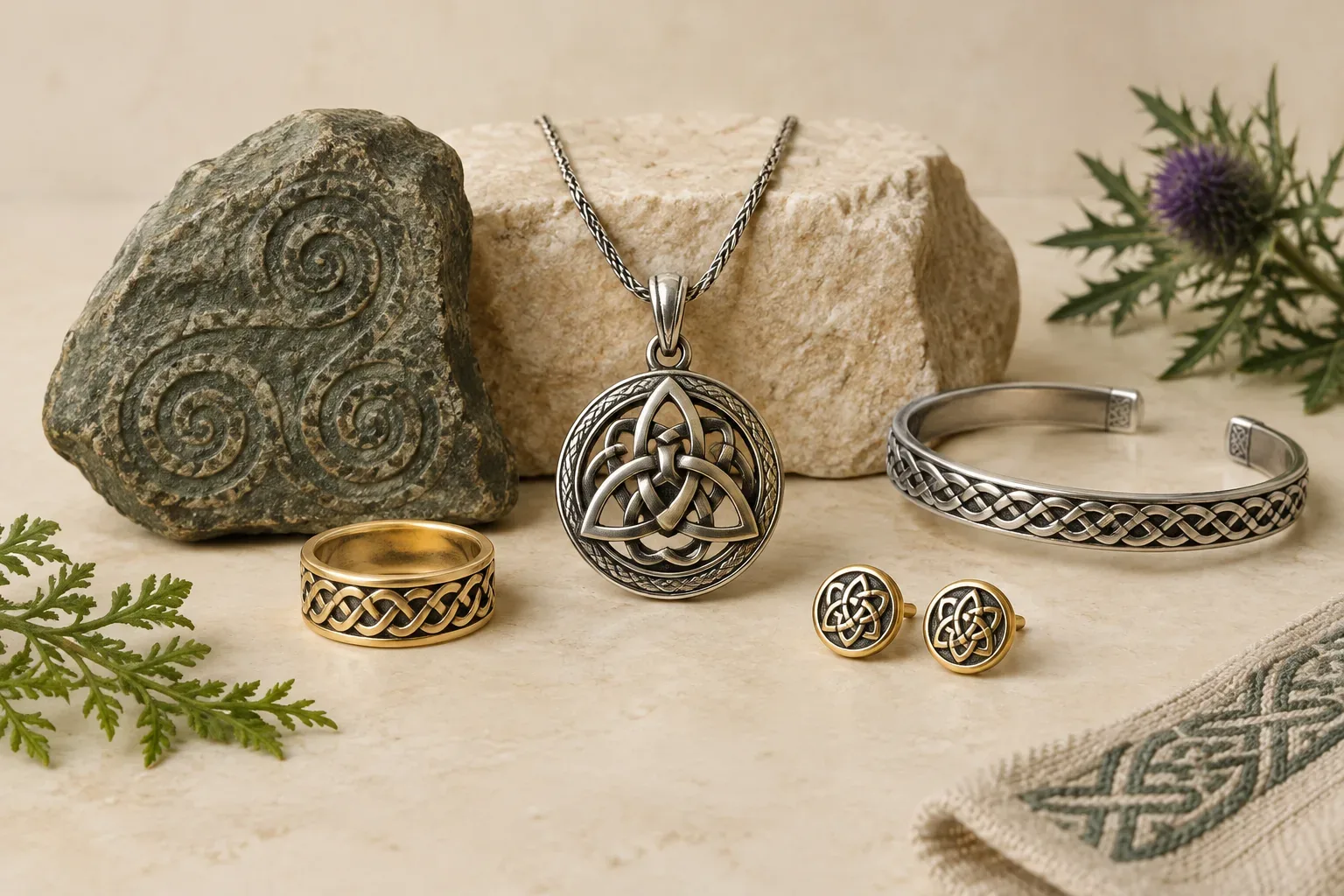
Motifs traditionally associated with the label "Celtic" are applied in many forms of jewellery: engraved or cast knotwork on rings, pendants featuring spirals or triskele compositions, and cross forms that combine ring and arms. In historic objects, such decoration was achieved by engraving, inlay, filigree, or hammering techniques appropriate to metalwork workshops of the time. In modern jewellery, those motifs are often reproduced by casting, laser engraving, or hand-carving in a wide range of metals.
Gemstones have long been used alongside ornament. The Victoria and Albert Museum’s resources on gemstones emphasise that different stones have been chosen historically for color, status, and availability. In contemporary pieces marketed as "Celtic," green or blue stones are frequently used because they evoke associations with Ireland or the Atlantic, but those color associations are modern aesthetic choices rather than fixed ancient prescriptions. If you are selecting gemstones, consider both the visual effect and the material’s provenance and treatment history.
Buying and material considerations
When purchasing jewellery with historical motifs, look for clear information about materials, maker, and any treatments. The Federal Trade Commission’s guidance on buying gemstones, diamonds, and pearls stresses disclosure: sellers should state whether a gemstone has been treated, dyed, or is an imitation. Transparent information about metal content, stone treatments, and maker provenance lets you assess value and authenticity.
For historically informed pieces, provenance matters if you value the object as an antique or as a continuation of a craft tradition. For contemporary pieces, craftsmanship and the maker’s respect for cultural sources are important. Many buyers also choose local or ethically produced items to support contemporary makers and reduce environmental impact.
Selecting and gifting Celtic-motif jewellery respectfully
Respectful selection begins by acknowledging that motifs have different histories and can carry cultural weight for living communities. If you are choosing a piece for someone with Irish, Scottish, Manx, or broader Gaelic heritage, consider whether the person values traditional meanings or prefers contemporary design. Ask about heritage and preference when appropriate and avoid assuming a symbol’s meaning.
Match the motif to the wearer’s intention. If you want to convey a specific sentiment, discuss that openly rather than relying on presumed ancient meanings. Choose appropriate materials and a scale the recipient will wear comfortably. If the piece is intended to reference a religious belief, make sure you understand the symbol’s role within that faith context and that the recipient is comfortable with that association.
When gifting to someone outside the culture, frame the gift as an appreciation of the motifs’ aesthetic and historical associations rather than as a claim to cultural belonging. If the recipient is researching their own heritage, include resources or a note explaining the distinction between historical evidence and modern meanings so the piece can be appreciated in context.
Care, authentication, and further research
Care for metal and gemstones according to the material. Basic guidance from museum and gem resources is to avoid harsh chemicals and to store pieces separately to prevent scratching. For antique pieces, consult a conservator or reputable dealer before attempting any cleaning.
If provenance or authenticity is important to you, ask sellers for documentation, photographs of hallmarks, and any conservation records. For gemstone purchases, request clarity about treatments and any certificates. The Federal Trade Commission highlights that sellers should disclose treatments and imitations, and reputable dealers will provide clear written information.
To learn more about a particular motif or object, follow museum catalogues, academic publications, and makers who specialise in historically informed designs. The Victoria and Albert Museum’s materials on jewellery history and gemstones are useful starting points for understanding how motifs and materials functioned in different historical contexts.
Final note
Celtic jewellery symbols are powerful because they link historic visual traditions with personal meaning today. The surviving evidence shows varied uses across time and context; modern readings add layers of personal and cultural significance. Selecting or gifting such jewellery is best done with attention to provenance, clear information about materials, and respect for the distinction between documented historical contexts and contemporary interpretation.
Frequently asked questions
Are Celtic knots originally symbols of eternal love?
No single historical source identifies knotwork in early medieval Insular art as an explicit symbol of "eternal love." The archaeological and art-historical record shows knotwork used as decorative ornament in a variety of secular and Christian contexts. The specific reading of knotwork as eternal love is a modern interpretation that emerged mainly during later revival and popular usage.
Do specific gemstones have traditional Celtic meanings?
There is no single, consistent catalogue of gemstone meanings from the early medieval Insular sources. Museums such as the Victoria and Albert Museum explain that gemstones have been chosen historically for color, rarity, and status. Modern associations—such as green stones evoking Ireland—are contemporary aesthetic choices rather than documented ancient prescriptions.
How can I tell if a piece is an authentic antique or a modern reproduction?
Ask the seller for provenance, photographs of hallmarks, and any conservation or purchase records. Reputable dealers will provide documentation. For gemstones, request information about treatments and certificates. The Federal Trade Commission recommends that sellers disclose treatments, enhancements, and whether a stone is an imitation.
Is it respectful to wear Celtic motifs if I am not of Irish or Gaelic heritage?
Wearing such motifs can be respectful when done with awareness. Acknowledge the origins of the designs, choose pieces made by contemporary makers when possible, and avoid asserting cultural belonging. If a motif has a clear religious function, ensure you understand and respect that context before wearing it publicly.
Where can I learn more about the history behind a specific motif?
Start with museum publications and catalogues that treat Insular art and jewellery history. The Victoria and Albert Museum’s resources on jewellery history are a useful beginning. For deeper study, seek specialist books or academic articles on Insular art and medieval metalwork, and consult makers who specialise in historically informed designs.
What should I ask a seller when buying Celtic-style jewellery?
Request clear information about the materials, any gemstone treatments, maker provenance, and whether the item is new or antique. Ask for measurements, metal hallmarks, and return policies. Transparent answers will help you evaluate authenticity, value, and whether the piece fits the intended meaning or occasion.
Sources and further reading
- Bedazzled: A History of Jewellery — Victoria and Albert Museum
- An A-Z of Gemstones — Victoria and Albert Museum
- Buying Gemstones, Diamonds, and Pearls — Federal Trade Commission