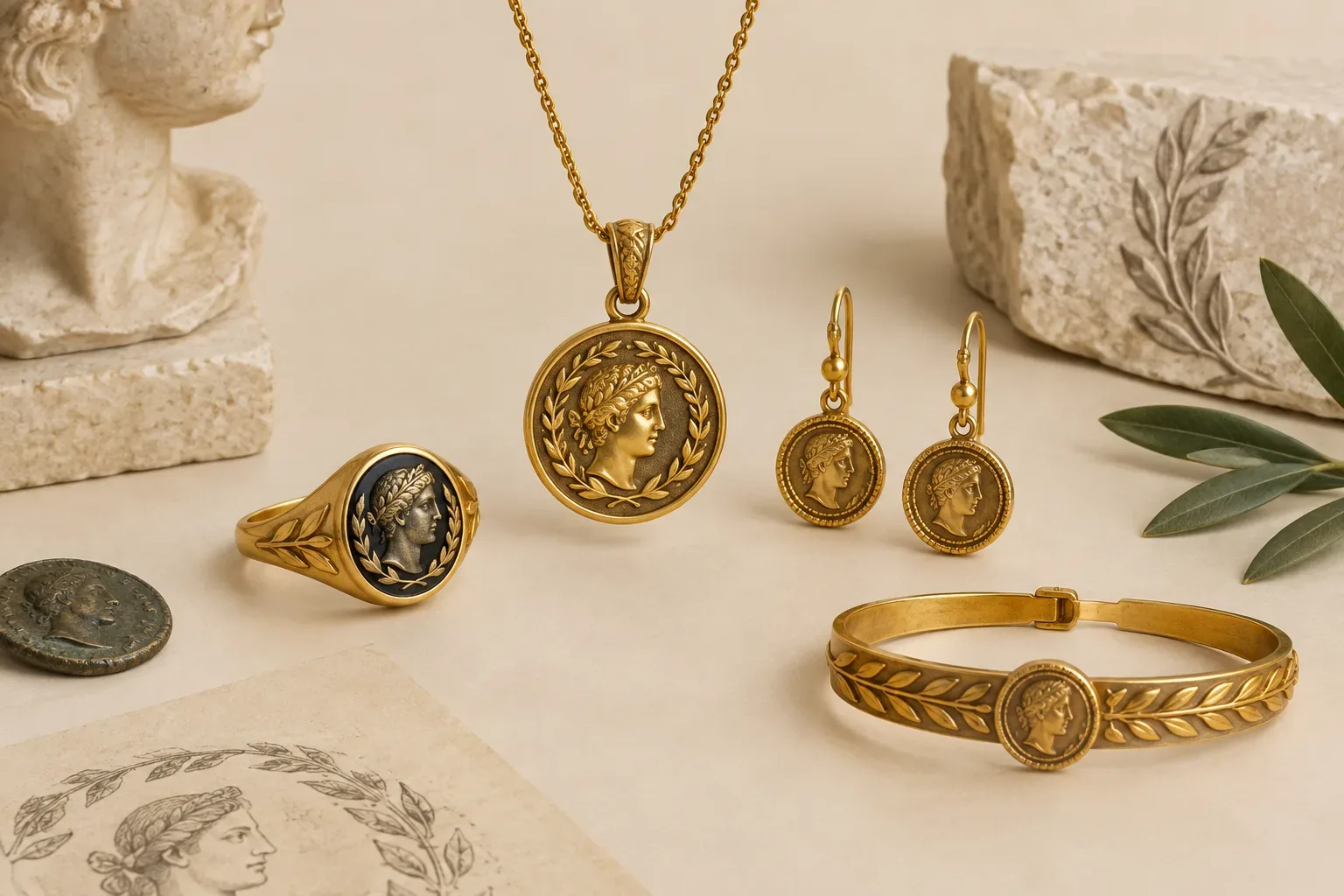
Meaning at a glance
Explain the documented history and changing contexts of the ancient roman jewelry identification motif, separate cultural or religious evidence from later popular interpretations, and give practical guidance for choosing and wearing the motif in modern jewelry.
What we can document about Roman jewelry and motifs
Museum collections and jewelry histories show that Roman jewellery—made and used across the city of Rome and the provinces during Republican and Imperial periods—varied widely in materials, subject matter and social role. The Victoria and Albert Museum frames jewellery history as a record of changing social context, meaning that similar shapes or motifs can have different uses or values across time and place. Surviving objects and archaeological finds therefore give us evidence about what motifs appear and how they were used, but this evidence must be read alongside find context and comparative material.
From those museum-backed studies, common kinds of Roman jewellery in collections include metal rings and finger rings set with carved gems (intaglios and cameos), necklaces and pendants, brooches and fibulae used as dress fasteners, and personal amuletic items. Motifs carved into gems and metal commonly reproduce portraits, gods and mythological scenes, religious symbols, civic or military emblems, and geometric or naturalistic ornament. These recurring images reflect tastes, identities and practices recorded in museum catalogues and surveys of jewellery history rather than a single, uniform symbolism.
How scholars and museums date and place Roman pieces
Dating and cultural attribution rely on multiple lines of evidence. Museums and historians compare stylistic features such as portraiture style, gem-carving technique, mounting and joinery, and overall design vocabulary with securely dated examples from archaeological contexts. The Victoria and Albert Museum and similar institutions emphasise examining style together with documented provenance and context, because single features can be reused or revived in later hands.
Because jewellery styles evolve gradually and are often copied, a ring or gem with classical imagery is not automatically ancient Roman; it could be a later revival or modern reproduction. For confident dating you need find context or scientific analysis; museum practice is to treat provenance and stylistic comparison as primary evidence and to seek laboratory testing when necessary.
Documented historical meanings versus modern interpretations
Where museums can document meaning, it is most often in social function rather than a single symbolic translation. In Roman contexts, jewellery served to display wealth and status, to mark civic or military identity, and sometimes to act as an amulet or funerary good. These interpretations come from archaeological contexts, ancient texts and museum studies that link object types and imagery to social role rather than to a one-word meaning.
Modern buyers and wearers frequently ascribe personal or contemporary meanings—romance, protection, national pride, or spiritual significance—to motifs borrowed from Roman art. Those modern meanings are valid personal choices, but they are different from the documented uses recorded by museums. The Victoria and Albert Museum's approach to jewellery history stresses that meanings change across time and communities, so it is important to keep historical evidence and modern personal interpretation distinct.
Common Roman motifs and how they appear in jewellery
Portraiture: Rings and signet-type gems often show likenesses, busts or idealised faces used for private identification or display. On mounted gems these portraits are usually carved in intaglio or cameo technique and set within a metal bezel on a ring or pendant.
Deities and mythological scenes: Gods, myth episodes and symbolic animals appear on gems and plaques. These scenes can be narrative when small figures are carved into hardstone gems, or emblematic when a divine figure stands alone on a pendant or brooch.
Civic and military imagery: Eagles, standards and other emblems of office or achievement are recorded on personal items and dress accessories and sometimes indicate a wearer’s affiliation or rank.
Amuletic symbols: Objects used to protect or bring good fortune are present across the Roman world, sometimes in the form of small pendants or engraved gems whose imagery is believed by contemporary users to confer benefit. Museums emphasise that the interpretation of protective function is drawn from stringing typology and contextual association rather than a single textual decree.
Gemstones and technique: Hardstone gems, glass imitations, and cut precious stones are all found in Roman-period jewellery. The Victoria and Albert Museum’s resources on gemstones note that different materials were chosen for colour, cost and carving properties, and that carved intaglios and cameos were especially prized in personal rings.
Common mislabels and how they happen
There are three frequent reasons items are mislabelled. First, later revival styles copy Roman motifs—19th-century revival jewellery, for example, deliberately imitated classical forms—so a classical-looking piece can be Victorian in date rather than Roman in origin. Second, modern makers create reproductions or fantasy pieces using ancient imagery without clear marking. Third, commercial listings sometimes stretch language for marketing, calling a modern piece 'Roman style' or 'inspired by Roman' when it is not ancient.
To reduce mislabelling, museums and experienced dealers rely on provenance, comparative stylistic study and material evidence. The Victoria and Albert Museum’s approach to jewellery history highlights changes in social meaning over time, which is also a warning that aesthetics alone are an unreliable indicator of antiquity.
How gemstone identification and disclosure affect labeling
Gemstones and their imitations matter for both identification and value. The Victoria and Albert Museum’s A–Z of Gemstones explains how gem type, cutting and carving influence how a gem was used. The Federal Trade Commission advises that sellers must disclose common treatments and imitations when selling gemstones today, and that buyers should be told whether a stone is natural, synthetic, treated or an imitation.
Because Roman-period objects may include glass or treated stones designed to mimic more expensive gems, disclosures and laboratory reports are especially important when assessing age and authenticity. Modern reproductions can use contemporary treatments and assembled components that differ materially from ancient practice.
Practical guidance for choosing or gifting Roman motifs respectfully
Decide what you want the piece to mean. If your priority is historical authenticity, look for documented provenance and independent assessment by museum professionals or qualified archaeologists. If you value the classical look for personal or aesthetic reasons, a modern piece described accurately as 'Roman-inspired' or 'classical motif' can be an ethical and wearable choice.
Buy transparently. Ask sellers for provenance, condition reports and any gem-treatment disclosures. The Federal Trade Commission’s consumer guidance emphasises that dealers should disclose treatments, imitations and whether a stone is natural or synthetic. For items sold as ancient, request written documentation and be cautious when provenance is missing.
Respect cultural context. Don’t assume a single symbolic meaning; acknowledge that imagery carried different meanings for ancient wearers. When gifting, explain whether the item is an authentic antiquity, a documented antiquity with provenance, or a modern piece inspired by Roman designs to avoid miscommunication about origin and significance.
Consider wearability and conservation. Ancient jewellery was sometimes repaired or altered; genuine antiquities should usually be treated as museum objects and worn sparingly. If daily wear is intended, modern reproductions that copy Roman motifs are often more practical and allow the recipient to enjoy the design without risking a fragile original.
When to seek expert help
If an item is offered as ancient Roman and the price or provenance suggests it might be genuine, seek an expert assessment before purchase. Museums, qualified antiquities specialists and reputable dealers can advise on stylistic and material indicators; scientific testing and conservation reports provide further confirmation when needed.
If you already own a piece you believe to be Roman, consult a conservator or museum professional before cleaning or wearing it regularly. Handling and improper cleaning can damage archaeological materials and harm their information value.
Frequently asked questions
How can I tell if a ring is genuinely ancient Roman?
Look for documented provenance, archaeological find context, and an independent condition or authenticity report. Museums and specialists date items by comparing style, carving technique and metalwork with securely dated examples. If provenance is absent or unclear, treat the piece as possibly a later revival or reproduction and seek expert assessment before purchase.
Do specific Roman motifs have one fixed meaning?
No. Museums record that motifs functioned in different ways—display, identity, amulet or funerary use—depending on context. Modern wearers often assign new personal meanings, but those are contemporary interpretations rather than universally documented ancient meanings.
Are gemstones in Roman jewellery the same as modern gems?
Roman jewellery used many of the same gem types valued today, often carved as intaglios or cameos, and also used glass or imitations. The Victoria and Albert Museum notes differences in cutting and use; the Federal Trade Commission advises buyers today to request disclosure about treatments, synthetics and imitations when assessing a stone.
Is it respectful to wear Roman-inspired jewellery?
Yes, provided you are transparent about whether an item is ancient or a modern piece inspired by Roman design. Respectful use means acknowledging provenance and avoiding false claims about antiquity when gifting or displaying such pieces.
What should I ask a seller when buying an item described as 'ancient Roman'?
Request documentation of provenance, a condition or authenticity report, information on materials and any gem treatments, and the seller’s return policy. If the seller cannot provide reliable documentation, consider the piece a styled reproduction rather than a verified antiquity.
Sources and further reading
- Bedazzled: A History of Jewellery — Victoria and Albert Museum
- An A-Z of Gemstones — Victoria and Albert Museum
- Buying Gemstones, Diamonds, and Pearls — Federal Trade Commission