Meaning at a glance
Treat ancient Roman–style jewelry as a revival form: understand what museums document about materials and contexts, separate historical meanings from modern personal symbolism, check material disclosure and treatments, and choose or gift pieces with cultural respect and accurate provenance.
What the historical evidence shows (and how we know it)
Museum collections and curatorial summaries provide the best-verified record for how jewellery functioned in past societies. The Victoria and Albert Museum places such objects in changing social and material contexts and documents how styles, materials, and uses shift across time and place. Use museum catalogues and reputable institutional summaries when you want to know what is documented rather than assumed.
Identifying cultures and periods precisely
When you read labels or seller descriptions, be precise about the culture and period being referenced. "Roman" may mean the city of Rome in the Republican period, the Roman Empire in the first centuries BCE and CE, or later regions influenced by Roman art and material culture. The V&A organizes jewelry history by changing social context, and its approach is useful: treat "ancient Roman" as a historical category that should be anchored to archaeological provenance and museum scholarship rather than a vague stylistic tag.
If a seller markets a piece as a direct ancient find, ask for documentation: where and when it was found, which excavations or museum record it belongs to, and whether it has published provenance. If the item is a modern revival or historically inspired design, the seller should say so. Revival pieces can reference Roman forms without being archaeological objects; both are legitimate markets but require different expectations.
Documented historical meanings versus modern interpretations
Documented historical meanings come from archaeological context, contemporary texts, and museum interpretation. For example, museums like the Victoria and Albert Museum emphasize how jewellery signified status, identity, or fashion in particular periods. Those documented functions—status display, personal ornament, or signet use—are specific claims about the past and should be presented as such.
Modern personal or popular interpretations—such as assigning uniform spiritual powers or universal symbolism to a motif—are different. Contemporary wearers and designers often repurpose Roman motifs for personal reasons: aesthetic preference, family heritage, or modern symbolic associations. Those modern meanings are valid for the wearer but should not be conflated with what is documented about ancient Roman practices. Make that distinction explicit when you research, buy, or gift.
How Roman motifs, gemstones, and traditions appear in jewelry
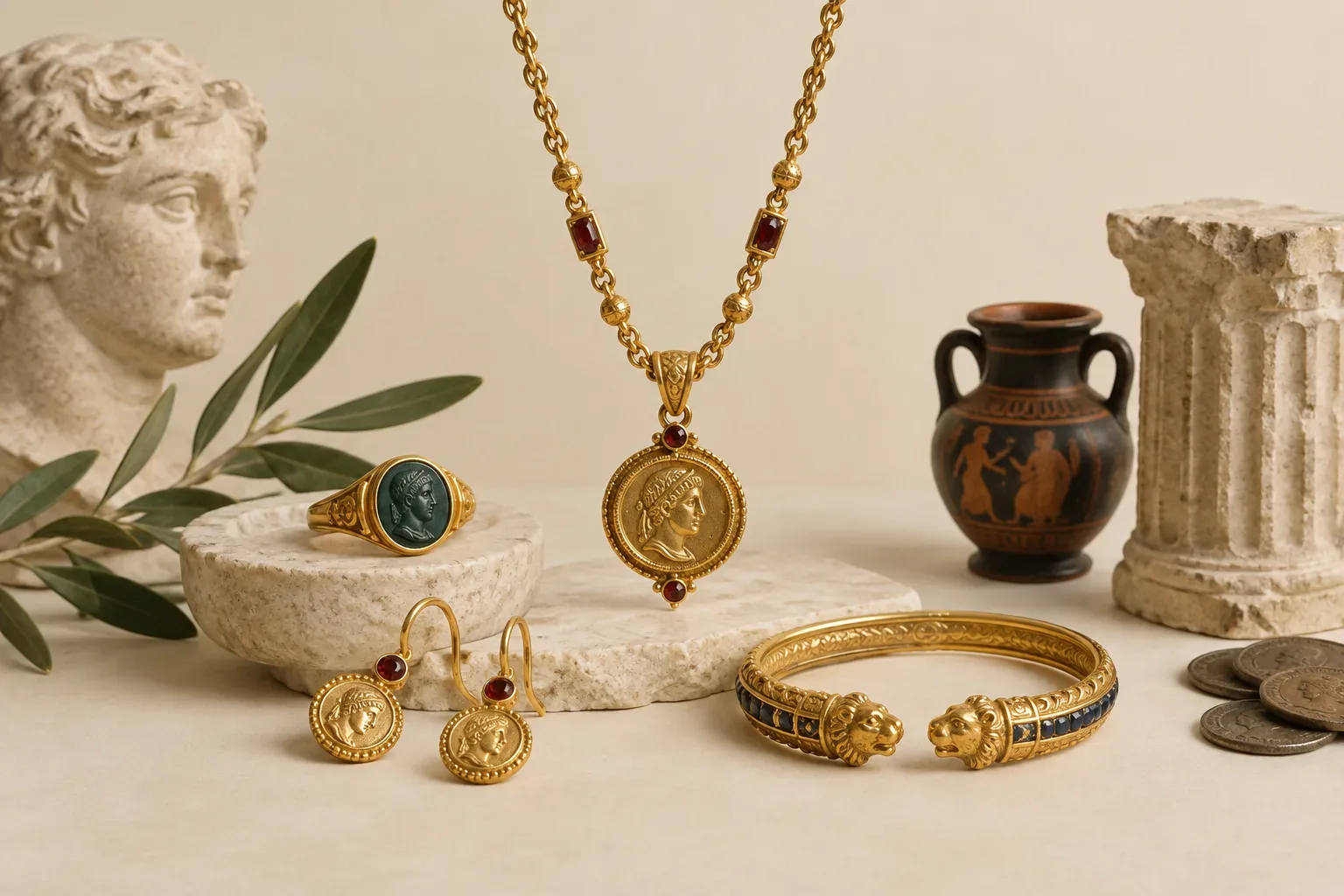
Roman-inspired jewellery appears in several ways: faithful archaeological reproductions, modern reinterpretations that mix ancient motifs with contemporary metals and settings, and pieces that borrow a single element such as an engraved intaglio, laurel motif, or classical profile cameo. Museums present these categories differently, but all three are common in the marketplace.
Gemstones associated with classical-style jewellery are common in both ancient and modern pieces. The Victoria and Albert Museum's A–Z of Gemstones provides context for how specific stones have been valued and used across history; that resource is useful when assessing whether a gem type is period-appropriate or a modern fashion choice. Modern stones may be heat-treated, dyed, or synthetically produced; such treatments affect value and should be disclosed.
Materials, treatments, and what to ask sellers
Ask sellers to state clearly whether a piece is ancient, a reproduction, or inspired by Roman design. If the object is ancient, request published provenance or conservation records. If it is modern, ask about maker, materials, and treatments. The Federal Trade Commission offers consumer guidance on disclosure for gemstones, diamonds, and pearls; commercial sellers should comply with disclosure norms about treatments, imitations, and enhancements.
Specific questions to ask include: What metal is used and is it hallmarked? Are the stones natural, treated, or synthetic and are treatments disclosed? If the piece is claimed to be ancient, can the seller provide documentation or an expert report? If the item is a reproduction, does the description say whether it is a faithful copy, an inspired reinterpretation, or a mass-produced fashion piece?
Practical and respectful selection and gifting guidance
Be clear about your intention before you buy. If authenticity and historical accuracy matter—for a collection, a museum loan, or serious study—prioritize pieces with verifiable provenance and condition reports. If the item is a modern gift meant to honor classical style, choose reputable makers who explain their creative approach and respect the cultural source.
When gifting, avoid presenting a modern revival as an ancient object. Explain the context: whether the ring echoes a Roman signet style, whether the necklace borrows classical motifs, or whether the bracelet is a contemporary artisan’s interpretation. That honesty prevents accidental cultural or scholarly misrepresentation and shows respect for the original context.
Consider the recipient’s relationship to the culture represented. If you are giving jewellery that references a historical culture for reasons of heritage, ask about family traditions and sensitivities. If the recipient has a particular faith or cultural background that overlaps with Roman iconography, choose designs they will understand and appreciate rather than items likely to offend or confuse.
Care, conservation, and ethical choices
Treat genuine ancient objects as cultural heritage that requires specialist conservation. Museums advise that archaeological metal and gem work can be fragile; professional cleaning or repair is appropriate only when recommended by a conservator. For modern reproductions or new jewellery inspired by Roman forms, follow standard metal and gemstone care but also ask the maker about recommended maintenance.
Consider ethical sourcing. If a gemstone or metal has no clear disclosure about origin or environmental and labor practices, ask questions. The FTC guidance underscores the importance of transparent disclosure for materials and treatments; buyers should expect similar transparency about ethical sourcing from reputable sellers.
Final checklist before buying
Require clear language about whether an item is ancient, a reproduction, or inspired by Roman design. Seek provenance or certificates for archaeological objects. Confirm material and treatment disclosures for gemstones and metals as advised by the Federal Trade Commission. Prefer makers or dealers who situate the piece within accurate cultural and historical explanation, as recommended by museum documentation practices.
Frequently asked questions
How can I tell if a piece is actually ancient Roman?
Ask the seller for provenance, excavation records, or a published catalogue entry. Museums such as the Victoria and Albert Museum distinguish objects by archaeological context and published research; similar documentation should be available for items sold as authentic archaeological finds.
Is it acceptable to wear or gift revival Roman-style jewellery?
Yes; modern revival pieces are a legitimate form of design. Be transparent when gifting: explain whether the piece is a modern interpretation or an authentic antique, and consider the recipient’s cultural sensitivities.
What questions should I ask about gemstones and treatments?
Follow consumer guidance from the Federal Trade Commission: ask whether gemstones are natural, treated, or synthetic, and request disclosure of any enhancements or imitations. Treatment affects value and care, so sellers should be explicit.
Are certain motifs or symbols definitively Roman in meaning?
Avoid assuming universal meanings. Museums document how jewellery functioned in specific social contexts, but later cultures and modern wearers attach new meanings. Distinguish documented functions (as detailed in museum sources) from contemporary personal interpretations.
What should I do if considering an authentic archaeological object?
Prioritize provenance and conservation records, consult a qualified specialist or accredited dealer, and be aware that genuine archaeological objects may have legal and ethical considerations for sale or export that vary by country.
How should I care for a reproduction versus an authentic ancient piece?
Modern reproductions can usually be cleaned and maintained following maker instructions. Authentic archaeological objects are often fragile—seek a conservator’s advice before any cleaning or repair, following museum conservation best practice.
Sources and further reading
- Bedazzled: A History of Jewellery — Victoria and Albert Museum
- An A-Z of Gemstones — Victoria and Albert Museum
- Buying Gemstones, Diamonds, and Pearls — Federal Trade Commission