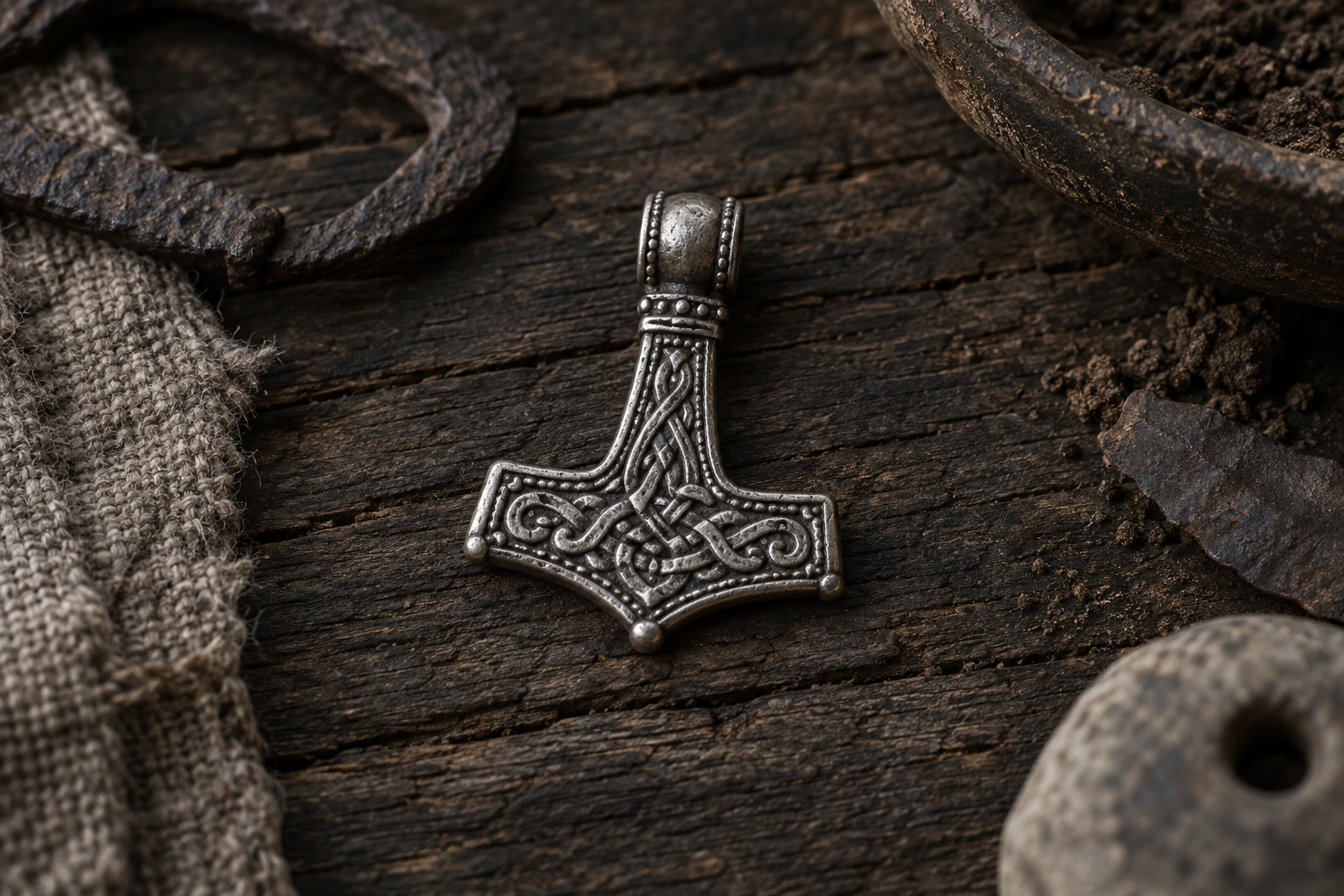
Meaning at a glance
Mjölnir jewelry draws on Viking Age Thor's-hammer pendants and can express attachment to Thor, protection, identity, or modern Norse-inspired style, but no single meaning applies to every wearer or archaeological find.
Quick answer
Mjolnir jewelry draws on Viking Age Thor's-hammer pendants and can express attachment to Thor, protection, identity, or modern Norse-inspired style, but no single meaning applies to every wearer or archaeological find.
What the historical evidence shows
Archaeological and museum records place hammer-shaped pendants in the Viking Age material record. The National Museum of Denmark describes Thor's-hammer pendants among the kinds of jewellery associated with people in the Viking Age, linking the hammer motif to that period's personal ornamentation and religious environment.
The hammer motif belongs to the Norse religious and mythic sphere that included the god Thor. The National Museum of Denmark treats Thor and Mjölnir as components of Norse religious tradition, and that cultural context is the clearest historical anchor for hammer pendants in northern Europe.
A further piece of documentary evidence comes from runic and inscribed objects. The Swedish History Museum preserves and documents rune-inscribed pieces—such as rune sheet 120571_HST—that demonstrate some amulets and small objects carried inscriptions invoking Thor, which scholars interpret as protective or devotional in function. That evidence shows that, for at least some artefacts, the hammer or related inscriptions were used in contexts understood by their owners as invoking a deity or protection.
Which claims are historical and which are modern interpretations
Documented historical claims supported in the museum record are limited and specific. Museums report that hammer-shaped pendants are a feature of Viking Age jewellery and that Thor and Mjölnir are part of Norse religion. They also document inscribed amulets that appear to invoke Thor for protection. Those are archaeological and object-based facts about finds and the cultural tradition to which they belong, as described by the National Museum of Denmark and the Swedish History Museum.
Modern claims about what a Mjölnir pendant 'means' to a wearer today are interpretive. Contemporary wearers attribute a variety of meanings to Mjölnir jewellery—personal devotion to Thor, a symbol of protection, an expression of Norse cultural or ethnic identity, a statement of interest in mythology, or simply an aesthetic choice inspired by Viking motifs. The National Museum of Denmark explicitly treats many of these present-day meanings as interpretations rather than single, fixed historical facts.
Because archaeological items do not come with a universal, explicit label of meaning, it is important to keep two things separate: the historical contexts and the contemporary practices. Museums provide the background that links the motif to the Viking Age and Norse religion; present-day symbolic uses are diverse and personally assigned by wearers, collectors, and communities.
How the Mjölnir motif appears in jewellery (historically and today)
Historically, the motif appears in the archaeological record as small hammer-shaped amulets and pendants worn on the person, which museum catalogs identify as part of Viking Age jewellery collections. Those objects were likely recognizable to their original owners as related to Thor or to protective practice, especially when accompanied by inscriptions invoking the god, as the Swedish History Museum documents.
In modern jewellery, the Mjölnir motif appears in many forms: faithful replicas inspired by archaeological finds, stylized or contemporary interpretations used as pendants and charms, and hybrid designs that pair the hammer shape with gemstones, modern metals, or other mythic symbols. Today’s designers often draw visual inspiration from museum examples but adapt scale, finish, and decoration to suit contemporary tastes and manufacturing techniques.
Because modern makers and wearers have different aims, Mjölnir pieces can range from historically minded reproductions intended for reenactors or collectors to fashion-forward pieces meant to signal an interest in Norse aesthetics. Some makers market Mjölnir jewellery as an amulet or talisman; others present it chiefly as an iconic motif in a broader jewellery collection.
Selecting or gifting Mjölnir jewellery: practical and respectful guidance
Think about the recipient’s relationship to the symbol. Ask whether they treat Norse symbols as religious, cultural, historical, or purely aesthetic. A piece given to someone for whom Thor is a living religious figure may have different emotional significance than one given as a fashion accessory.
Respect cultural and personal sensitivities. The Mjölnir motif belongs to a Norse mythic and religious tradition, and some people treat it with devotional respect while others view it as heritage or style. If you are uncertain about how a recipient feels, choose neutral designs or ask directly. Avoid assuming that the symbol has the same meaning for everyone in historically connected communities.
Select appropriate quality and style for the occasion. For a collector or reenactor, look for well-researched reproductions that reference museum examples; for everyday wear, select durable materials and a comfortable size. If the gift is for a ceremony or rite within a modern heathen or pagan group, verify the preferred maker, ritual customs, and any inscriptions that might be included.
Be mindful of inscriptions and modern political associations. Some symbols from the past have been appropriated in modern political contexts by fringe groups. When gifting a Mjölnir pendant with text or combined imagery, ensure the combination doesn’t unintentionally carry an extremist or exclusionary message.
If authenticity matters, ask the seller about provenance and craftsmanship. Museums document Viking Age finds; modern sellers should be able to describe whether a piece is a reproduction, an archaeological original (rare and typically in institutional settings), or an original design inspired by Norse motifs.
Concluding perspective
Mjölnir jewellery connects contemporary wearers to a clear archaeological and mythic lineage: Viking Age hammer pendants and the Norse god Thor, as represented in museum collections and runic inscriptions. That history provides context but does not prescribe a single meaning for every object or owner. Today, wearers infuse the motif with personal, cultural, aesthetic, or spiritual significance—and that diversity of meaning is as much a part of the symbol’s living history as its origins.
Frequently asked questions
Was Mjölnir always a sign of protection historically?
Some archaeological objects and inscriptions suggest that Thor or objects invoking him were used in protective contexts; the Swedish History Museum documents rune-inscribed pieces that appear to invoke Thor for protection. However, not every hammer-shaped pendant can be proven to have had the exact same function, and museums treat such uses as artefact-based evidence rather than universal prescriptions.
Are Mjölnir pendants authentic Viking artefacts or modern copies?
Both exist. Museums identify and catalogue Viking Age hammer pendants as part of the historical record, while modern makers reproduce or reinterpret the motif. If authenticity matters, ask for provenance and documentation from the seller; genuine archaeological finds are normally housed in museums or described in specialist catalogues.
Is it disrespectful to wear Mjölnir jewellery today if I am not Norse?
Wearing Mjölnir jewellery is not inherently disrespectful, but sensitivity is important. The motif has religious and cultural significance for some people today. Consider the recipient’s or your own intentions—religious, cultural, or aesthetic—and avoid combining the symbol with imagery or slogans that have been co-opted by exclusionary movements.
Can Mjölnir jewelry be used in modern religious practice?
Yes. Contemporary Norse-inspired religious communities and individuals sometimes use Mjölnir jewellery as a devotional object. Museums describe the hammer as part of Norse religious tradition, and some modern practitioners adopt the symbol in ways meaningful to them while acknowledging historical contexts.
How should I choose a Mjölnir pendant as a gift?
Consider the recipient’s relationship to the symbol, choose a size and material suited to daily wear if appropriate, and ask about preferred styles if you can. For collectors, seek historically informed reproductions; for someone who values personal meaning, consider an inscription or accompanying note that explains why you chose the piece.
Where can I learn more about the Viking Age background of Mjölnir?
Museum resources are a reliable starting point. The National Museum of Denmark provides information about Viking Age clothing and jewellery and treats Thor and Mjölnir as part of Norse religious tradition; the Swedish History Museum documents rune-inscribed objects that illuminate protective or devotional practices.
Sources and further reading
- The clothes and jewellery of the Vikings — National Museum of Denmark
- The Viking gods — National Museum of Denmark
- Rune sheet 120571_HST — Swedish History Museum