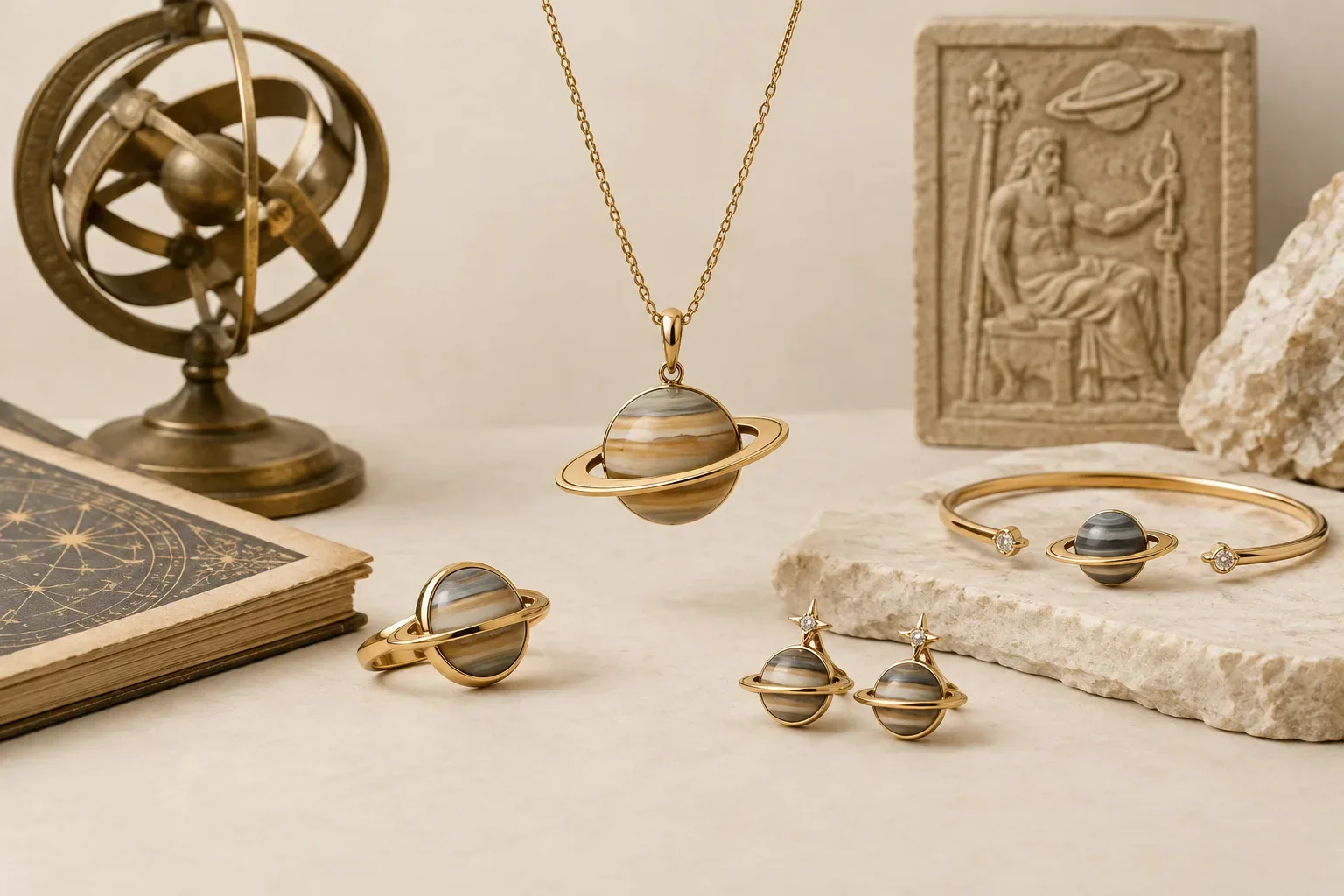
Meaning at a glance
This article explains the documented history and evolving contexts of the Saturn motif in jewelry, separates traceable historical uses from later personal interpretations, and offers practical guidance for selecting and caring for Saturn-themed pieces.
Quick answer
Saturn planet jewelry meaning rests on three linked facts: the motif stems from the planet's distinctive ringed appearance, historical jewellers and makers used celestial imagery at specific moments in decorative history, and contemporary wearers layer scientific, aesthetic, and personal symbolism onto those historic precedents. This article explains the documented history and changing contexts of the Saturn motif, distinguishes cultural evidence from modern interpretation, and gives practical advice for choosing and gifting such jewelry.
Documented historical evidence and cultural contexts
Museum collections and exhibitions show that celestial themes have recurred in jewelry as tastes, technologies, and cultural interests changed. The Victoria and Albert Museum documents how makers in different periods adopted stars, moons, comets, and other cosmic images to respond to fashion, scientific interest, and symbolic trends rather than as a single universal meaning. The V&A places these motifs within shifting social and stylistic contexts rather than as fixed religious statements (Victoria and Albert Museum).
In particular, late 19th- and early 20th-century decorative art movements captured renewed public fascination with astronomy and used celestial motifs in brooches, pendants, and rings. The V&A's historical surveys note that changes in gem-cutting, enamel techniques, and metalworking enabled makers to render planets and orbits with greater visual clarity, and that these techniques were applied when celestial imagery was fashionable in a given period (Victoria and Albert Museum).
These museum-based observations link the presence of planetary motifs to documented workshops, exhibition pieces, and surviving objects rather than to single shared meanings across cultures. Where a motif appears in a particular cultural or religious context, careful museum cataloguing specifies that provenance; general collections studies emphasise variety and changing social contexts (Victoria and Albert Museum).
Why Saturn? Basic astronomical origin of the motif
The visual cue for Saturn jewelry is straightforward: Saturn is recognisable for its rings, and rings are an easy visual motif for designers to echo in metalwork, settings, and composition. Designers translate that ringed silhouette into concentric metalwork, halo settings, and layered elements that signal 'planet' to a viewer without textual explanation.
Because the motif comes from an observable planetary appearance rather than from a single religious or cultural doctrine, its early use in decorative arts tends to follow fashions in art, science popularisation, and the technical ability to depict small, detailed forms in metal and gemstone.
Documented meanings versus modern personal interpretations
When museums describe celestial jewelry, they document provenance, technique, and the social moment in which the object was made. The V&A emphasises that meanings attached to motifs often shift: what a maker intended during one period can be reinterpreted later by wearers and markets (Victoria and Albert Museum).
Modern buyers and wearers commonly attribute new symbolic meanings to Saturn-themed jewelry—ideas about structure, time, limits, protection, or destiny are frequent personal interpretations—but these are contemporary layers and not necessarily traceable to the original maker or wearer. Responsible interpretation separates documented historical context from later personal or popular symbolism.
Where a piece explicitly carried an intended symbolic program at the time of making, museum documentation or a labelled provenance will record that. Absent such documentation, claims about historical spiritual or magical properties of a Saturn motif should be treated as modern reinterpretation unless primary historical evidence is cited (Victoria and Albert Museum).
How the Saturn motif and related traditions appear in jewelry
Jewellers translate Saturn’s ringed profile into several recognisable motifs. The simplest is a central stone or disk encircled by one or more thin metal or gem 'rings' to suggest planetary rings. Designers also use overlapping circles, openwork bands, or concentric bezels to achieve the same visual shorthand.
Materials and techniques vary across periods. Museum examples discussed by the V&A show makers using enamel, small pavé-set stones, and metal filigree to render minute orbit lines and halo effects where the available gem-cutting and enamel techniques allowed. Contemporary makers extend these options with laser-cut metal, 3D-printed forms, and modern gemstone cuts to suggest Saturn’s silhouette with high precision (Victoria and Albert Museum).
Gemstone choices historically reflected colour, cost, and technology. The V&A's gemstone surveys explain that historic gem selection was pragmatic—dark stones, smoky tones, or silvery metals can suggest Saturn’s subdued palette, while bright stones create a more celestial or cosmic look. Where specific gemstones are claimed to carry historical Saturn meanings, such claims should be checked against museum records and jewellery provenance (Victoria and Albert Museum; An A-Z of Gemstones).
Practical selection and respectful gifting guidance
Start by asking what the recipient values: do they prefer historically inspired pieces, contemporary minimalism, or jewelry tied to personal symbolism? If you are gifting a Saturn motif to mark an achievement, transition, or interest in science, explain your intention in a short note so the recipient understands whether the piece is meant as an aesthetic token, an encouragement, or a symbolic charm.
Respect cultural and religious difference. Because planetary motifs can be reinterpreted in different communities, avoid asserting a single, universal meaning or claiming the motif conveys specific spiritual powers unless you know the recipient’s beliefs and the historical provenance that supports such a claim. If the piece is heirloom or antique, check museum or seller documentation for provenance before ascribing historical purpose (Victoria and Albert Museum).
Consider practical factors: match metals and gemstone hardness to the wearer’s lifestyle and allergies, choose secure settings for active wear, and select sizes and chain lengths that fit how the recipient normally wears jewelry. If the gift is intended to be a long-term keepsake, consider higher-quality metals and reputable gemstones with documented treatment histories.
Care, authentication, and buying tips
When buying new gemstones or antique pieces, remember that treatments, simulants, and lab-grown stones exist and can affect value and care requirements. The Federal Trade Commission advises buyers to ask sellers for truthful disclosure about treatments, origin claims, and whether stones are natural, lab-created, or simulants, and to request receipts or certification where available (Federal Trade Commission).
For antiques, ask the seller for provenance, conservation records, and any previous restoration work. For modern pieces, request clear information on metals and plating, stone types, and any treatments. Proper documentation helps you understand both the object’s value and how to care for it safely.
Routine care depends on materials: keep metals and gems away from harsh chemicals, store pieces separately to avoid rubbing, and use cleaning methods appropriate for the stones and settings. For high-value or fragile historic pieces, consult a professional conservator rather than attempting aggressive cleaning.
Final note: Wear and meaning are personal
Saturn planet jewelry occupies a flexible place between a recognisable visual motif and a vehicle for personal meaning. Museum evidence shows that makers adapted celestial imagery to style and technology, not to a single symbolic program, and modern wearers freely reassign meanings based on interest, life events, or aesthetics (Victoria and Albert Museum).
If you want a historically grounded piece, prioritise documented provenance and museum-quality descriptions. If you want a personal talisman, choose a design and material that resonates with you or your recipient, and be clear about the contemporary meaning you intend to convey.
Frequently asked questions
What does a Saturn symbol traditionally mean in historical jewelry?
Historical records in museum collections show that makers used celestial imagery for a mix of aesthetic and topical reasons—fashion, scientific interest, and available techniques—rather than a single, universal symbolic meaning. When a specific symbolic program exists, it is normally recorded in provenance or museum documentation (Victoria and Albert Museum).
Are there specific gemstones that historically symbolised Saturn?
Museum discussions of gemstones indicate that historic gem choices were based on colour, availability, and cost. While some modern sources assign particular stones to planetary symbolism, you should check primary documentation for any historical claim about an individual gem’s traditional connection to Saturn (Victoria and Albert Museum; An A-Z of Gemstones).
How can I tell if a Saturn-themed piece is antique or a modern reproduction?
Ask the seller for provenance, condition reports, and any documentation of restoration. Museum-style descriptions, maker’s marks, hallmarks, and consistent ageing signs support antique attribution. If in doubt, request an independent appraisal or a condition report from a conservator (Victoria and Albert Museum).
What should I ask about gemstones when buying Saturn jewelry?
Follow the Federal Trade Commission’s guidance: ask whether stones are natural, treated, lab-grown, or simulants, and request written disclosure of treatments and origin claims where available. This information affects care, value, and ethical considerations (Federal Trade Commission).
Is it appropriate to give Saturn jewelry as a symbolic gift?
Yes, provided you are sensitive about the intended meaning. Explain your intention in a note to avoid misinterpretation and avoid asserting specific religious or spiritual powers unless you know the recipient’s beliefs and any historical provenance that supports such claims (Victoria and Albert Museum).
Sources and further reading
- Bedazzled: A History of Jewellery — Victoria and Albert Museum
- An A-Z of Gemstones — Victoria and Albert Museum
- Buying Gemstones, Diamonds, and Pearls — Federal Trade Commission