Meaning at a glance
Planet Earth jewelry meaning combines documented decorative and commemorative uses—recorded in museum histories—with newer personal and political interpretations; choose pieces informed by historical context, gemstone disclosure, and the recipient’s intent.
Quick answer
Planet Earth jewelry meaning is best described as a motif whose documented uses have been decorative, commemorative, or pedagogical in historical jewellery, while many modern meanings—environmentalism, global unity, travel, or personal spirituality—are contemporary personal interpretations. This article explains the evidence for historic uses, separates those from later symbolic readings, shows how the motif appears in jewellery, and gives practical advice for selecting and gifting pieces.
What the historical record shows (and what it does not)
Museum scholarship traces jewellery as a shifting social language rather than a stable set of fixed meanings. The Victoria and Albert Museum summarizes jewellery history as changing with technology, taste, and social context, with objects serving decorative, commemorative, status, and sentimental roles rather than single immutable symbolic definitions. Relying on that work helps keep historical claims grounded in documented use rather than later popular explanation.
Specific motifs related to the globe, maps, and terrestrial imagery appear in different periods and places as decorative or educational elements. For example, European jewellers and patrons incorporated miniature globes or painted map motifs into objects used for display, memento, or novelty purposes; the V&A places such uses within the broader history of fashioning small, curious, and instructive objects as part of jewellery traditions. That documentation supports treating globe motifs as historically decorative and commemorative rather than inherently religious or doctrinal.
Because museum summaries emphasize changing social contexts, they do not support a single universal meaning for an Earth motif across cultures. Where a particular culture imbued terrestrial images with specific religious or cosmological significance, those meanings must be shown by direct evidence from that culture; general surveys in museum histories show patterns of use but not every localized belief.
Separating documented historical meanings from modern interpretations
Documented historical meanings: Evidence collected and interpreted by institutions such as the Victoria and Albert Museum shows that globe and map motifs in jewellery were often decorative, commemorative, or curiosity pieces. Museums classify many of these objects alongside other small portable items made to display craftsmanship, commemorate travel or learning, or signal interest in exploration and science. Those documented uses are grounded in physical objects, inventories, and contemporary descriptions preserved in collections and scholarship.
Modern personal interpretations: In the 20th and 21st centuries, the planet Earth motif has been reinterpreted widely as a personal symbol. Common contemporary readings include environmental concern, global citizenship, a love of travel, scientific interest in astronomy or geography, and spiritual connections to the planet. These modern meanings are legitimate personal or cultural expressions but should be presented as recent, contingent layers of meaning rather than the only or original interpretations.
Identifying cultures and periods precisely
When discussing historical jewellery, it is important to specify the culture or period. Museum histories like those published by the Victoria and Albert Museum organize examples by time and place—European Renaissance and later early modern periods frequently show scientific and cartographic interests materialized in small objects, while 18th- and 19th-century European sentimental jewellery used lockets, miniatures, and novelty pieces to mark travel, learning, or personal memory. The V&A’s surveys are useful for placing globe and Earth motifs within these European contexts.
Outside Europe, representations of terrestrial order or cosmology appear in many traditions, but those require specific cultural evidence before attributing a particular symbolic meaning. The V&A’s general histories caution against extrapolating a single symbolic interpretation across different cultures and periods; scholarship must be consulted for each geographic and religious context individually.
How the planet Earth motif and related gemstones appear in jewellery
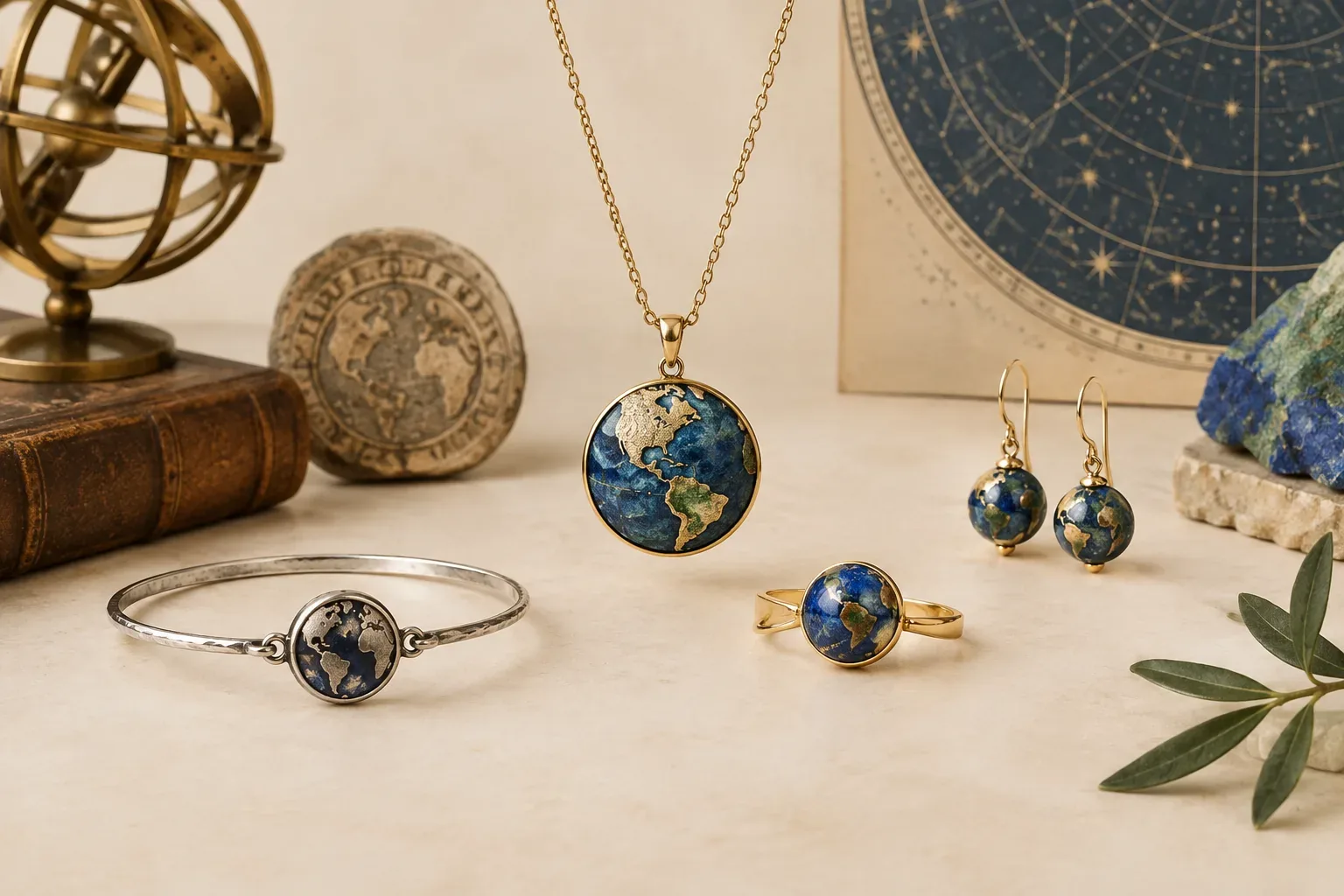
Motifs: The planet Earth motif appears in jewellery as tiny sculpted globes, map inlays, painted miniatures, enamelled spheres, and engraved or cast silhouettes of continents. Designs may emphasize blue-and-green colour schemes to suggest water and land, or they may use more stylized, abstract representations. Historically these forms could be worn as pendants, incorporated into chatelaines and lockets, or mounted as decorative beads and charms.
Gemstones and materials: Gemstones and materials that convey ‘earth’ visually are commonly used in modern designs. Blue stones such as sapphire, lapis lazuli, and turquoise can represent oceans, while green stones such as emerald, jade, and green tourmaline suggest land or vegetation. Iridescent materials such as opal or certain treated shells are sometimes chosen for their shifting colours and sense of living surface. The Victoria and Albert Museum’s A–Z of Gemstones provides historical context for how particular materials have been used in jewellery over time and helps identify stones by their traditional associations and visual properties.
Techniques: Enamel is a frequent historical technique for rendering detailed maps and tiny painted scenes, because it allows durable, colourful imagery at small scale. Contemporary makers may reproduce this effect with resin, printed miniatures, or hand-painted metal. Beads and carved miniatures can echo historic portable curiosities, while more literal three-dimensional globe pendants use casting and stone inlay.
Practical and respectful selection or gifting guidance
Match motif to intention: If you are buying planet Earth jewellery as a gift, be explicit about what you want it to signify for the recipient. For a gift that honours travel, scientific interest, or professional work in geography or environmental fields, choose a design that communicates that interest clearly—for example, a detailed miniature globe for a collector, or a simple blue-green pendant for someone who prefers subtlety.
Respect cultural meanings: Avoid assuming the motif is neutral in all contexts. If the design references a specific cultural map, language, or sacred image, research whether that imagery has particular significance to the culture or religion it represents. When in doubt, choose designs that express universal visual references (blue and green palettes, stylized globes) rather than appropriated or sacred symbols.
Check materials and disclosures: The Federal Trade Commission’s guidance on buying gemstones, diamonds, and pearls stresses the importance of disclosure for treatments, imitations, and enhancements. Ask the seller whether stones are natural, treated, or lab-grown and request written information about any treatments or fillings. The FTC guidance helps protect buyers and gift-givers from misunderstandings about value, durability, and care.
Consider production and ethics: If the recipient cares about environmental or social impact, ask about the maker’s sourcing practices, conflict-free certifications, or whether the piece is recycled or sustainably produced. Contemporary meanings tied to environmentalism may be better matched to jewellery with transparent, ethical production.
Practical care and verification tips
Ask for documentation: For valuable gemstones or antique pieces, request any available paperwork, such as gem lab reports, retailer statements about treatments, and clear descriptions of metal content. The FTC advises consumers to seek clear disclosure on treatments and imitations to make informed decisions.
Care by material: Care instructions depend on the materials. Enamel and painted miniatures need gentle handling to avoid abrasion; porous stones like turquoise are sensitive to chemicals and oils; opals require humidity care. When a piece combines delicate enamels, inset stones, or articulated elements, recommend professional cleaning and inspect settings periodically.
Appraisals and repairs: For antique or complex items, consider professional appraisal and use qualified conservators for major repairs so as not to damage historical materials or later, valuable custom work.
Final thoughts
Planet Earth jewellery meaning is layered. Museum research shows that historic globe and map motifs were used in decorative, commemorative, and pedagogical ways, while contemporary wearers freely add meanings that reflect modern values and identities. Treat historical evidence and modern interpretation as distinct layers: documented use comes from object records and scholarship such as that published by the Victoria and Albert Museum, while environmental, political, or spiritual readings are contemporary and variable.
When choosing or gifting, align the piece’s visual language, materials, and provenance with the intended meaning. Use available disclosures about gemstone treatments and sourcing to make an informed purchase, following the Federal Trade Commission’s guidance on buying gemstones and disclosing treatments. Thoughtful selection and clear communication will help ensure the planet Earth motif in jewellery conveys the meaning you intend.
Frequently asked questions
What is the basic meaning of planet Earth jewelry?
Historically, planet Earth motifs have functioned as decorative, commemorative, or pedagogical elements in jewellery collections as described by museum scholarship; modern wearers layer on meanings such as environmental concern, global identity, or love of travel. Treat historical evidence and contemporary interpretation as separate kinds of meaning.
Does planet Earth jewellery have a single universal symbolism?
No. Museum histories emphasize that jewellery meanings change with culture and period. A globe motif in one context may be a novelty or educational object, while in another it may be adopted as a statement about ecology or identity—meanings are not universal and should be assessed case by case.
Which gemstones are commonly used to represent Earth in jewellery?
Designers often use blue stones such as sapphire, lapis lazuli, or turquoise to suggest oceans and green stones such as emerald, jade, or tourmaline to suggest land. Iridescent opals and enamel can create shifting, planet-like surfaces. The Victoria and Albert Museum’s A–Z of Gemstones offers historical context for these materials.
How can I be sure a ‘planet’ gemstone is natural and not treated or simulated?
Ask the seller for clear information on whether a stone is natural, treated, lab-grown, or a simulant. The Federal Trade Commission advises consumers to require disclosure of treatments and imitations and to request any available written documentation before purchase.
Is it disrespectful to wear Earth-themed jewellery from another culture?
It can be if the piece incorporates sacred or culturally specific imagery. Research any symbols or maps used in the design and prefer neutral or stylized motifs when unsure. Choosing makers who explain their designs and sourcing helps avoid accidental appropriation.
How should I care for enamelled planet miniatures or painted map pendants?
Handle enamel and painted miniatures gently, avoid abrasive cleaners, and keep them away from harsh chemicals and high heat. For valuable or delicate pieces, seek professional cleaning and conservation advice to avoid damaging historic materials.
Sources and further reading
- Bedazzled: A History of Jewellery — Victoria and Albert Museum
- An A-Z of Gemstones — Victoria and Albert Museum
- Buying Gemstones, Diamonds, and Pearls — Federal Trade Commission