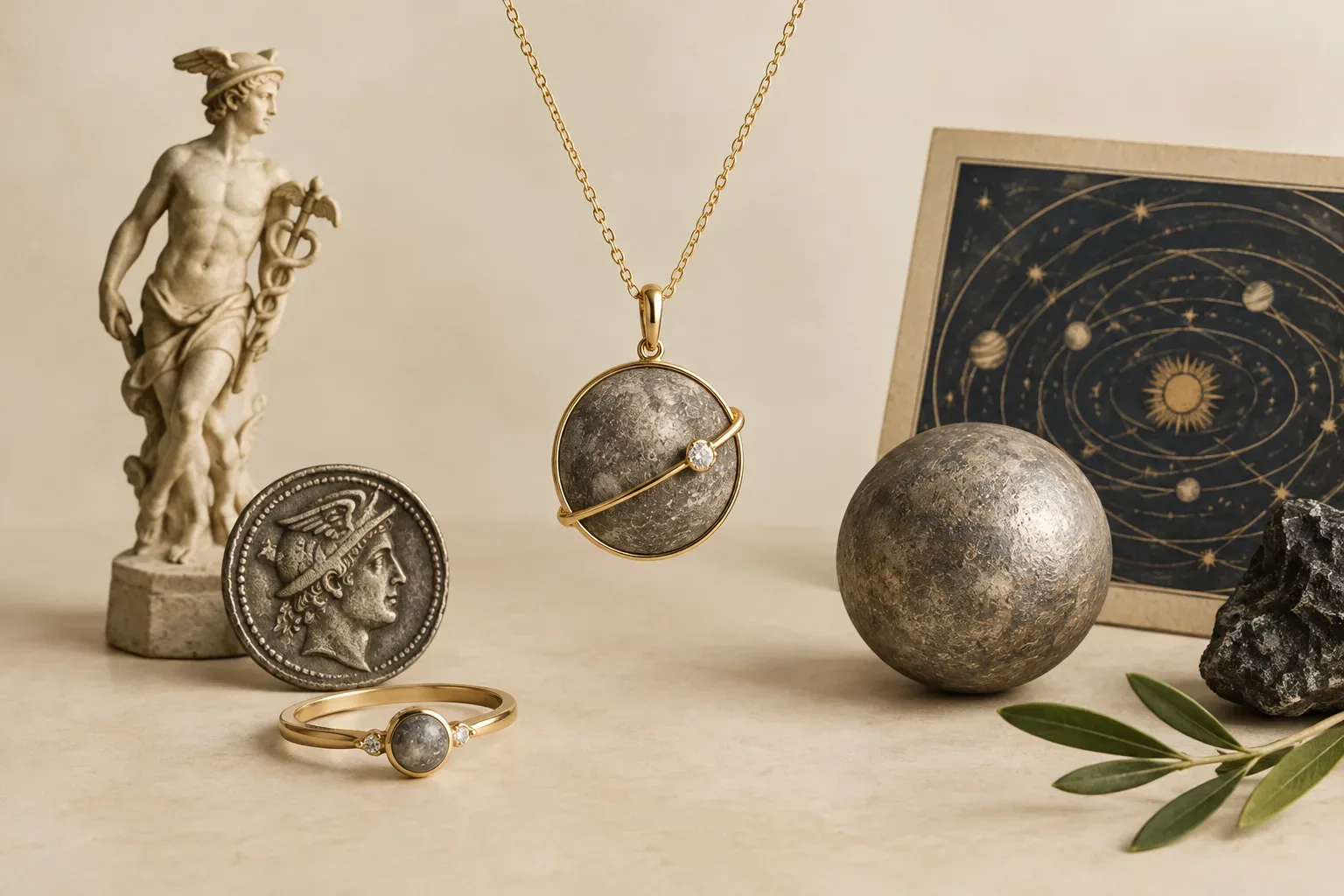
Meaning at a glance
This article explains documented historical context for celestial motifs in jewellery (as described by the Victoria and Albert Museum), separates those records from later or contemporary associations with the planet Mercury, describes how Mercury motifs and related gemstones appear in jewellery today, and gives practical, respectful guidance for selection and gifting including consumer-protection advice from the Federal Trade Commission.
Direct answer: what 'mercury planet jewelry meaning' refers to
Concise answer: 'Mercury planet jewelry meaning' today most often refers to a modern symbolic connection—communication, agility, travel, or intellectual quickness—applied to a planetary or astrological motif in jewellery; this contemporary usage is distinct from older documented reasons people wore celestial or classical motifs, which more often signalled status, identity, religious affiliation, or memory. The remainder of this article outlines the documented historical contexts for celestial motifs, distinguishes those records from later popular interpretations tied to the planet Mercury, explains how the motif and related stones appear in jewellery, and gives practical guidance on selection and gifting.
Documented historical evidence and the cultures or periods involved
Museum surveys of jewellery history emphasize that jewellery functions and motifs have changed with social, religious and technological contexts. The Victoria and Albert Museum's exhibits and interpretive material note that across periods and cultures jewellery has indicated rank, served as personal or family identity markers, acted as amulets or memorial objects, and responded to fashion and trade networks rather than preserving a single, unchanging symbolic vocabulary.
Because the V&A frames jewellery as a changing social language, it is safest to treat ancient or historical celestial imagery in jewellery as part of broadly documented patterns—use of classical motifs in post-classical Europe, adoption of religious iconography in devotional pieces, or the incorporation of exotic stones and forms via trade—rather than as direct evidence that a particular planet motif (for example a modern astrological glyph for Mercury) carried the same meanings it does for many wearers today.
In short, the V&A’s work supports two careful points: first, that celestial and classical motifs appear repeatedly in human jewellery-making across cultures and eras; and second, that the exact meaning of those motifs varied by culture, time, and social context. Where a specific culture’s texts or inscriptions survive, those sources are what allow specialists to tie a motif to a belief or function. For general museum surveys, however, the presence of a motif in a collection signals popular or elite tastes and craft practices more reliably than it signals a single, universal meaning.
Historical meanings versus modern personal interpretations
Documented historical meanings are derived from primary records, inscriptions, or consistent provenance that link an object to a cultural practice. Museum interpretation, such as that provided by the Victoria and Albert Museum, illustrates that many historic motifs were adopted for status, identity, devotional, or commemorative reasons. When a museum catalogue identifies a motif's historical context, it does so on the basis of object provenance, archival texts, or a pattern of use in that culture.
Modern personal interpretations—why someone today might wear a Mercury planet pendant or choose a Mercury-themed ring—are generally informed by contemporary astrology, modern fashion, or personal associations. These modern meanings are valid for the wearer but are not the same thing as documented historical meanings. It is important to note explicitly that wearing a Mercury motif today to express communication, learning, or travel is a contemporary practice; museum evidence catalogs how motifs circulated and changed but does not imply those exact modern concepts were universally held in past societies.
How the Mercury motif, gemstones, and traditions appear in jewellery today
In contemporary jewellery the 'Mercury' motif appears in several visual forms: planetary glyphs and astrological symbols used as pendants or stamped charms, stylized winged or messenger motifs inspired by classical art, and designer pieces that allude to quicksilver through fluid metalwork or reflective stones. Designers frequently adapt classical or astronomical imagery as a visual shorthand; museum histories remind us that this reuse of motifs is a long-standing practice in jewellery-making.
Gemstones used alongside Mercury motifs are chosen for aesthetic or associative reasons rather than documented historical planetary correspondences. Many modern makers favor high-luster or chatoyant stones—such as labradorite, moonstone, or polished hematite—that reflect light in a way that suggests motion or mercurial change, and faceted neutral-coloured stones for a minimalist, scientific feel. The V&A’s A–Z of Gemstones is a useful resource for identifying stones and understanding their historical uses in jewellery.
Traditional forms that recur include signet- or coin-style pendants that reference classical antiquity, small charm necklaces or stacking rings that allow a motif to be worn as part of a constellation of meanings, and minimalist glyph necklaces that reproduce astrological symbols. Many contemporary makers also produce personalised pieces—engraved or combined with birthstones—where the Mercury motif functions as one element among several personal symbols.
Practical and respectful guidance for selecting or gifting Mercury-themed jewellery
Choose with intention. If you are buying Mercury-themed jewellery for yourself or as a gift, think about whether the recipient values historical authenticity, astrological symbolism, aesthetic minimalism, or a combination. If historical context matters to the recipient, choose pieces from museum reproductions or makers who document their sources; if personal symbolism matters, choose a style the recipient will wear frequently.
Ask about materials and treatments. The Federal Trade Commission’s consumer guidance on buying gemstones, diamonds, and pearls recommends asking the seller whether a stone is natural, treated, synthetic, or an imitation, and requesting written confirmation where available. Treatment and imitation disclosure matter for both value and care: some treatments require special cleaning or temperature precautions.
Be culturally respectful. Avoid assuming a motif is sacred or neutral for all audiences. If a design explicitly references another culture’s religious iconography or a living tradition, prefer makers from that culture or those who clearly credit their sources. Museum context shows how motifs travel and change meaning; respectful collecting acknowledges that journey and credits origin where it is known.
Consider form and wearability. Mercury-themed pieces range from delicate pendants to statement rings. Think practically about how the recipient lives: an active wearer may prefer a durable metal and low-profile setting, while a collector might appreciate a more elaborate piece that references classical design.
Documentation and provenance. For higher-value purchases, request provenance documentation. For stones and precious metals, ask about hallmarks, testing certificates, or vendor return policies. The FTC guidance emphasises transparency as the buyer’s protection and as a sign of reputable practice.
Frequently asked questions
What does mercury planet jewelry mean?
Today, 'mercury planet jewelry meaning' most often reflects contemporary associations—communication, agility, travel, or quick intellect—applied to a planetary or astrological motif. These modern meanings are personal or astrological interpretations and should be distinguished from historical reasons people wore celestial or classical motifs, which museums show were often about status, identity, memory, or devotion.
Is the Mercury symbol an ancient religious icon?
The use of celestial or classical motifs in jewellery extends far back in many cultures, but whether a particular Mercury-like symbol functioned as a religious icon depends on the time and culture. Museum surveys emphasize that motifs change meaning with context; if religious significance is important to you, seek pieces with clear provenance or documentation from specialist collections or makers.
Which gemstones pair well with a Mercury motif?
Modern makers commonly pair Mercury motifs with reflective or neutral-toned stones—such as moonstone, labradorite, hematite, or polished onyx—to suggest motion or quicksilver-like qualities, but these are aesthetic choices rather than historically documented planetary correspondences. Consult a gemstone reference such as the Victoria and Albert Museum’s A–Z of Gemstones for identification and historical uses.
How can I verify a gemstone’s authenticity or treatment?
Follow the Federal Trade Commission’s advice: ask the seller whether the stone is natural, treated, synthetic, or an imitation and request written confirmation if possible. Reputable sellers should disclose treatments and provide testing certificates for higher-value stones.
Is it appropriate to gift Mercury-themed jewellery to someone with a specific cultural or religious identity?
Be respectful and informed. If a design references contemporary religious symbols or a living cultural tradition, consider buying from makers within that community or those who clearly explain and credit their sources. When in doubt, choose a design that celebrates the recipient’s personal interests (for example, astrology or literature) in a way that avoids appropriating sacred symbols.
Where can I learn more about jewellery symbolism and history?
Museum collections and exhibitions provide authoritative context on how motifs have been used across periods; the Victoria and Albert Museum’s exhibits and writings are a recommended starting point. For practical buying guidance on gemstones, the Federal Trade Commission’s consumer pages are a helpful resource.
Sources and further reading
- Bedazzled: A History of Jewellery — Victoria and Albert Museum
- An A-Z of Gemstones — Victoria and Albert Museum
- Buying Gemstones, Diamonds, and Pearls — Federal Trade Commission