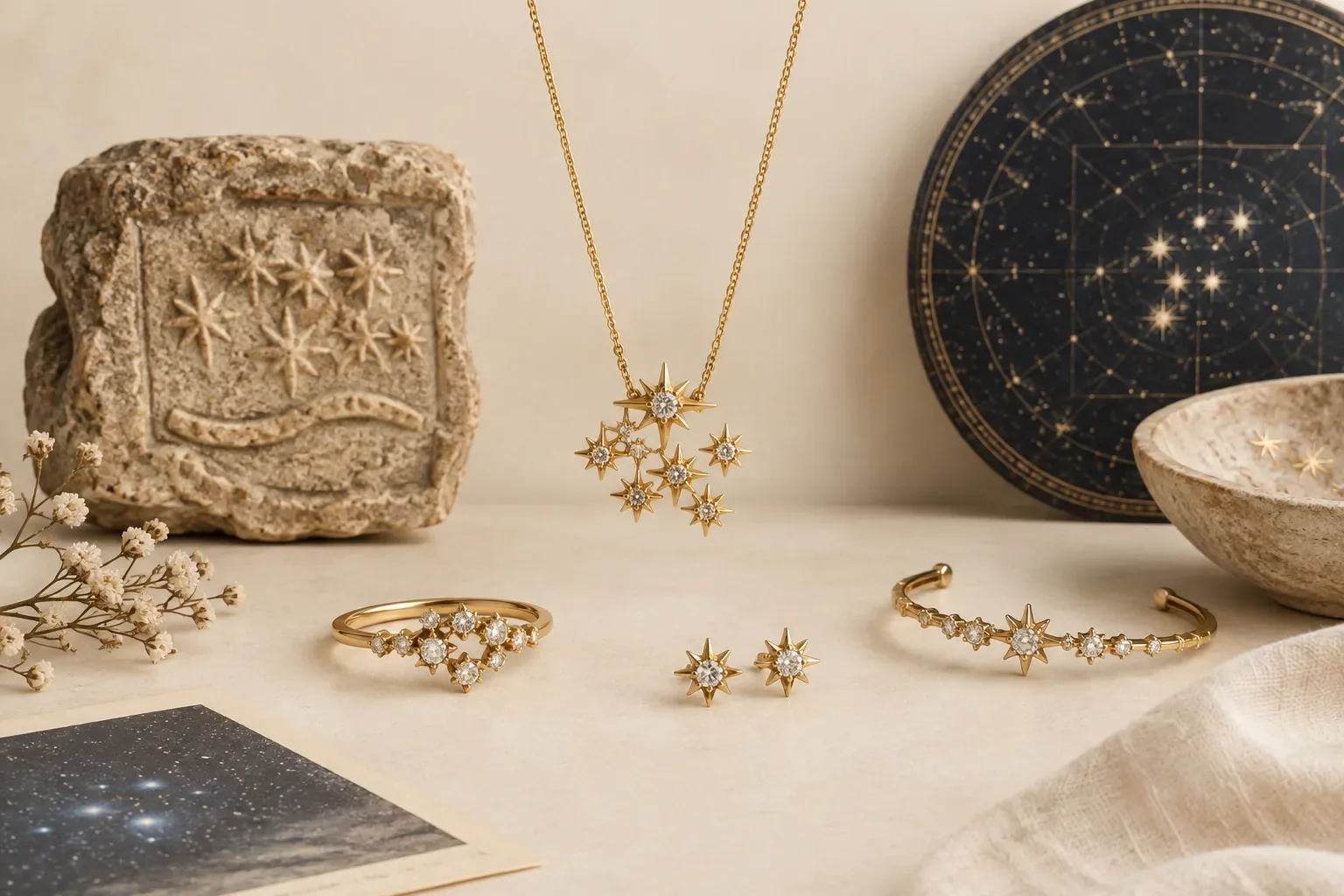
Meaning at a glance
The Pleiades jewelry meaning combines a long museum-documented tradition of celestial motifs in decorative arts with a variety of later cultural and personal interpretations; documented evidence shows that star-based designs have been popular in specific periods such as Victorian and early 20th-century European jewellery, while explicit Pleiades references are more often modern or interpretive. Choose or give Pleiades-themed pieces by checking maker statements, materials, and cultural context, and follow consumer-protection guidance for gemstones and treatments.
What the historical record shows (and how museums present it)
Museum scholarship and collection notes emphasize that jewellery has long drawn on celestial imagery, using stars, suns, comets and clustered settings to reference the heavens and to signal status, sentiment or fashion. The Victoria and Albert Museum describes how jewellery styles and motifs changed with social context, and that celestial motifs appear in specific historical fashions such as Victorian star-set designs and in early 20th-century decorative movements.
Identifying cultures and periods precisely
Victorian Britain and the broader European context of the late 19th century saw popular use of star motifs in brooches, watch chains and other ornaments; the Victoria and Albert Museum places such motifs in the wider narrative of jewellery’s changing social meanings. In the early 20th century, designers associated with Art Nouveau and later Art Deco continued to use celestial forms, adapting them to new materials and aesthetics. These attributions come from museum curatorial and historical work rather than from a single ancient textual source, and the V&A cautions that interpreting symbolic intent requires careful contextual evidence.
Documented meanings versus modern interpretation
Documented meanings recorded in museum catalogues and curatorial notes tend to emphasize fashion, allegory and technical display—sets of diamonds or pearls arranged as a star might advertise gem quality or sit within an allegorical composition. The Victoria and Albert Museum supports reading such motifs as part of social and aesthetic histories rather than as single, fixed symbolic messages.
Modern interpretations are more varied and often personal. Contemporary jewellers and wearers may name a piece 'Pleiades' to signal family groups, navigation, protection, feminine lineage, or astronomical interest. Those meanings are valid as personal or contemporary cultural uses, but they are different in kind from what curators document about historical garments or objects; they are reinterpretations rather than direct continuations unless explicit provenance or maker statements prove continuity.
How the Pleiades motif and related motifs appear in jewellery
Design approaches that evoke the Pleiades commonly use cluster settings—several small stones grouped within a frame or scatter—to suggest a compact star cluster. Star-setting techniques place a central gemstone within radiating notches to create a starburst effect, while pavé or bead settings can give a sparkling, crowded-field impression like a distant cluster.
Gemstones often chosen to represent stars include diamonds for bright, white sparkle and white or golden pearls for softer luminous points. The Victoria and Albert Museum’s overview of gemstones explains historical preferences and working techniques for stones and pearls, and can help you understand why certain gems were chosen in different eras.
Crafting and materials: what to look for
From a technical standpoint, cluster and star motifs may be executed in precious metals with fragile prong work or in modern casting with secure bezel settings. If a piece is described as historic, museum and trade practice recommends checking maker marks, hallmarks and provenance statements to establish date and origin; museum cataloguing practices emphasize the value of such documentary evidence.
For contemporary Pleiades-themed pieces, makers may use treated stones, simulated gems or lab-grown alternatives to achieve a starry effect. The Federal Trade Commission provides consumer guidance about disclosure of treatments, imitations and the marketing of gemstones, and advises buyers to seek clear information about what they are purchasing.
Selection and gifting guidance: practical and respectful advice
First, be explicit with the maker or seller about intent. If you want a piece that specifically references the Pleiades as a constellation, ask the maker to describe their inspiration and whether the design refers to any cultural story or specific tradition. If the piece is claimed to be an historic Pleiades motif, request provenance documentation or an appraisal; museum practice treats attribution conservatively unless clear evidence exists.
Second, check materials and disclosures. Ask whether stones are natural, treated, synthetic or simulants, and request written confirmation of treatments and any guarantees. The Federal Trade Commission recommends clear disclosure about treatments, lab-grown stones and imitations—this protects both buyer and recipient and preserves the integrity of the gift.
Third, be mindful of cultural context. If a maker or community ascribes a particular religious or cultural meaning to a Pleiades image, respect that origin when selecting or gifting the piece. If you are commissioning work that references an identifiable living tradition, consider consulting or commissioning from artists within that tradition to avoid appropriation and to support authentic storytelling.
Finally, think practically. For everyday wear choose secure settings and durable stones; for heirloom or commemorative pieces consider keeping documentation, care instructions and a statement of the chosen meaning so the recipient can carry both the object and its interpreted significance forward.
Interpreting antique versus contemporary Pleiades pieces
When evaluating antiques, place the object in its documented historical context. The Victoria and Albert Museum’s curatorial work shows that motifs can change meaning over time; a star cluster in a Victorian brooch might have been primarily decorative or allegorical rather than an explicit astronomical label.
For contemporary pieces, treat the maker’s stated intent as part of the object’s meaning. Modern jewellers who name their pieces 'Pleiades' are creating new meanings tied to present-day interests—astronomy, family, mythic resonance—and those meanings coexist with historical uses rather than replacing them.
Care and long-term stewardship
Caring for cluster-style jewellery means paying attention to prongs and small settings where stones can loosen. Follow standard conservation and care advice for the particular gemstones and metals involved; museum and trade resources emphasize documentation, secure storage and regular inspection as best practice.
If you plan to gift a piece as an heirloom, include written notes about materials and maker information, and consider professional valuation or insurance for high-value items.
Frequently asked questions
Is the Pleiades motif historically common in jewellery?
Museum scholarship shows that celestial motifs such as stars and clusters are common in many jewellery traditions and especially in Victorian and early 20th-century European pieces, but explicit historical identification of a design as the Pleiades varies and should be supported by provenance or maker statements.
What gemstones best represent the Pleiades in jewellery?
Diamond and white pearls are common choices for star-like sparkle or soft luminous points; the Victoria and Albert Museum’s gemstone overview explains historical preferences and why certain stones were chosen in different periods.
How can I tell if a Pleiades-themed piece is authentic or antique?
Ask for hallmarks, maker’s marks, provenance documentation and a professional appraisal; museum practice treats attribution conservatively and relies on documentary evidence rather than stylistic guesswork alone.
What should I ask a seller before buying Pleiades jewellery?
Request written disclosures about whether stones are natural, treated, lab-grown or simulants, ask for the maker’s stated inspiration and any provenance, and seek clarity on return policies and warranties, following consumer guidance from the Federal Trade Commission.
How do I gift a Pleiades piece respectfully?
Learn whether the motif has a living cultural or religious meaning for a specific community and, if it does, consider commissioning from or crediting an artist from that tradition; include written notes about the intended meaning and material disclosures for the recipient.
Sources and further reading
- Bedazzled: A History of Jewellery — Victoria and Albert Museum
- An A-Z of Gemstones — Victoria and Albert Museum
- Buying Gemstones, Diamonds, and Pearls — Federal Trade Commission