Meaning at a glance
Documented museum evidence for Little Dipper–specific jewelry is limited; however, historical use of celestial and star-cluster motifs across periods is well attested, and modern Little Dipper jewelry draws on astronomy, personal symbolism, and contemporary design practices—choose pieces by material, maker transparency, and the recipient’s cultural context.
What the historical evidence shows
Museum scholarship and exhibitions show that jewellery has long used celestial imagery, and that meanings and fashions around such imagery have shifted with social context. The Victoria and Albert Museum (V&A) presents jewellery as a medium that reflects changing social uses, technologies, and tastes, including repeated interest in stars and astronomical motifs across different periods. This establishes a firm background for understanding why a modern motif like the Little Dipper can feel familiar and resonant in jewellery design.
That said, the V&A’s survey of jewellery history does not identify the Little Dipper specifically as a discrete, repeatedly used motif in premodern or early modern collections in the way that other motifs (for example, religious crosses or portrait miniatures) are documented. In other words, while star and constellation imagery is historically documented, concrete examples explicitly labeled and consistently used as the Little Dipper are scarce in the published museum record.
Periods and cultures where celestial motifs appear (precisely identified)
Victorian Britain (19th century): The V&A’s collections and interpretive work show that Victorian jewellery often embraced sentimental and natural motifs and that celestial symbols—stars, comets, and sunbursts—were fashionable in various forms during the 19th century. In this period jewelers used small diamonds, seed pearls, and enamel to create night-sky effects that could be personalized for sentiment.
Early 20th century movements (Art Nouveau and Art Deco): Museums observe renewed interest in stylized natural and geometric forms during the turn of the twentieth century. Art Nouveau designers explored organic and celestial themes in flowing forms, while Art Deco makers favored graphic, star-like geometries and stepped designs that suggested celestial order.
Contemporary and late 20th century jewellery: The V&A documents ongoing reinterpretation of tradition in contemporary studio and commercial jewellery. In modern practice, artists and brands reference astronomy more explicitly, aided by advances in precise stone cutting, micro-setting, and laser engraving that make constellation-specific designs more feasible.
Documented historical meanings versus modern interpretations
Documented historical meanings. Museum-based work emphasizes that meanings attached to motifs change with context: a star in a 19th-century brooch could signify celestial aspiration, romantic sentiment, or fashionably modern taste, depending on the owner and context. These meanings are derived from material culture studies and provenance records rather than universal symbolism, and are best understood through museum documentation and object histories.
Modern personal interpretations. Contemporary references to the Little Dipper tend to be personal and varied. Many wearers choose the Little Dipper motif for reasons such as a love of stargazing, an interest in the North Star (Polaris), a connection to a place or memory, a nod to an astrological birth chart, or simply aesthetic preference. These are modern, subjective readings rather than documented historical meanings tied specifically to the Little Dipper constellation.
How the motif, gemstone, or tradition appears in jewelry
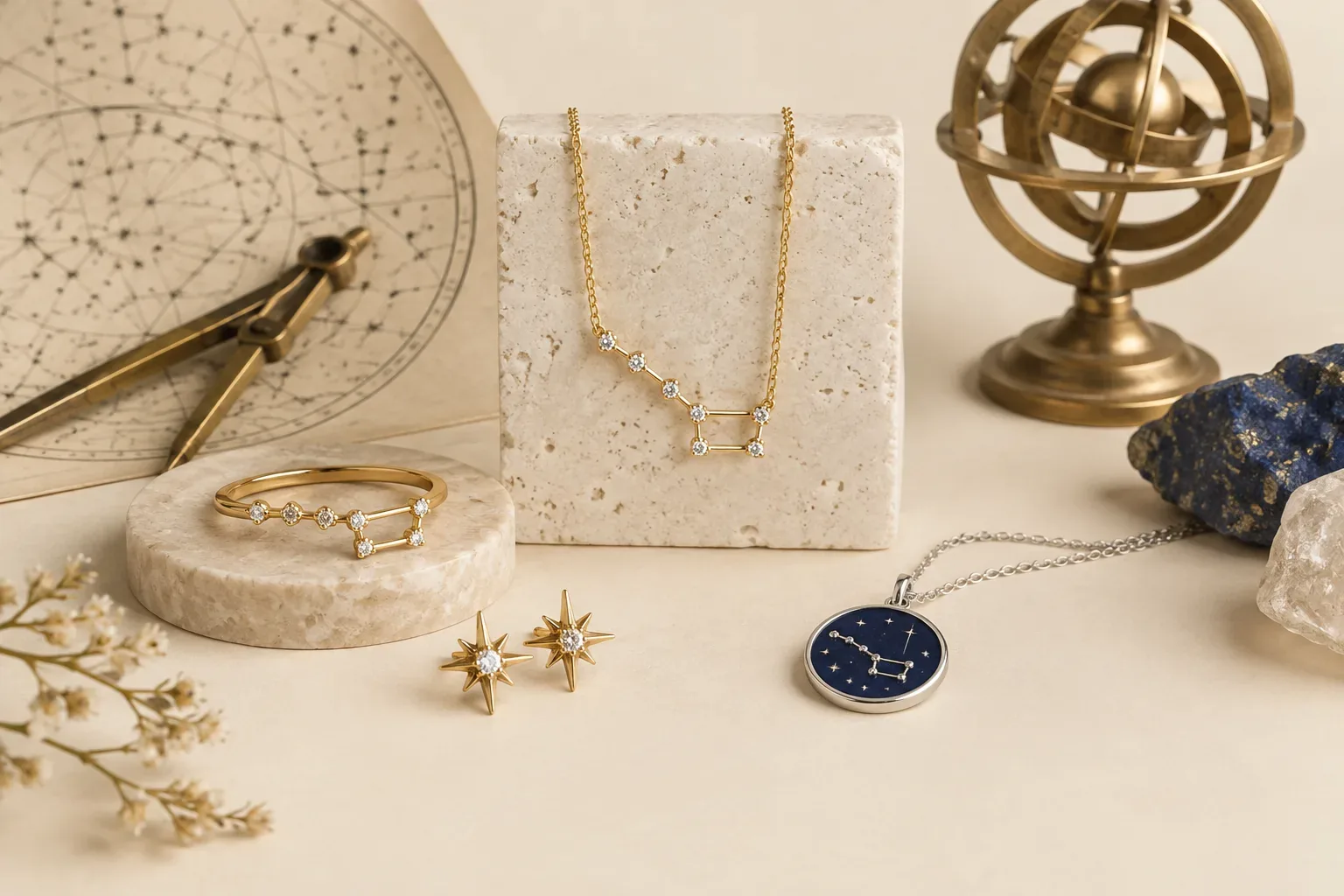
Design approaches. Jewelers and designers represent the Little Dipper in several practical ways: as a linear or curved arrangement of stones indicating the seven primary stars; as a stylized star cluster pendant; as engraved or laser-etched constellation maps on metal surfaces; or combined with a prominent North Star motif (often highlighted by a larger stone). Designers may choose graphic outlines or naturalistic point representations depending on aesthetic aims.
Gemstone choices and historical practices. Historical gem use and identification practices are well documented by museum resources. Designers commonly use small diamonds and white sapphires to mimic brilliant star points, seed pearls for softer lunar effects, or colored sapphires and tourmalines to suggest a twilight palette. The Victoria and Albert Museum’s material on gemstones explains how different stones have been used historically and how their visual properties influence design decisions.
Construction techniques. Techniques commonly employed include micro-pavé and bead settings to create star clusters, bezel or prong settings for a highlighted North Star, and pavé or millegrain edging to suggest a field of distant stars. Contemporary makers may use laser engraving or inlay to reproduce star maps at very small scales. These are standard jewellery techniques adapted to astronomical motifs.
Material transparency and consumer protection
Because modern Little Dipper pieces often rely on small stones and treatments (surface finishes, lab-grown gems, coatings), checking material disclosure is important. The Federal Trade Commission (FTC) provides guidance on purchasing gemstones, diamonds, and pearls and underscores the importance of accurate disclosure for treatments, synthetic stones, and imitations. Ask for written confirmation of whether stones are natural, lab-grown, or treated, and request any grading or treatment reports the seller can provide.
Also consider maker provenance and hallmarking. Museum practice emphasizes that provenance and maker information help place jewellery in context; for contemporary purchases, maker transparency supports ethical and quality choices. If responsible sourcing or recycled metals are important, ask the seller for specific claims and documentation.
Practical and respectful selection or gifting guidance
Clarify intended meaning with the recipient. Because the Little Dipper often functions as a personal or contemporary symbol, ask (or reflect) whether the recipient values astronomy, sentimental association, or purely aesthetic jewelry. If the piece is a surprise, choose a neutral or clearly explained message—inscribe a short note or include a card explaining what the motif means to you.
Mind cultural and religious context. While stars and constellations are widely used motifs, some designs or inscriptions may touch on cultural narratives or spiritual meanings for particular communities. Be respectful: if you know the recipient has particular cultural or religious sensitivities, prefer a design whose intended meaning is explicit and considerate.
Choose durable construction for everyday wear. Little Dipper designs often use multiple small stones that can be vulnerable to snagging. Prioritize secure settings (for example, well-made bezels or bead-set pavé), sturdy chains and clasps, and settings that keep stones protected. For pieces meant for daily wear, choose metals and stones that withstand regular use.
Verify gemstones and treatments. Use the FTC’s guidance to request disclosure about treatments or synthetic origins before purchase. If the piece is marketed as vintage or antique, request provenance and condition information; when possible, obtain a written condition report.
Personalize thoughtfully. If you or the recipient want a strongly personal connection—an engraved date, coordinates for a meaningful place, or a simulated star map—choose a reputable jeweler who can produce clear, durable engraving and who will document the materials used.
Care and maintenance notes
Small-stone constellation settings benefit from periodic inspection: have a trusted jeweler check prongs or pavé settings every six to twelve months to prevent loss. Clean pieces gently according to the stone types: warm soapy water and a soft brush is acceptable for many gems, but delicate stones or certain treatments may need specialist care.
Keep documentation and any treatment reports with the piece; these records preserve the object’s history and can help future conservation or resale decisions. Museums and consumer guidance both emphasize the value of good records for object care and provenance.
How to research a Little Dipper piece further
If you want to learn more about a specific item, begin with maker, hallmark, and provenance data, and consult jewelry-history resources to place the design in context. The V&A offers accessible material on jewellery history and gemstones that clarifies how motifs circulate and change. If you need help confirming gemstone identity or treatments, seek a qualified gemologist or independent laboratory report.
Frequently asked questions
Is the Little Dipper a historically documented jewelry motif?
Not specifically. Museum records show extensive use of celestial motifs (stars, comets, clusters) across periods, but explicit, repeatedly documented examples labeled as the Little Dipper are scarce; most Little Dipper designs are modern reinterpretations built on a long history of star imagery.
Does the Little Dipper carry a universal symbolic meaning?
No. There is no single universal meaning for the Little Dipper in jewellery. Historical meanings for star motifs varied by period and context, and modern wearers assign personal meanings such as navigation, memory, or aesthetic preference.
What gemstones work well for Little Dipper designs?
Traditionally, small white stones such as diamonds and white sapphires are used to suggest bright star points, while seed pearls and colored sapphires create different night-sky palettes. The Victoria and Albert Museum’s resources on gemstones explain how stone properties influence design choices.
How can I be sure the stones are genuine or disclosed correctly?
Ask the seller for written disclosure of whether stones are natural, lab-grown, or treated, and request any available grading or treatment reports. The Federal Trade Commission provides guidance on disclosure practices for gemstones, diamonds, and pearls.
Is Little Dipper jewelry appropriate as a gift for anyone?
Often yes, but be mindful of the recipient’s cultural or religious context and personal preferences. If you are unsure about symbolic connotations, choose a design with a clear, neutral explanation or offer the piece with a note explaining your intended meaning.
How should I care for a Little Dipper pendant with many small stones?
Have prongs and pavé settings checked periodically by a jeweler, clean gently according to the stone types (warm soapy water and a soft brush is usually safe for many gems), and store the piece to avoid tangling or impact that could loosen small stones.
Sources and further reading
- Bedazzled: A History of Jewellery — Victoria and Albert Museum
- An A-Z of Gemstones — Victoria and Albert Museum
- Buying Gemstones, Diamonds, and Pearls — Federal Trade Commission