Meaning at a glance
This article explains the documented history and changing contexts of the Big Dipper motif, distinguishes what is supported by museum surveys from later popular or personal interpretations, and gives practical guidance for choosing and gifting modern Big Dipper jewelry.
What historians and museums say
When assessing the meaning of any motif, it is important to start with what curators and historians have documented. The Victoria and Albert Museum records how jewelry motifs gain, lose, and change meanings as fashions, technologies, and social practices evolve. The V&A's overview of jewelry history emphasizes that the same visual devices—stars, flowers, hearts—have been used for different reasons at different times and that social context matters for interpretation.
Applied to the Big Dipper, that approach leads to two cautious conclusions. First, star and astronomical motifs are well attested across many periods of jewelry history as decorative elements, sentiment tokens, or as signs of fashionable interest in astronomy. Second, explicit documentary claims that a particular culture or historical period consistently used the Big Dipper motif in jewelry with one fixed meaning are not widely established in museum surveys; instead, meanings are often constructed later by collectors, makers, or communities.
Separating documented historical meanings from modern interpretations
Documented historical meanings come from primary records, provenance, and museum catalogues that link objects to a time, place, and social use. The V&A's work on jewellery history shows how careful contextual documentation supports historical interpretation. For the Big Dipper motif, available museum evidence supports the general use of star and celestial imagery in jewelry but does not uniformly attribute a single symbolic role to the specific Great Bear/Big Dipper configuration across cultures.
Modern interpretations, by contrast, are often personal, local, or newly created. Contemporary designers and wearers commonly attach meanings like guidance, home, northern identity, or a love of astronomy to Big Dipper jewelry. These are valid as personal or cultural expressions today, but they should be distinguished from claims about continuous historical usage. If you need to assert a historical, cultural, or religious association for a particular piece, look for explicit provenance or curator notes rather than assuming continuity.
Documented cultural references vs. modern reuse
Across cultures, stars and constellations have long been sources of stories and symbolism, but how those stories translate into jewelry varies by time and place. Museum catalogues and exhibits record many instances where celestial motifs appear in rings, brooches, pendants, and watch covers, often reflecting contemporary taste for astronomy, romance, or sentiment. The V&A's exhibitions and articles on gemstones and jewellery highlight that design choices often reflect technological possibilities, like gem cutting and setting, and popular interests of the moment.
Modern reuse of the Big Dipper often synthesizes astronomy with personal meaning. For example, jewelers might set seven stones to represent the dipper’s seven principal stars, or use northern materials to suggest place. Those creative choices are contemporary reinterpretations rather than undisputed continuations of an ancient, single meaning.
How the Big Dipper motif appears in jewelry
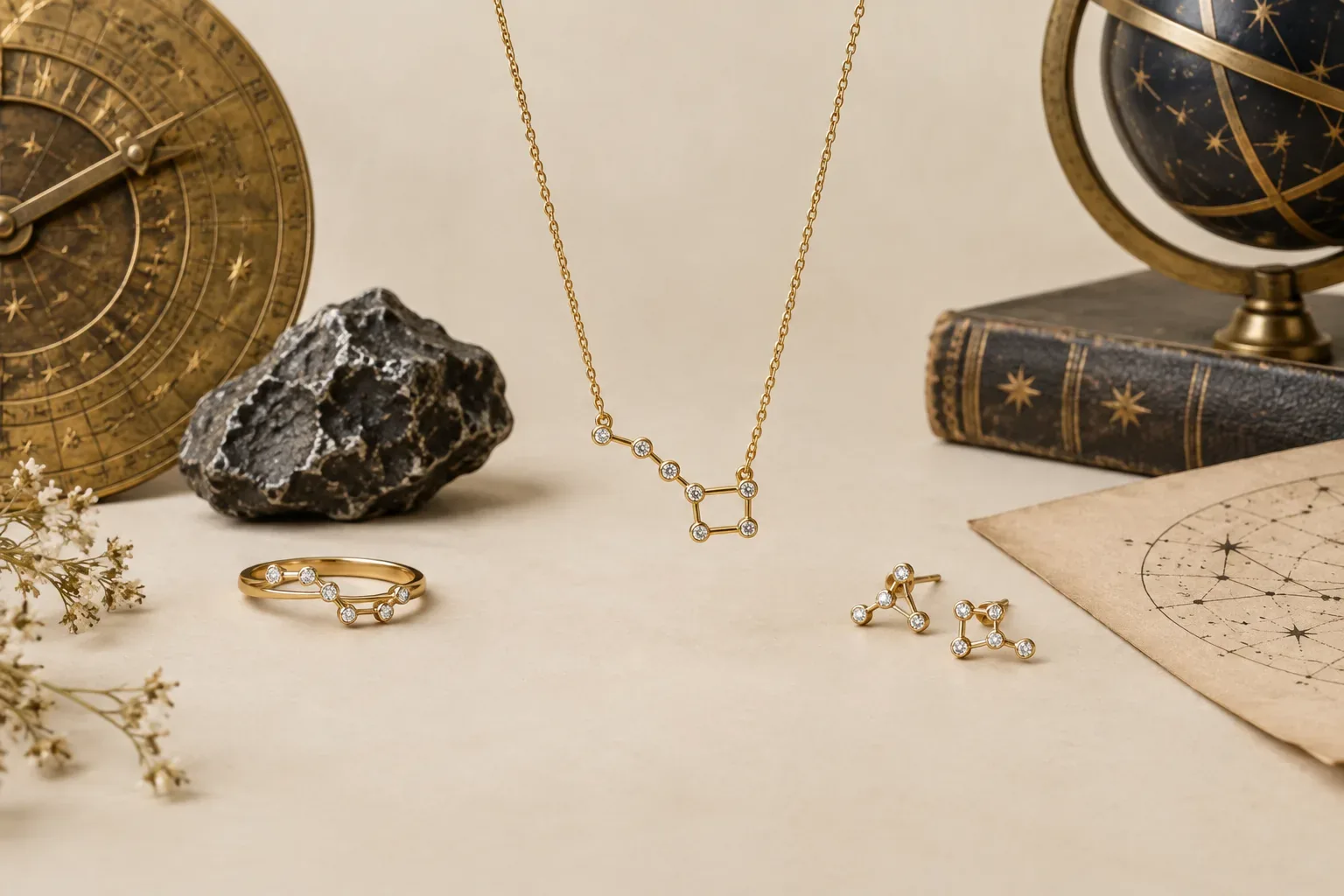
Designers use at least three common approaches to represent the Big Dipper in jewelry: schematic constellation patterns, starburst motifs that suggest celestial light, and representational groupings of gems that echo the dipper’s seven bright stars. Schematic designs typically show small stones or engraved points connected by fine lines, while starburst treatments place a central stone with radiating facets to evoke starlight. Groupings of seven gems are a straightforward literal reference when makers want to suggest the Big Dipper without illustrating the entire Ursa Major figure.
Gemstones and materials matter to meaning and effect. The Victoria and Albert Museum's A–Z of Gemstones explains how different gems have been valued and used. Diamonds, white sapphires, and rock crystal are often chosen to represent bright stars because of their brilliance, while moonstone, labradorite, or opal can suggest milky light. Metals and finishing—polished white gold, hammered silver, or oxidized bronze—also shape how literal or stylized a piece feels.
Practical makers’ choices are influenced by durability and clarity as well as symbolism. Designers who want small, bright “stars” may choose melee diamonds or laboratory-grown white sapphires; those choices change price, care needs, and disclosure requirements, which consumers should be aware of.
Gemstone and disclosure considerations
When gemstones are used to depict a constellation, the identity, treatment, and origin of those stones affect both value and the ethical footprint of the jewelry. The U.S. Federal Trade Commission provides guidance to consumers about buying gemstones, diamonds, and pearls, and requires that sellers disclose treatments, imitations, or enhancements that materially affect value. If a pendant advertises itself as set with “diamonds” but uses simulants or heavily treated stones, the FTC guidance explains how that should be reported to a buyer.
If provenance or natural origin is important to you or the recipient, ask the seller for written information about treatments and origin and look for independent gemmological reports for higher-value pieces. For costume or low-cost pieces, designers may use crystals or synthetic gems for visual effect; that is a legitimate design choice when properly disclosed.
Respectful selection and gifting guidance
Begin by asking what the motif means to the person who will wear it. Many people choose Big Dipper jewelry because it feels personal—an interest in astronomy, a connection to a northern homeland, or a private mnemonic. If you are giving such a piece as a gift, a short conversation about the recipient’s associations will help you avoid unintended cultural insensitivity or miscommunication.
Avoid assumptions about sacred or community-specific meanings unless you have clear evidence. Some communities attach religious or cultural significance to constellations; if you are aware of a piece being promoted as tied to a particular culture, ask for provenance or curator notes. If no clear historical connection exists, treat the design as contemporary symbolism rather than an ancestral emblem.
Consider materials, care, and disclosure. Use the FTC’s advice as a checklist: ask whether stones are natural or lab-grown, whether they have been treated, and whether the seller provides a return policy and documentation. Think about wearability: necklaces and studs with small stones are daily-wear friendly, while heavily embellished brooches may be more fragile and symbolic than practical.
For a meaningful gift, pair the piece with context: a short note that explains why you chose the design, a reference to an astronomical event, or a personal story anchored to place can help the recipient receive the symbol as you intend. If the piece is meant to honor a community connection, consider working with a maker from that community or seeking informed permission where appropriate.
When to research further
If you encounter claims that a particular Big Dipper design is a historic emblem for a named culture, ask for source documentation: museum provenance, ethnographic notes, or curator statements. The V&A’s scholarship is an example of the kind of curator-led documentation that supports reliable historical claims about jewelry motifs.
If a piece is expensive or offered as an antique with an asserted cultural meaning, request written provenance and, if relevant, independent gemmological reports. For questions about gemstone treatments and consumer protection, consult the Federal Trade Commission guidance on buying gemstones, diamonds, and pearls to ensure you understand what you are buying.
Summary and practical next steps
In short, Big Dipper jewelry meaning today most often reflects contemporary interests—astronomy, navigation, place, or personal story—rather than a single, continuous historical symbolism. Museum study of jewellery history, notably work collected and presented by institutions such as the Victoria and Albert Museum, shows how motifs change their social significance over time. When choosing or gifting Big Dipper jewelry, clarify the intended meaning, verify materials and disclosure, and respect cultural context by researching claims of traditional significance before accepting them as historical fact.
If you want to explore further, read museum catalogues for documented examples, consult gemstone references when assessing material choices, and use consumer protection guidance on gemstone disclosure when making a purchase. For practical gift guidance and research methods, consider our related articles about choosing meaningful jewelry and how to research symbols.
Frequently asked questions
Is the Big Dipper a traditional symbol in jewelry collections?
Museum surveys show that celestial motifs are common in jewelry history, but explicit documentary evidence tying the Big Dipper specifically to a single, continuous traditional meaning in jewelry is limited. Many historic pieces use star imagery, and modern designers often adapt constellation themes for contemporary meanings.
Can the seven stars of the Big Dipper be represented with any stones?
Yes. Designers commonly use seven stones—diamonds, white sapphires, or simulants—to suggest the Big Dipper. The Victoria and Albert Museum's resources on gemstones describe how gem choice affects appearance and historical associations.
How can I verify what gemstones are in a Big Dipper piece?
Ask the seller for written disclosure about whether stones are natural, lab-grown, treated, or simulants. For higher-value items, request an independent gemmological report. The Federal Trade Commission provides consumer guidance on disclosure when buying gemstones, diamonds, and pearls.
Is it cultural appropriation to wear Big Dipper jewelry?
Wearing a Big Dipper motif is generally a contemporary stylistic choice, but if a design is explicitly presented as a traditional or sacred emblem of a specific community, you should research provenance and consider seeking guidance from community representatives. Avoid claiming a historic cultural meaning without documentation.
How should I gift Big Dipper jewelry to convey meaning?
Pair the piece with a short note explaining why you chose it—astronomy, a personal memory, or a place connection. Confirm the recipient’s comfort with any cultural associations and check stone disclosures and care instructions before gifting.
Sources and further reading
- Bedazzled: A History of Jewellery — Victoria and Albert Museum
- An A-Z of Gemstones — Victoria and Albert Museum
- Buying Gemstones, Diamonds, and Pearls — Federal Trade Commission