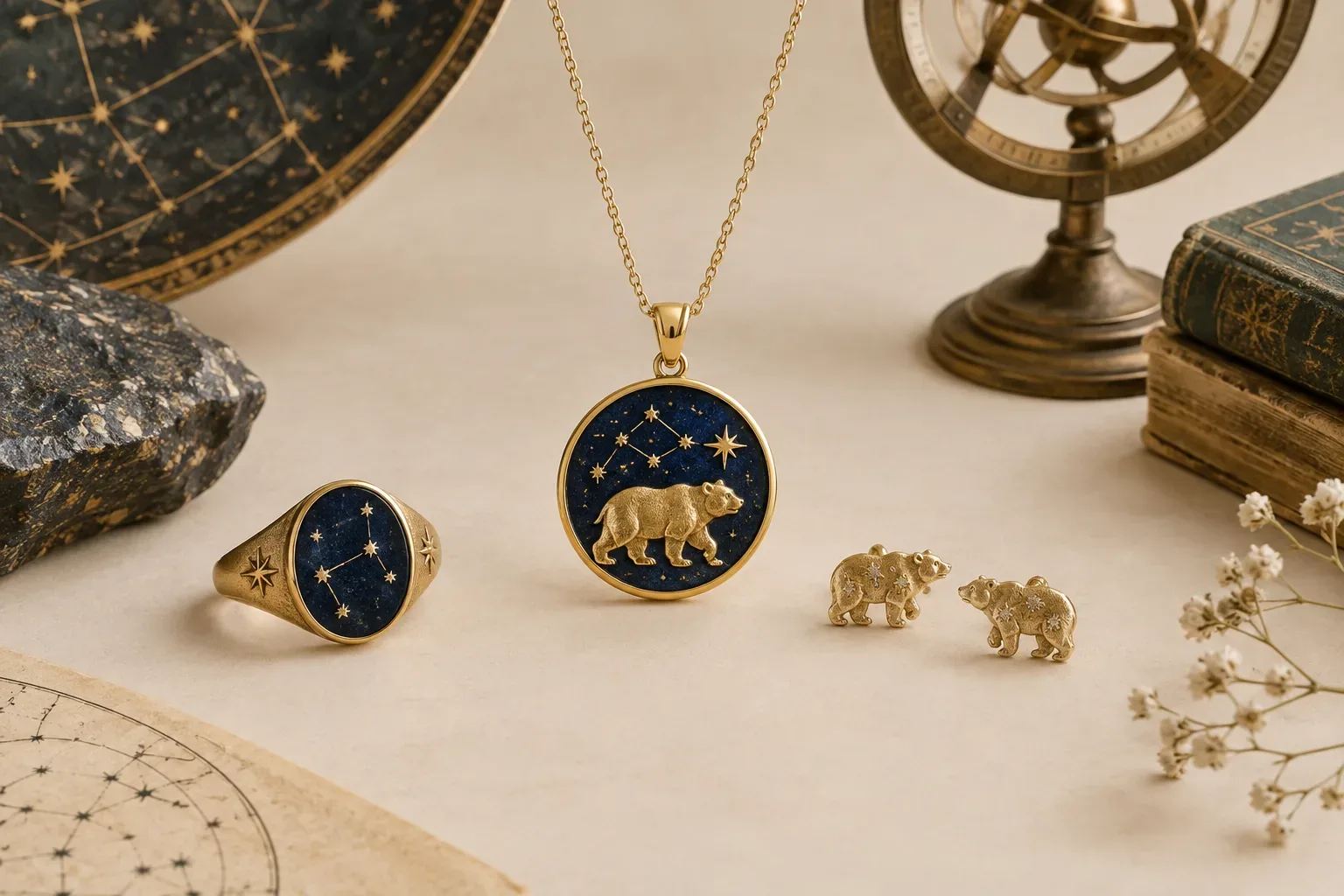
Meaning at a glance
Explain the documented history and changing contexts of the ursa major motif, separate cultural or religious evidence from later popular interpretations, and give practical guidance for choosing and wearing the motif in modern jewelry.
Historical evidence, and which cultures or periods it comes from
Direct, documented claims about a motif reading specifically as 'Ursa Major' (the constellation often called the Big Dipper or the Plough in various languages) are less common in museum records than general evidence for celestial and star imagery in jewellery. The Victoria and Albert Museum (V&A) notes that jewellers have long drawn on astronomical and celestial imagery across multiple periods for ornamental, sentimental, and status purposes rather than as a single fixed meaning. The V&A's survey of jewellery history illustrates that star motifs and constellation-inspired groupings appear in Victorian sentimental jewellery, in 20th-century design movements that used geometric and celestial forms, and in contemporary work that references astronomy explicitly or decoratively.
Because the V&A presents jewellery history as changing social context rather than a stable symbolic dictionary, the safest historical claim is that jewellers across time have used starry motifs and groupings of stones to suggest the night sky, navigation, or a poetic sense of the heavens. Precise religious or mythological attributions to specific cultures for the Ursa Major image would require direct primary sources for each culture; the V&A emphasizes how meanings evolve with fashion, technology, and social use rather than remaining fixed.
Documented historical meanings versus modern personal interpretations
Documented historical meanings: museum documentation, such as material collected and explained by the Victoria and Albert Museum, shows that jewellers employed celestial motifs for several recorded reasons: ornament and display, sentimental or memorial uses (stars as metaphors in mourning and love), and as part of fashionable language in a given period. These are contextual, period-specific uses recorded by curators and historians and should be cited as the primary documented record.
Modern personal interpretations: in contemporary practice, people often assign meanings that are personal, cultural, or astrological. Modern wearers and designers commonly describe Ursa Major-inspired jewellery as representing guidance (the Big Dipper points to the North Star), constancy, navigation, family (seven stars as a group), or personal journeys. Those readings are valid as personal or cultural symbolism but are not universal or necessarily grounded in the museum-documented uses of celestial imagery. Treat modern symbolic claims as contemporary interpretations rather than established historical fact.
How the motif, gemstone, or tradition appears in jewelry
Design approaches: jewellers translate the Ursa Major idea into jewelry in several consistent ways. Some pieces depict the Big Dipper’s seven prominent stars as a cluster of round stones or set diamonds arranged in the recognizable dipper shape. Others use a single focal gem (often a sapphire or deep-blue stone) with smaller white diamonds or metal dots to suggest a star field. Designers may also render a silhouette of the bear in metalwork, combine figuration with star clusters, or use engraving and enamel to create a night-sky backdrop.
Gemstone choices and techniques: historically and today, deep-blue gems—such as sapphire—are commonly used to evoke the night sky, and diamonds or white gems serve as star points. The Victoria and Albert Museum’s resources on gemstones note the long-standing use of particular stones for their color, optical effects, and symbolic associations, and they also document how cutting and setting techniques change with period style and technology. Contemporary makers may include treated or lab-grown stones; when assessing material, buyers should know that treatments and imitations are common in the market and that disclosure is regulated for consumer protection.
Settings and motifs in practice: you will see Ursa Major motifs across rings, pendants, brooches, and earrings. Star-set pavé, cluster settings for the 'dipper', and dark enamel or treated stone backgrounds are practical approaches to rendering the motif. Sentimental traditions, such as lockets with night-sky motifs or engraved constellations inside a pendant, echo historical uses of jewellery to hold memory and meaning; the Victoria and Albert Museum’s discussion of jewellery as social object underlines these continuities in form and use.
Practical and respectful selection or gifting guidance
Start with meaning and the wearer’s context: decide whether you want the piece to emphasize astronomical reference, personal symbolism, or purely decorative appeal. If the intended recipient values astronomy, a piece that references the constellation and its orientation may feel more meaningful; if they prefer subtlety, a small cluster of stones or a star-set pendant can convey the motif without explicit mythological reference.
Consider materials, durability, and lifestyle: choose metals and settings suited to the wearer’s daily life. Low-profile settings are safer for active wearers; bezel or flush settings protect stones better than high prongs. For gemstone choices, dark blue stones for a night-sky effect and bright white stones to mark the stars are common. The Victoria and Albert Museum’s guidance on gemstones is useful for understanding historical choices, while modern practicalities—such as treatments or imitations—are addressed by consumer-protection guidance.
Ask precise questions about authenticity and treatments: the Federal Trade Commission advises buyers to request clear information about gemstone treatments, lab-grown versus natural stones, and any imitations. If provenance or natural origin matters to you or the recipient, ask the seller for written disclosure. For higher-value purchases, request gemological reports and consider a trusted jeweller who provides documentation of treatments and origins.
Cultural respect and sensitivity: if a particular culture or community associates the Ursa Major figure with religious or sacred meanings, approach such pieces with awareness. Because meanings vary, avoid claiming a universal sacred value for the motif. A respectful gift is one that acknowledges the recipient’s beliefs and background; when in doubt, ask the recipient or choose a design that emphasizes personal meaning rather than asserting a broad cultural claim.
Presentation and accompanying explanation: when gifting, a short note explaining why you chose the motif—whether for navigation, family symbolism, or an interest in astronomy—helps anchor the piece’s meaning for the recipient. If the piece uses lab-grown gems or treated stones, including the disclosure documentation with the gift honors transparency and can be appreciated by recipients who care about gemstone origin.
Care, authentication, and long-term considerations
Care and maintenance: how you care for Ursa Major jewellery depends on materials. Gemstone hardness, setting type, and metal will dictate cleaning methods and storage. For example, softer gems require more careful storage away from harder stones; deep-blue stones used to evoke the night sky vary widely in hardness and care needs, a point general gemstone guides from museums and reference sources emphasize.
Authentication and disclosure: follow the Federal Trade Commission’s consumer guidance when purchasing. Ask for written information on treatments, certification, return policies, and insurance options for valuable pieces. For sentimental heirloom-style pieces, consider having a professional appraisal and photographic record for insurance and provenance.
Longevity of meaning: remember that jewellery meanings evolve. A historic V&A example of a star or celestial motif had meanings tied to its period context; contemporary wearers will continue to invest personal and cultural meanings into the design. Treat the piece as both object and story: good care preserves the object, and an explained provenance or personal inscription preserves the story.
Frequently asked questions
Is the Ursa Major motif a traditional symbol in any single culture?
Museum documentation, such as resources from the Victoria and Albert Museum, shows that celestial motifs appear across many periods and cultures in jewellery but does not support a single, universal traditional meaning tied exclusively to Ursa Major. Specific cultural attributions require primary evidence from those cultures; general museum histories treat celestial motifs as recurring decorative and sentimental elements rather than one fixed symbol.
What should I ask a jeweller when buying Ursa Major jewellery?
Ask whether the stones are natural, lab-grown, or treated; request written disclosure of treatments or imitations; ask about metal type and setting durability; and, for high-value items, request gemological reports. The Federal Trade Commission recommends that sellers disclose treatments and origin so buyers can make informed choices.
Can Ursa Major jewellery be worn as a birth-sign or astrological symbol?
While some people use constellation motifs for astrological or birth-related symbolism, Ursa Major is not an astrological sign in the same way as zodiac constellations. Using the motif for personal or astrological meaning is a contemporary interpretive choice rather than a documented historical practice tied to astrology.
Are certain gems traditionally used to represent the night sky in these designs?
Jewelers commonly use deep-blue gemstones such as sapphire to evoke a night-sky background and diamonds or white gems to represent stars. The Victoria and Albert Museum’s materials on gemstones describe how color and optical properties inform historical and modern choices.
How can I gift Ursa Major jewellery respectfully?
Consider the recipient’s cultural and personal background, choose a design that reflects their taste, disclose material information, and include a note explaining why you chose the motif. If the recipient belongs to a community that treats the motif as sacred, discuss appropriateness with them before gifting.
Sources and further reading
- Bedazzled: A History of Jewellery — Victoria and Albert Museum
- An A-Z of Gemstones — Victoria and Albert Museum
- Buying Gemstones, Diamonds, and Pearls — Federal Trade Commission