Meaning at a glance
This article explains the documented history and changing contexts of the sun-and-moon motif, separates museum-recorded meanings from later popular interpretations, and offers practical guidance for selecting and gifting modern pieces.
Quick answer
The sun-and-moon motif in jewellery has appeared repeatedly across periods and regions and has been adapted to different social purposes; museum surveys show it was used for decorative, commemorative, and status-related reasons rather than a single universal meaning. Modern meanings—such as romantic complementarity, personal astrology, or duality—are mostly contemporary interpretations layered on those earlier uses.
Historical evidence, by culture and period
Surveys of jewellery history in major museum collections make clear that celestial imagery is recurring rather than unique to one culture. The Victoria and Albert Museum's overview of jewellery history describes how motifs, including celestial forms, appear in many eras—from ancient ornamental use through medieval and Renaissance jewellery to large-scale Victorian and later revivals—because craftsmen and patrons repeatedly borrowed and adapted familiar symbolic shapes to fit new fashions and meanings.
Museum records do not present a single fixed 'meaning' for sun and moon motifs. In earlier periods, such motifs were commonly chosen for visual effect and technical display as much as for symbolic content. For example, metalworking, enamel and gemstone techniques that caught light or created surface effects were valued because they showcased workmanship and wealth, a point emphasized in the Victoria and Albert Museum's presentations on historical jewellery and gemstones.
Precise cultural attributions and functions vary. Across different societies the same motif could serve as a protective emblem, a status marker, a calendrical or astronomical reference, or a purely decorative choice. The V&A documents these shifting contexts without endorsing a single interpretation as universally correct.
Documented historical meanings versus modern personal interpretations
What museums and historical catalogues can document are the contexts in which pieces were made and worn: who commissioned them, what materials and techniques they used, and how styles tracked social changes. The V&A's work on jewellery history emphasizes social context and material evidence rather than fixed symbolic dictionaries. That means historical ‘meanings’ often come from combination of provenance, inscriptions, and associated objects rather than from motif alone.
Modern common interpretations—such as reading the sun and moon as an emblem of romantic opposites, yin and yang, masculinity/femininity, or astrological identity—largely reflect contemporary cultural narratives rather than direct continuations of a single historical source. Those readings are valid as personal or cultural symbolism today, but they should be presented as modern layers of meaning applied to a long-standing decorative motif, not as universal historical facts.
When a sun or moon motif does have a more firmly documented historical role, that evidence usually comes from inscriptions, dated inventories, or other records catalogued by museums. Rely on provenance and institutional documentation for historical claims; use modern interpretations as personal or cultural context.
How the motif, gemstone, and tradition appear in jewellery
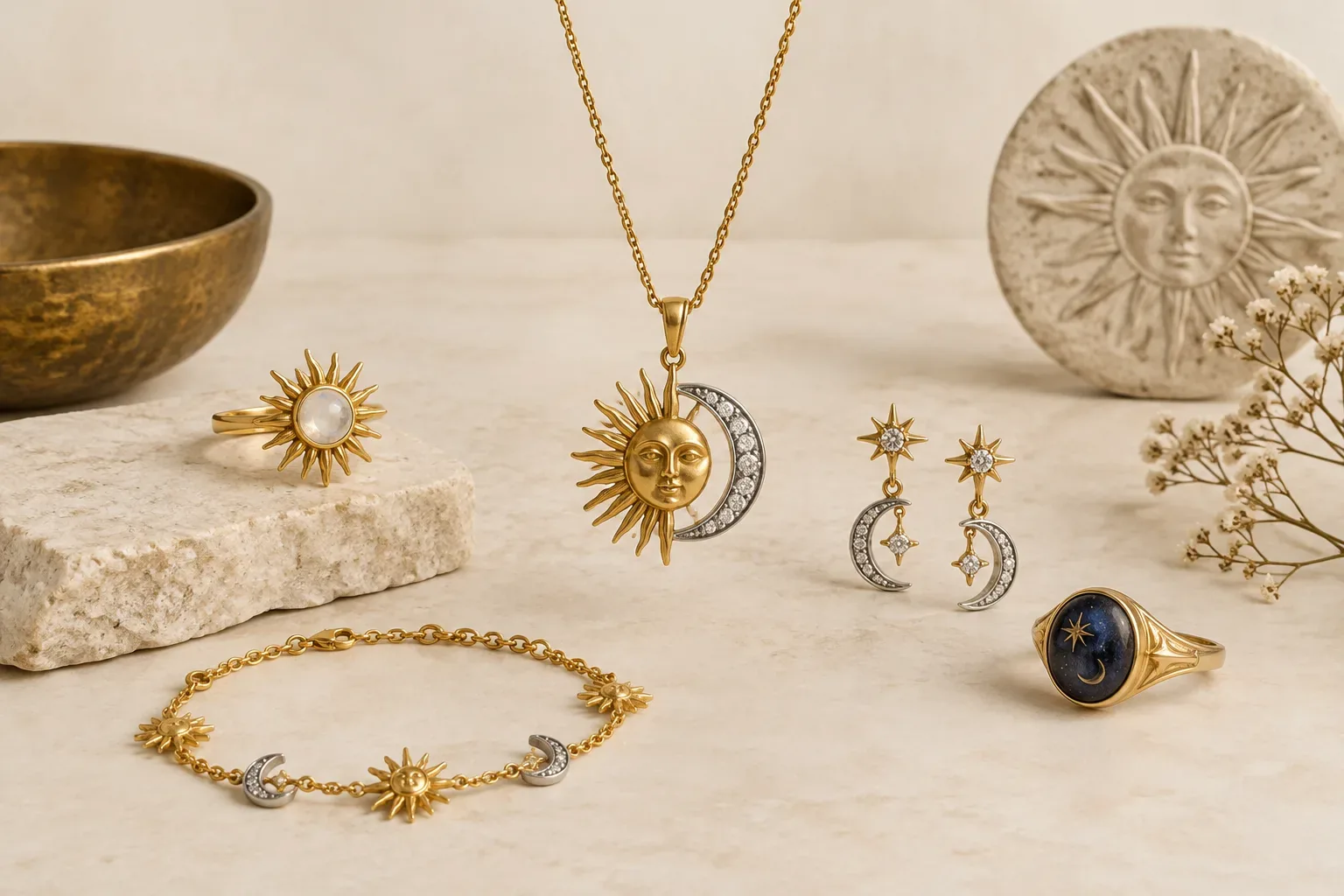
The sun-and-moon motif appears in jewellery through form, surface treatment, and choice of materials. Designers render the sun in radiating forms—sunbursts, rays, and stylised disks—while moons are shown as crescents, full circles, or as stylised faces. These shapes are used across brooches, pendants, rings, earrings, lockets and watch decorations. The Victoria and Albert Museum's exhibition materials and collection notes show that jewellers historically used these motifs to exploit symmetry, contrast and light.
Gemstones and materials play a practical role in evoking celestial effects. Stones with pearly or optical phenomena—such as moonstone, pearls, and opal—have long been selected to suggest lunar glow; stones with bright yellow, orange, or reflective faceting can suggest solar brilliance. The V&A's 'An A–Z of Gemstones' explains how gem properties and historical preferences influenced these choices. Enamel, gilt metal, and cut steel were also used historically to catch light and contrastingly depict sun and moon elements.
Certain jewellery forms carry cultural or sentimental meanings that interact with the motif. For example, lockets and mourning jewellery, documented in museum histories, often used symbolic imagery to convey memory and relationship. The presence of sun or moon imagery in such objects can combine decorative effect with personal sentiment, but the precise meaning depends on context and any documentary record.
Practical and respectful guidance for choosing or gifting sun-and-moon jewellery
Start with context: consider the recipient's tastes, cultural background, and whether they prefer literal or abstract imagery. If you intend the piece to convey a particular idea—partnership, remembrance, personal astrology—consider pairing the motif with an inscription or card explaining the intended meaning so it is less likely to be misread.
Choose materials thoughtfully. If you want a lunar effect, look for moonstone, pearls, or opal; for solar brightness, consider yellow gold, citrine, or well-cut diamonds and yellow sapphires. Use the Victoria and Albert Museum’s gemstone guides to learn which stones historically produced the visual effects associated with sun and moon motifs and why they were chosen.
Check disclosures and treatments. The Federal Trade Commission advises buyers to ask about treatments, enhancements, and imitations when purchasing gemstones or pearls and to expect clear disclosure from sellers. Ask for documentation of any treatments, and verify whether stones are natural, enhanced, or laboratory-grown if that matters to you.
Respect cultural sensitivities. While celestial imagery is widespread, particular cultures or religious groups may attach unique meanings to sun or moon symbols. If the piece is meant as a cultural or religious signifier, research the symbol’s specific use and, when appropriate, consult people from that tradition. Treat symbolic jewellery as you would any cultural object: with curiosity, respect, and humility.
Care and durability matter. Choose mounting styles and materials appropriate to how the recipient will wear the piece. High-bezel settings and hard stones are better for everyday wear; delicate enamel or soft stones require more cautious handling. Ask a jeweller about routine care for pearls, opals, and moonstone, which can be sensitive to heat, chemicals and abrasion.
Selections, occasions, and final notes
For a meaningful gift, match the form to the occasion: a pendant or locket can feel intimate and wearable daily, a brooch or statement ring is more fashion-forward, and matching sun-and-moon pairs suit anniversary or partnership themes. If you want the piece to read historically, choose designs or makers with verifiable provenance; if you want a contemporary personal symbol, prioritize design and material that will resonate with the wearer.
When in doubt, provide provenance and care details with the gift: a short note explaining whether the piece uses natural or treated stones, why you chose the motif, and how to care for the piece helps recipients appreciate both the material and the intent.
For further reading on symbols, how to choose meaningful jewellery, or the history of sentimental forms like lockets, see the internal links at the end of this article.
Frequently asked questions
Does sun and moon jewellery have a single historical meaning?
No. Museum surveys show celestial motifs recur across many periods and cultures and were used for a range of purposes—decorative, commemorative, technical display or personal sentiment. Historical meanings depend on context and documentary evidence rather than motif alone.
Which gemstones are commonly used to suggest lunar or solar effects?
Gemstones with pearly or adularescent qualities—such as moonstone, pearls and opal—are often used to suggest lunar glow, while yellow or highly reflective stones and metals suggest solar brilliance. The Victoria and Albert Museum's gemstone guides explain how historical jewellery makers chose stones for their optical qualities.
How can I be sure a gemstone is natural and not treated or simulated?
Ask the seller for written disclosures about treatments and for any available certificates. The Federal Trade Commission advises buyers to expect clear disclosure about enhancements, synthetics, and imitations when purchasing gemstones, diamonds and pearls.
Is it appropriate to gift sun-and-moon jewellery to represent a cultural or religious idea?
It can be appropriate, but do your research first. The same motif may have specific meanings in particular traditions. If the gift is intended as a cultural or religious signifier, consult reliable sources or people from that tradition to avoid misunderstanding.
What jewellery forms work best for everyday wear?
For daily wear choose durable settings and harder stones. Bezel settings, secure prongs, and durable stones reduce risk of damage; delicate enamels and soft stones like pearls and opals require more careful handling.
How can I add a personal meaning to a sun-and-moon piece?
You can add meaning through inscription, an explanatory note, pairing the motif with a specific gemstone that has personal significance, or choosing a form tied to the relationship you want to mark, such as a locket for memory or matched pendants for partnership.
Sources and further reading
- Bedazzled: A History of Jewellery — Victoria and Albert Museum
- An A-Z of Gemstones — Victoria and Albert Museum
- Buying Gemstones, Diamonds, and Pearls — Federal Trade Commission