Meaning at a glance
This article explains the documented history and changing contexts of the lunar eclipse motif, separates cultural and religious evidence from later popular interpretations, and gives practical guidance for choosing and wearing lunar-eclipse themed jewelry.
Quick answer
Lunar eclipse jewelry meaning is best understood as a layered history: historical use of moon and celestial motifs in jewelry reflects specific social and aesthetic contexts (as documented by the Victoria and Albert Museum), while the explicit association of a lunar eclipse with transformation, hidden knowledge, or ritual is mainly a modern interpretive layer rather than a single, longstanding universal symbolic meaning.
Astronomy in brief and why it matters for symbolism
A lunar eclipse occurs when the Earth moves between the Sun and the Moon so that the Earth’s shadow falls on the Moon. That natural interplay of light and shadow is the basic visual event that designers reference when they use partial discs, crescents paired with discs, or shadowed moon shapes in jewelry. The astronomical mechanics themselves do not prescribe symbolic meaning, but the striking visual contrast—light obscured by shadow—has had enduring aesthetic appeal and invites interpretation in many periods.
What the historical evidence shows (periods and contexts)
Surviving jewelry collections and museum research show that moon and celestial motifs appear in distinct historical periods and carry meanings tied to those periods’ tastes and social uses rather than to a single religious or cosmological message. The Victoria and Albert Museum frames much of that evidence around changing social contexts and fashion: for example, crescent moons and star motifs were popular in late 18th- and 19th-century European jewellery as fashionable motifs and as sentimental emblems in personal jewellery, and later reappeared in early 20th-century styles such as Art Nouveau and Art Deco as part of broader aesthetic movements, according to V&A scholarship.
The V&A’s surveys of jewellery history show that motifs drawn from the sky—moons, stars, suns—were adapted repeatedly because they lent themselves to decorative form and personal meaning. That documentation ties specific styles and uses to periods (for instance, Victorian sentimental jewellery and early 20th-century decorative revivals) rather than asserting a continuous religious or ritual meaning across cultures and centuries.
Separating documented historical meanings from modern interpretations
Documented meanings: Museum research indicates that celestial motifs were often chosen for their aesthetic appeal, for fashionable associations, or for intimate sentimental symbolism in a given period. For example, Victorian jewelers frequently used familiar motifs in memorial and sentimental items; the use of moons or stars in those items should be read in the context of Victorian taste and the piece’s function, not as evidence of a single, ancient meaning. These links between motif and social use are described in the V&A’s work on jewellery history.
Modern interpretations: Contemporary descriptions that link a lunar eclipse specifically to transformation, hidden knowledge, or spiritual initiation are largely modern layers of meaning applied by designers, astrologers, or wearers. These personal or contemporary symbolic readings are valid as individual meaning-making but are not the same as documented historical practice. It is important not to conflate recent metaphorical language around eclipses with historical ritual uses unless a source documents such practices explicitly.
How the lunar eclipse motif and gemstones appear in jewelry
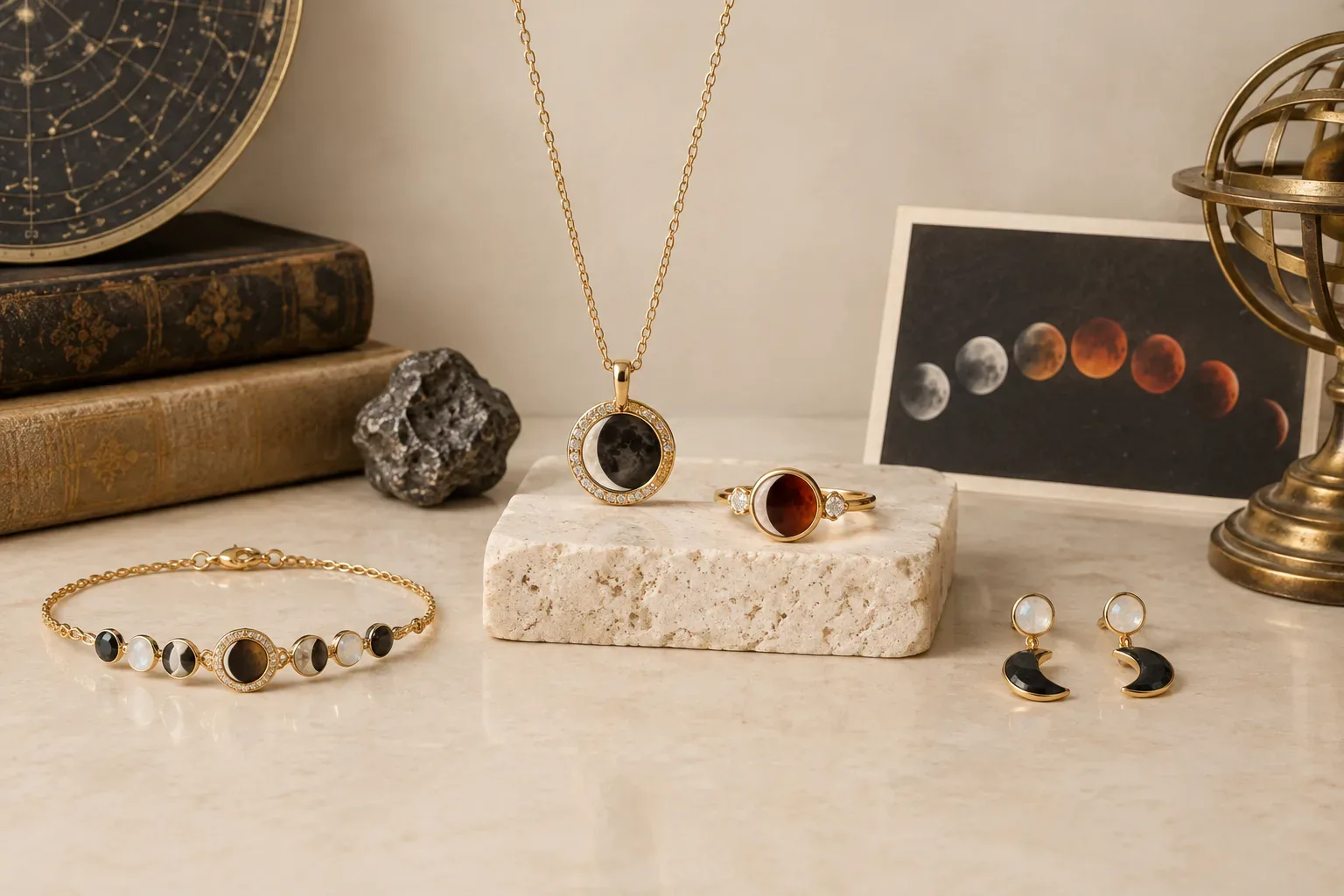
Designs that reference a lunar eclipse vary from literal to suggestive. Literal motifs depict a darkened disc overlapping a moon or crescent, often with a contrasting metal or stone to suggest shadow and illumination. More suggestive treatments use half-moons, crescents shielding a central cabochon, layered discs, or negative space to imply occlusion. These forms are versatile: they can be rendered as small pendants, brooches, rings with partially obscured settings, or linked elements in bracelets.
Gemstones are often chosen for their color contrast or optical effects. Dark stones such as onyx, black spinel, or moonstone with a subtle sheen can suggest shadowed lunar surfaces, while pale stones like moonstone, opal, pearl, and silvered metals imply reflected light. The Victoria and Albert Museum’s overview of gemstones explains how different stones have been used historically for effect and how their material properties lend themselves to particular visual metaphors.
Metalwork—oxidised silver, mixed metals, and textured surfaces—also plays a role in suggesting eclipse effects. In modern production, designers combine cut and setting styles to create a sense of depth; historical pieces achieve similar effects through engraving, repoussé, and the juxtaposition of polished and matte surfaces, as described in museum studies of decorative technique.
Material, treatment, and buying considerations
If you are choosing lunar-eclipse themed jewelry, be aware of common treatments and imitations in gemstones. The Federal Trade Commission provides consumer guidance on buying gemstones, diamonds, and pearls, including the importance of disclosure for treatments, enhancements, and imitations. Ask sellers whether stones are natural, treated, synthetic, or assembled, and request written disclosure if you need verification. For gemstones that rely on optical effects—such as moonstone or opal—clarify whether the stone is natural or an imitation and whether it has been stabilized or treated.
Consider how the piece was made: historical-style techniques may be reproduced in handmade contemporary work, while mass-market pieces may use plated metals and lab-created stones. If provenance, maker, or material authenticity matters to you, request documentation and be prepared to prioritize reputable dealers or museum-trusted makers.
Choosing or gifting lunar eclipse jewelry—practical and respectful guidance
Reflect on whether the recipient prefers historically grounded symbols, contemporary metaphors, or purely aesthetic pieces. If you are gifting for a milestone such as transition or renewal, explain whether the eclipse theme is your modern metaphor so the recipient understands the intended meaning. If the recipient has cultural or religious connections where celestial events carry special significance, take care to ask or to choose neutral aesthetic language to avoid appropriating or misrepresenting beliefs.
Select a form that suits the wearer’s lifestyle. A delicate pendant or stud that references an eclipse can be appropriate for everyday wear, while a bold brooch or cocktail ring is better suited to someone who enjoys statement pieces. Material choices should respect sensitivities: if the recipient has metal allergies, choose nickel-free metals; if they value ethical sourcing, seek sellers who can document origin and labour practices. For keepsakes, consider including a short note that explains the design inspiration—historic motif, contemporary metaphor, or simply an appreciation of the night sky—so the gift retains both personal meaning and honesty about interpretation.
Care and interpretation over time
Jewellery meanings change as people wear and retell a piece’s story. A lunar-eclipse motif purchased as a fashionable pendant in one decade may be treasured as a memory of a life event in another. Curatorial documentation and museum writing, such as the V&A’s histories, are useful resources for understanding original contexts, while consumer guidance such as the FTC’s buying tips helps with practical preservation and transparency.
If you collect pieces because of their historical resonance, research makers, hallmarks, and documented provenance. If you collect for contemporary symbolism, accept that your personal reading is the primary meaning for you and communicate that context when gifting or cataloguing the item.
Summary
Lunar eclipse jewelry meaning sits at the intersection of documented historical practice and modern personal symbolism. Museum research shows repeated use of celestial forms across particular historical periods and social contexts, while contemporary designers and wearers layer modern metaphors of transformation or mystery onto eclipse imagery. When choosing or gifting a lunar-eclipse piece, be clear about whether you are referencing historical fashion, conveying a personal message, or celebrating the visual drama of light and shadow, and follow best practices for material disclosure and respectful cultural awareness.
Frequently asked questions
Does a lunar eclipse motif have a single historical meaning?
No. Historical evidence shows that celestial motifs including moons and stars were used for aesthetic, fashion, and sentimental reasons in specific periods; museums such as the Victoria and Albert Museum document these changing social contexts rather than a single continuous meaning.
Are eclipse-themed gemstones special or treated differently?
Not inherently. Stones used to suggest eclipses are chosen for color and optical effect. The Federal Trade Commission advises buyers to ask about treatments, enhancements, or imitations and to request written disclosure if material authenticity matters to you.
Can I gift an eclipse motif to represent personal transformation?
Yes. Contemporary symbolic uses—such as gifting an eclipse motif to represent transformation—are valid personal meanings, but they are modern interpretations rather than documented historical symbolism.
Which gemstones commonly evoke lunar effects in jewelry?
Gemstones that evoke lunar surfaces or reflected light include moonstone, opal, pearl, and darker stones like onyx or black spinel for shadow contrast; museum guides such as the V&A’s A–Z of Gemstones explain historical choices and optical properties.
How should I check authenticity when buying lunar-eclipse jewelry?
Ask the seller about materials, treatments, and provenance. For gemstones and pearls, request disclosure of natural vs. synthetic status and any enhancements, following consumer guidance from the Federal Trade Commission.
Is it appropriate to use eclipse imagery from another culture?
Use care and respect. If a design references specific cultural or religious meanings, consult reliable sources or the recipient, and avoid assuming a universal significance. When in doubt, frame the gift in aesthetic or personal terms.
Sources and further reading
- Bedazzled: A History of Jewellery — Victoria and Albert Museum
- An A-Z of Gemstones — Victoria and Albert Museum
- Buying Gemstones, Diamonds, and Pearls — Federal Trade Commission