Meaning at a glance
Viking symbol jewelry can stand for protection, identity, faith, memory, wisdom, and ties to Norse myth—but only a subset of motifs are documented from the Viking Age; later Icelandic magical signs and modern commercial meanings are distinct interpretations.
Quick answer
Viking symbol jewelry can represent protection, courage, identity, faith, memory, wisdom, and connection to Norse mythology. Archaeological evidence supports some specific Viking Age motifs—most notably Thor’s hammer pendants and runic inscriptions—while other signs commonly sold today (for example the Vegvísir or Helm of Awe) come from later Icelandic manuscripts or modern interpretation rather than clear Viking Age use. Distinguishing documented history from later or modern meanings helps you pick and gift pieces responsibly.
What the archaeological record actually shows
Archaeology and museum research show that Viking Age jewelry served social, religious, and decorative roles rather than a single, universal symbolic program. The National Museum of Denmark explains that jewellery from the Viking Age had social, religious and decorative functions, and that specific object types appear repeatedly in graves and hoards, indicating shared cultural practices across Scandinavia and the North Atlantic.
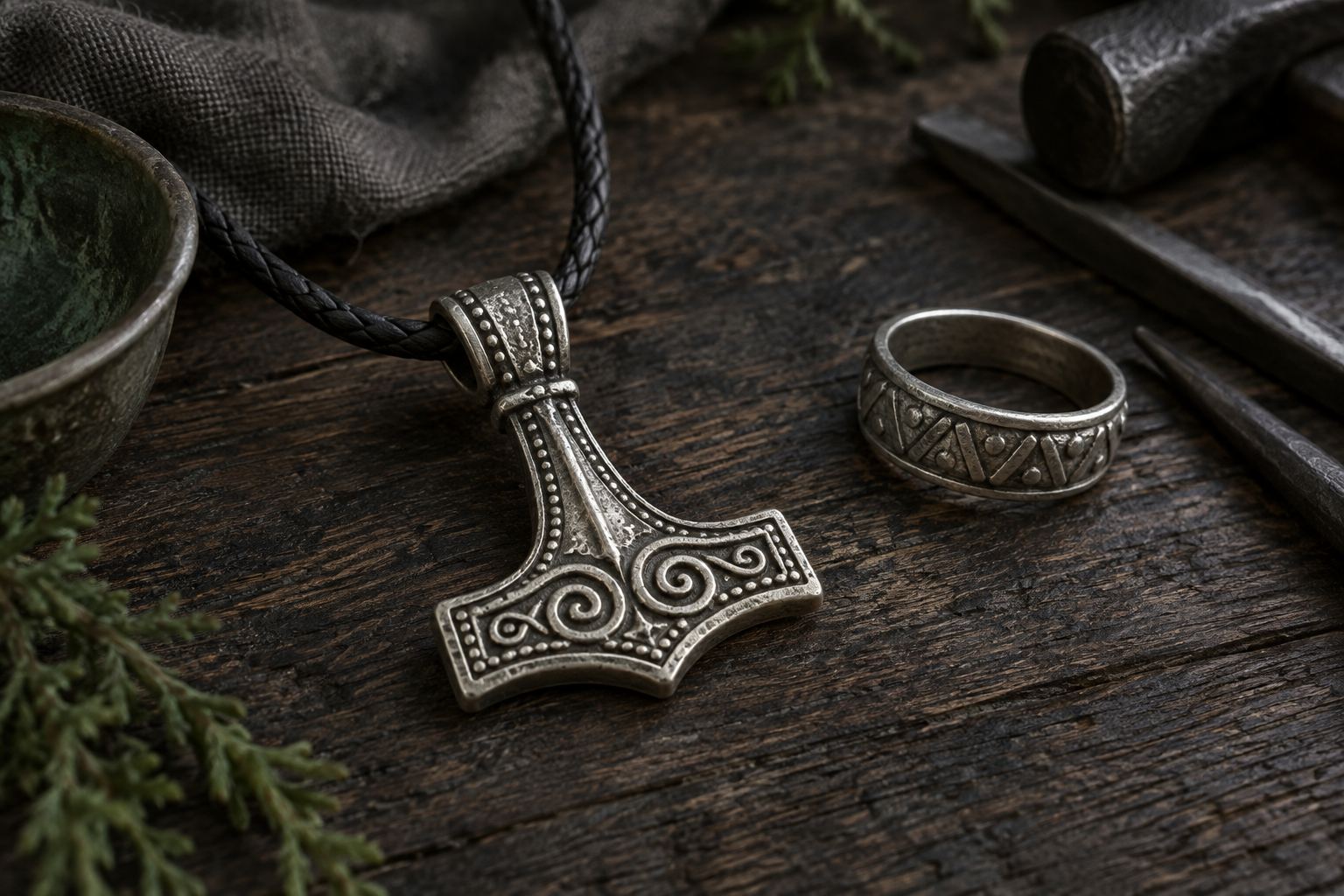
One of the clearest, documented Viking Age symbols in jewelry is the Thor’s hammer pendant. Mjölnir pendants are supported by Viking Age archaeological evidence and are found across Norse contexts, which suggests a durable association between that form and references to Thor or protection in the Viking Age, as summarized by the National Museum of Denmark.
Runic inscriptions also appear on objects and are part of the material record. As the Swedish History Museum notes, runes were a writing system and not solely magical symbols; they were used for messages, names, ownership marks and occasionally short formulaic expressions placed on jewelry or small objects. Treating every rune as a talismanic charm is therefore an anachronistic simplification of a broader practice.
Iconography drawn from myth—animal motifs, stylized serpents, and depictions related to key figures like Odin—appear in Scandinavian art and mythic literature. The Swedish History Museum highlights that ravens and wolves are present in Norse mythological traditions and that the world-tree Yggdrasil is a recurring motif in later sources. These mythic references inform how modern designers select imagery, but the precise meanings assigned to a motif in a given archaeological find are often inferential rather than definitively stated in contemporary texts.
Signs to treat as later or uncertain (Icelandic magic and modern attributions)
Not every well-known 'Viking' symbol actually belongs to the Viking Age. Two widely seen examples—the Vegvísir (a runic-looking compass) and the Ægishjálmur (often called the Helm of Awe)—are documented in later Icelandic manuscript traditions rather than in Viking Age archaeological contexts. Academic research shows that these signs are post-Viking and specifically Icelandic rather than securely attested pan-Scandinavian symbols of the Viking Age.
The so-called Valknut is another motif commonly sold as a 'Viking symbol for the slain' or 'symbol of Odin.' Research at Aarhus University emphasizes that the modern name and many of the popular meanings ascribed to the Valknut are modern constructions and not Viking Age certainties. That is, the object type appears in the material record, but precise ancient naming and symbolic explanation are not supported by contemporary written sources, so assigning a single definitive meaning would be misleading.
In short, later medieval Icelandic magic signs and modern commercial narratives coexist alongside genuine Viking Age material, and they must be distinguished in responsible labeling and interpretation.
How motifs and traditions appear in jewelry today
Contemporary jewelry uses a mix of directly attested forms and creative reinterpretations. Thor’s hammer is commonly made as a pendant, frequently in cast silver or bronze, modeled on archaeological finds; those are directly rooted in the Viking Age record and are therefore reasonable choices for someone seeking historical continuity, as noted by the National Museum of Denmark.
Runes appear as engraved bands on rings, pendants and bracelets. Because runes were a writing system used for names and messages, many modern pieces use runic inscriptions to spell names, dates or single-word concepts. The Swedish History Museum’s framing of runes as a script helps explain why runic inscriptions are used both as identifiers and as decorative motifs.
Later Icelandic symbols such as the Vegvísir or Ægishjálmur appear widely in contemporary designs that draw on medieval manuscript sources rather than Viking Age artifacts. Designers may combine these with modern materials, colored enamel or gemstones for aesthetic effect; these combinations reflect modern taste and personal meaning rather than a direct Viking precedent. Likewise, mythic animal motifs—raven, wolf, boar—are popular as stylized metalwork and can reference Norse stories even when the specific design is modern.
Separating documented meanings from modern personal interpretation
Documented meanings are those we can reasonably infer from the archaeological record and contemporary evidence. For example, the recurrence of Thor’s hammer pendants in Viking Age graves points to some connection with Thor-related identity or protective associations in that period, and this is the kind of conclusion supported by museum research such as that of the National Museum of Denmark.
By contrast, modern personal interpretations—such as using a Valknut necklace specifically to guarantee a particular destiny or calling the Vegvísir an 'authentic Viking compass'—are contemporary constructions. Aarhus University and other scholarship caution that many modern jewelry meanings must be labeled as interpretations rather than historical facts.
A practical rule of thumb: if a meaning is promoted by a seller but not explicitly attested in Viking Age finds or texts, it should be treated as a modern symbolic layer added for fashion, spirituality or storytelling. That is not inherently wrong, but clarity about origin helps avoid misrepresentation.
Practical guidance for choosing or gifting Viking-symbol jewelry respectfully
Decide what matters most to you or the recipient: historical authenticity, aesthetic appeal, spiritual resonance, or a combination. If historical authenticity is the priority, choose motifs and object types that are archaeologically attested from the Viking Age—Thor’s hammer pendants and runic-name inscriptions are examples the National Museum of Denmark and the Swedish History Museum identify as such.
If you want a piece with spiritual or navigational symbolism, be aware many well-known 'Viking' signs are from later Icelandic manuscripts. If that matters to the recipient, look for honest labeling that cites the source tradition rather than implying a Viking Age origin.
Consider the recipient’s beliefs and identity. Some Norse-themed symbols are used as religious emblems today; gifting a symbol of faith should be done with sensitivity and, when appropriate, with a conversation about what the symbol means to them. Conversely, if you gift a piece as a historical replica or design object, make that clear rather than suggesting it conveys an ancient magical power.
Choose reputable makers or museum-replica sources when authenticity is important. Inspect craftsmanship and materials; simple, well-made silver or bronze castings modeled on archaeological examples will communicate a commitment to authenticity. If you prefer modern or hybrid designs, look for makers who explain their inspirations and sources, so meaning is transparent.
Finally, respect cultural context. Distinguish Viking Age artifacts from later medieval Icelandic magic signs, as scholarship collected by De Gruyter and academic work such as that at Aarhus University underscores that conflation of sources is common but avoidable with good labeling.
Frequently asked questions
Are Thor’s hammer pendants authentic Viking symbols?
Yes. Thor’s hammer (Mjölnir) pendants are supported by Viking Age archaeological evidence and are widely discussed by museum sources such as the National Museum of Denmark as an attested object type rather than a solely modern invention.
Were runes only used as magical symbols?
No. The Swedish History Museum explains that runes were a writing system used for names, ownership marks and short inscriptions; while some runes had ritual or symbolic uses, they were not exclusively magical signs.
Is the Vegvísir a Viking Age symbol?
No. The Vegvísir is documented primarily in later Icelandic manuscripts and not in the Viking Age archaeological record; De Gruyter and other scholarship describe it as a later Icelandic sign rather than an attested Viking symbol.
What is the Valknut and is its meaning certain?
The Valknut appears in the material record, but modern names and many ascribed meanings are not guaranteed Viking Age facts. Aarhus University research advises treating many popular Valknut explanations as modern interpretations unless supported by explicit contemporary evidence.
How should I choose a piece to give as a gift?
Decide whether the recipient values historical authenticity, spiritual meaning, or modern design. If authenticity matters, prefer motifs attested to the Viking Age and choose reputable makers who cite sources. If gifting a symbol of faith, discuss its significance with the recipient first to ensure respect for personal beliefs.
Can modern interpretations of Viking symbols be meaningful?
Yes. Modern meanings can be personally significant and culturally resonant. The important practice is to be transparent about whether a meaning is historically attested or a contemporary interpretation, a distinction highlighted in academic discussion.
Sources and further reading
- Clothes and jewellery — National Museum of Denmark
- The first runes — Swedish History Museum
- A “VALKNUT” IN THE CAPITOL: Viking Age Symbol and Modern Myth — Aarhus University
- Odin – leader of the gods — Swedish History Museum
- Guidance from ancient symbols: Vegvísir, Ægishjálmur and other galdramyndir — De Gruyter