Meaning at a glance
The waterfall motif in jewelry has limited direct documentation as a continuous historical symbol; museum sources show that natural and flowing forms reappear in different periods and contexts, while most specific meanings attached to 'waterfall'—such as flow, renewal, or abundance—are modern personal interpretations. This article separates documented history (as outlined by the Victoria and Albert Museum) from contemporary uses, explains typical design treatments and gemstone choices, and gives practical guidance on selecting, verifying, and gifting waterfall-style jewelry with reference to consumer-protection advice from the Federal Trade Commission.
Direct answer — concise
Documented museum evidence does not present a single, continuous historical meaning for the "waterfall" motif; instead, museums record that natural and flowing forms have been adopted and adapted by different designers and periods. Modern associations—flow, renewal, emotional release, or abundance—are contemporary, personal, or commercial interpretations rather than universally attested historical meanings. Use the motif as a personal or aesthetic symbol, and apply standard buying safeguards when choosing gemstones and treatments.
What the historical record actually shows
The phrase "waterfall motif" as a distinct, named symbol is not extensively documented across ancient cultures in the curated material available from museum overviews. The Victoria and Albert Museum presents jewelry history as a sequence of changing styles and social meanings rather than a catalog of fixed symbolic motifs, and it emphasizes that designers repeatedly borrow natural forms and flowing shapes when those ideas suit contemporary tastes or technologies. In short, museum scholarship records that flowing, cascade-like shapes appear across periods but does not treat "waterfall" as a single, stable symbol with one agreed meaning.
Which cultures or periods use flowing, water-like forms in jewelry?
Museum collections and exhibitions show that artisans and jewellers have repeatedly favored naturalistic and flowing motifs when those styles were fashionable. For example, late nineteenth- and early twentieth-century tendencies toward naturalism led many designers to make pieces inspired by plants, water, and other organic forms; the Victoria and Albert Museum frames these shifts as changes in taste and social context rather than as transmission of a single meaning.
Similarly, in other periods and regions a preference for curving lines or graduated elements can reflect technological advances in setting, the availability of particular gemstones, or changing dress styles that called for longer, layered or draped jewellery. The V&A's materials emphasize style and context over any single symbolic definition, so attributions that present the waterfall motif as a historically stable emblem should be treated cautiously.
Documented historical meanings versus modern personal interpretations
Documented historical meanings: Museum interpretive materials attribute meaning to jewelry by situating pieces in their social, economic, and stylistic context. When a museum like the Victoria and Albert Museum explains why a motif appears—whether to signal status, to follow a fashionable aesthetic, or to reference nature—it does so by citing period tastes and available techniques. Those are documented, contextual explanations, not universal symbolic claims about water or waterfalls.
Modern personal interpretations: The most common meanings attached to waterfall designs today—flow, emotional release, resilience, abundance, or continuity—are modern resonances that individuals and designers apply. These interpretations are valuable for personal expression and marketing, but they are not documented as longstanding, cross-cultural meanings in the museum sources consulted here. Treat such contemporary meanings as subjective and local rather than historical fact.
How the waterfall motif, gemstones, and techniques appear in jewelry
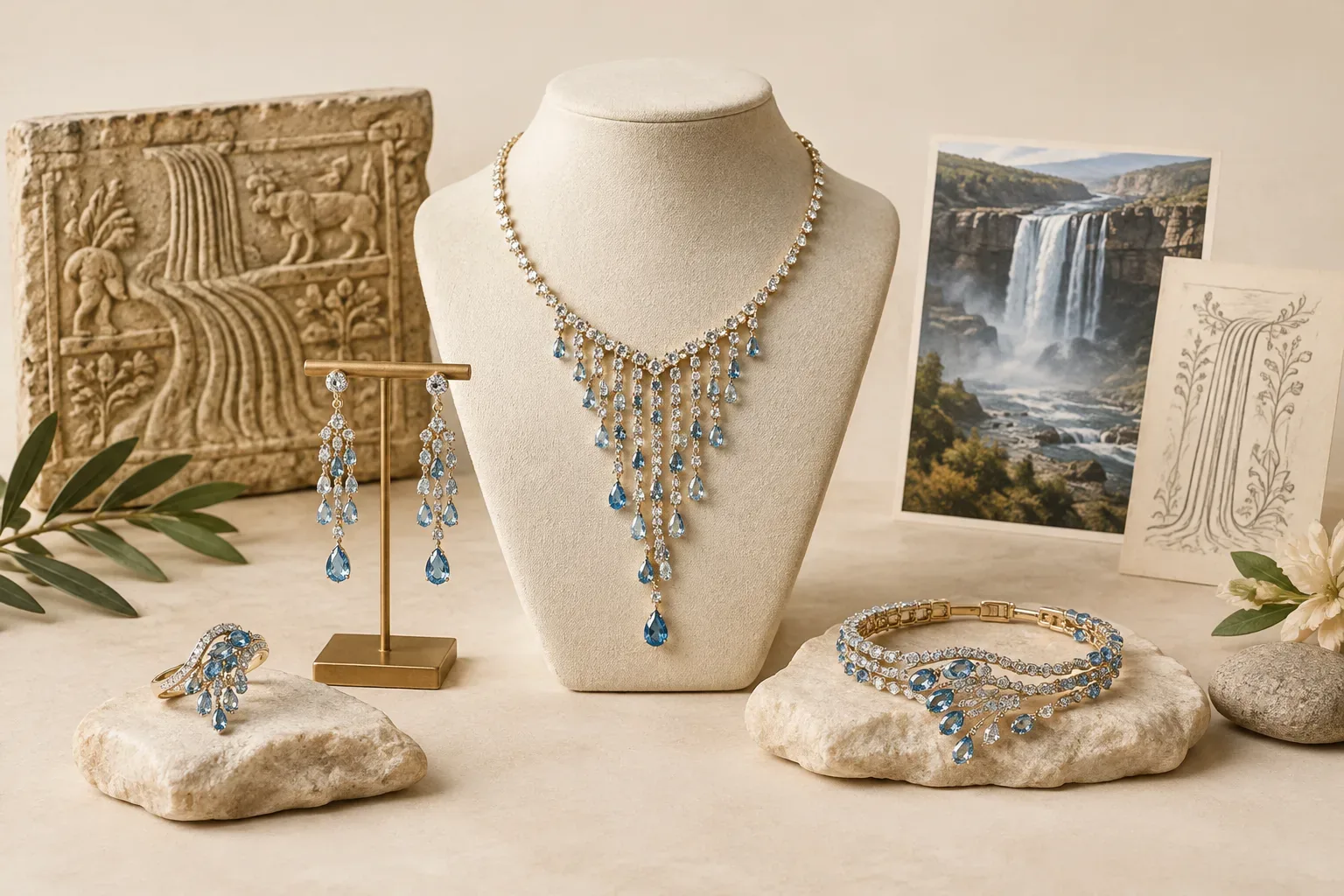
Design languages: In modern jewellery the 'waterfall' idea is usually communicated through cascade structures, graduated gem sizes, tapered arrangements, or layered chains that create a downward or flowing visual motion. Designers may use rows of graduated stones, fringe-like settings, or overlapping metalwork to suggest movement similar to a falling stream.
Gemstones and cuts: Jewellers often choose stones and cuts that enhance the sense of flow. Faceted drops, pear shapes, graduated rounds, and small pavé stones can all contribute to a cascading effect. The Victoria and Albert Museum's overview of gemstones notes how gem identification and cutting have influenced jewellery styles; historically, the availability of particular cuts and gem types affected how designers achieved desired visual effects.
Construction and setting: Cascade designs rely on mobility and light play to convey motion. Multi-link chains, articulated settings, and secure but flexible joins create movement while maintaining durability. Because waterfall-style pieces often include many small stones or delicate links, construction quality matters for longevity and wearer comfort.
Practical guidance for selecting or gifting waterfall jewelry
Begin with the wearer’s style and lifestyle: Choose scale and motion that suit daily habits. A dramatic, multi-tiered waterfall necklace reads as evening jewellery and may snag on fabrics, while a small cascade earring or pendant offers the motif in a more wearable daily form. Consider metal allergies, clasp strength, and how the piece will pair with existing jewellery.
Check materials and disclosures: The Federal Trade Commission advises buyers to expect truthful labeling about treatments, imitations, and metal content. Ask the seller about gem treatments, whether stones are natural or lab-grown, and whether any plating or surface treatments are present. Reputable retailers will provide clear information and, where appropriate, certification or a written disclosure.
Assess construction for movement and durability: Because the motif depends on articulated parts, inspect joins, jump rings, and settings. For pieces with multiple small stones, check that prongs, bezels, or settings are secure and evenly finished. For vintage or delicate waterfall pieces, factor in professional maintenance or restringing costs.
Match symbolism thoughtfully and respectfully: If you are choosing a waterfall motif to convey a meaning—renewal, emotional flow, or resilience—make that intent personal and explicit rather than assuming the symbol carries that meaning for everyone. Avoid presenting a motif as a religious or culturally sacred emblem unless you have specific evidence for that culture and context. If the piece or style references a distinct cultural tradition, learn its background and, when appropriate, seek the guidance of practitioners or scholars.
Care, authentication, and resale considerations
Care: Articulated pieces and multiple small stones require gentle handling. Store waterfall jewellery flat or in a way that prevents entanglement. Clean according to the gemstone and metal type to avoid loosening settings or damaging soft stones.
Authentication: For higher-value gems, consider independent appraisal or lab reports. For consumers, the FTC’s guidance about gemstone treatments and imitations is a practical baseline: ask sellers to disclose treatments, enhancements, and country of origin where relevant.
Resale and sentimental value: Because the waterfall motif is fundamentally a design choice, resale value depends on material content, maker, condition, and provenance rather than symbolic meaning. Sentimental value is separate from market value and may make the motif especially appropriate for commemorative gifts.
Putting it together: choosing a waterfall piece with intention
Use the motif to express an intention or to complement a wardrobe. If you want the symbolism to be part of the gift, explain your intention in a card or conversation so the recipient understands why you chose a waterfall design. If the goal is purely aesthetic, focus on proportion, movement, and construction quality.
When in doubt, prioritize quality disclosures and clear communication. Museums remind us that forms migrate through time and that designers repurpose natural imagery to new ends; the most reliable way to be respectful is to be transparent about your own meaning and to verify material claims when material value matters.
Frequently asked questions
Does waterfall jewelry have a single historical symbolic meaning?
No. Museums such as the Victoria and Albert Museum document that flowing and natural forms recur in jewellery across time, but they do not present a single, continuous symbolic meaning for the "waterfall" motif. Many of the meanings people attach to waterfall designs today are modern or personal interpretations.
What gemstones work well for a waterfall design?
Stones that emphasize movement and light—faceted drops, pear cuts, graduated rounds, or small pavé stones—are commonly used. The Victoria and Albert Museum's gemstone guidance explains how cut and availability have historically shaped design choices. Choose stones and settings that match the intended wear (daily use versus occasional).
How can I verify that a waterfall piece’s gemstones are as described?
Ask the seller for written disclosure about treatments, whether stones are natural or lab-grown, and any imitations. The Federal Trade Commission recommends clear labeling and disclosure for gemstones and treatments. For higher-value purchases, request an independent lab report or appraisal.
Is it respectful to give waterfall jewellery as a symbolic gift?
Yes, provided you do not claim the motif as a sacred emblem for a culture unless you have clear evidence. Explain your personal intention when gifting and be mindful if the design clearly references a specific cultural tradition—seek informed guidance if needed.
What should I inspect when buying a waterfall-style piece in person?
Check the security of joins and settings, test the strength of clasps and jump rings, look for consistent finishing, and ensure small stones are firmly set. Consider how the piece moves when worn and whether it suits the recipient’s lifestyle.
Sources and further reading
- Bedazzled: A History of Jewellery — Victoria and Albert Museum
- An A-Z of Gemstones — Victoria and Albert Museum
- Buying Gemstones, Diamonds, and Pearls — Federal Trade Commission