Meaning at a glance
Documented museum histories show that water and river imagery have been used in jewellery in different cultures and periods with changing social meanings; modern wearers add personal and cultural layers, and practical buying guidance includes asking about gemstone treatments and respecting local meanings.
Quick answer
The river jewelry meaning is best described as a motif with historically shifting uses: museums document that water imagery and gems linked with water have been used in many periods and places for decorative, symbolic, and sentimental reasons, while modern wearers commonly layer personal interpretations—such as continuity, change, or emotional flow—on top of those earlier contexts. This article follows that documented history, separates historical evidence from later interpretations, and gives practical selection and gifting advice.
What the historical record shows
Museum research and exhibitions emphasize that jewellery motifs and their meanings change with time and social context rather than remaining fixed. The Victoria and Albert Museum presents jewellery history as a story of evolving styles, technologies, and social roles, and its materials make clear that motifs drawn from nature—including water—appear repeatedly in collections from different eras and places. Use of river or water imagery in jewellery is therefore best read as part of those changing visual vocabularies rather than as one single, invariant meaning.
Collections and reference guides such as the V&A’s survey of gemstones note that certain stones have long visual or thematic associations with water because of their colour, origin, or use in maritime settings. Gemstones commonly linked to watery themes in museum contexts include aquamarine, pearls, opal, and turquoise. The museum’s resources treat these links as part of how people have chosen materials and motifs to convey fashion, status, occupation, or taste rather than as universal symbolic laws.
Because the authoritative sources used here are museum surveys of jewellery and gemstones, the historical claims that follow are intentionally cautious: museums document presence, usage, and changing context, but they do not reduce motifs to a single meaning that applies across cultures and centuries. Where a motif is recorded in a specific cultural object or period, that object’s provenance and context must be consulted for a reliable interpretation.
Documented historical meanings (separate from later claims)
What is documented in museum histories is primarily the use and changing function of motifs rather than a single, universal symbolic dictionary. For example, the V&A’s overview of jewellery history highlights that motifs drawn from nature—including imagery of water and flowing lines—appear in multiple periods as decorative elements, status markers, or components of sentimental jewellery. In museum catalogues, the appearance of a water-related motif is recorded; the interpretation of meaning is tied to the object's date, maker, patron, ritual setting, or inscription rather than to the motif alone.
Similarly, gemstones with visual or cultural ties to water are recorded for their material properties, geographical sources, and historical uses. The V&A’s A–Z of gemstones provides context about which stones were used in specific periods and why they appealed to jewellers and wearers, for reasons such as colour, rarity, or trade connections. Those documented associations—stone choice, setting style, and placement in collections—are reliable pieces of historical evidence; assigning emotional or spiritual meanings beyond the object’s documented role is a later interpretive step and needs separate substantiation.
Modern personal and cultural interpretations
Contemporary wearers commonly project personal meanings onto river motifs: continuity, adaptability, emotional flow, life transitions, fertility, travel, or homecoming are examples that people today may intend when choosing a river-themed piece. These modern interpretations are valid personal or cultural responses but should be distinguished from the documentary record of historical use. Museums such as the V&A make the difference clear by focusing on provenance and material context when describing older objects.
Modern symbolic meanings often emerge through contemporary design and marketing as well as personal narrative. A jeweller today might brand a wave or flowing-line pendant as ‘representing resilience’ or an aquamarine ring as ‘a reminder to go with the flow.’ Those branding statements and the wearer's private associations are meaningful in contemporary practice but should not be conflated with documented historical meanings unless a specific object or text from the relevant period supports the claim.
How the river motif, gems, and traditions appear in jewellery
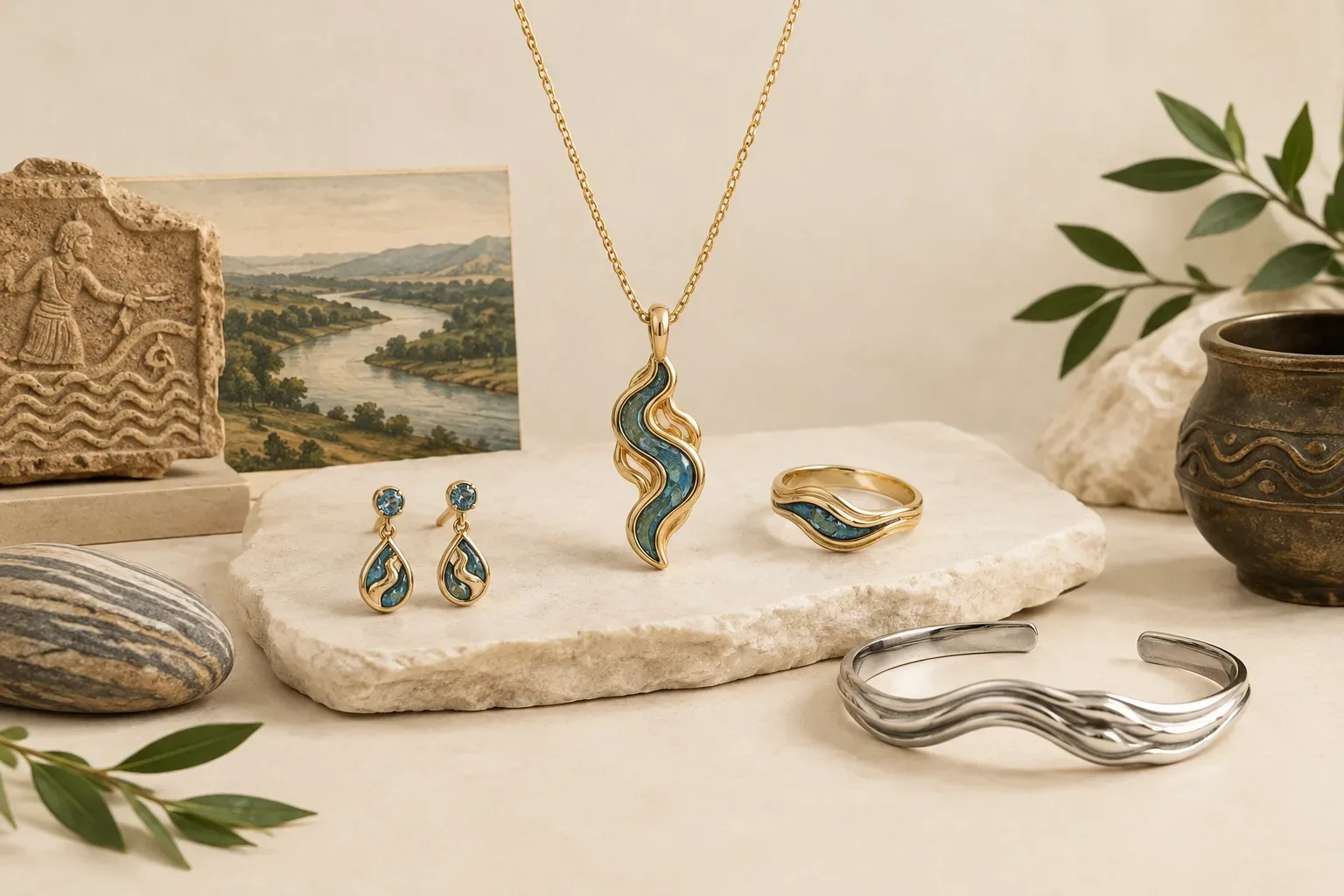
Design vocabulary: River and water imagery is expressed in jewellery through several well-established design devices: stylized wavy lines and undulating metalwork that suggest moving water; enamel or painted miniature scenes depicting streams or rivers; flowing chains and graduated bead strings that mimic current and motion; and layered or graduated gemstones that evoke depth and shimmer.
Gemstones and materials: Stones often associated with water in museum documentation include aquamarine (pale blue-green hues), pearls (organic nacre with a maritime provenance), turquoise (opaque blue-green shades tied to particular mining traditions), and opal (play-of-colour reminiscent of water reflections). These materials are used for their colour, texture, or origin stories, and museum guides discuss them in terms of identification, historical use, and cultural preferences.
Techniques and traditions: Makers have used settings that enhance movement—long drop earrings, fringe necklaces, and articulated bangles—to create an impression of flow. Enamel scenes or inlaid stones can narrate landscape themes that include rivers. In sentimental jewellery traditions documented by museums, fluid forms and water metaphors were sometimes used alongside inscriptions, lockets, or hairwork to convey memory, travel, or separation, with the exact meaning inferred from accompanying evidence such as inscriptions or provenance.
Practical and respectful guidance for choosing or gifting river jewellery
Match meaning to context: If you buy or gift a river-themed piece because of a particular symbolic intention—such as marking a move, recovery from illness, or a relationship milestone—consider explaining that intention to the recipient, or choose a design whose form communicates the idea without appropriating another culture’s sacred imagery. Asking the recipient about preferences and any cultural or religious sensitivities is respectful and prevents unintended offense.
Check materials and disclosures: When assessing gemstones, ask the seller for clear information about treatments, enhancements, or imitations. The Federal Trade Commission recommends that buyers be told about treatments and that sellers disclose whether gems are synthetic or laboratory-grown. Request written confirmation or a lab report for high-value stones and be alert to common enhancements that affect value and care.
Prioritise durability and wearability: If the piece is intended for daily wear, choose durable settings and harder gems. Consider how often the recipient wears jewellery and whether they prefer subtle or statement pieces. Designs with articulated elements or long drops convey movement but may require more maintenance than a simple pendant.
Respect provenance and cultural meanings: Avoid using elements that are explicitly sacred or culturally specific unless you understand their significance and have permission or clear local guidance for such use. If a river motif is a distinct emblem with a community-specific meaning, consult sources or members of that community before adopting it as a personal symbol.
Care and maintenance: River-themed jewellery that uses delicate enamel, articulated links, or softer stones (pearls, opal, turquoise) benefits from gentle cleaning and appropriate storage. Ask the seller or a trusted jeweller about recommended cleaners and whether the piece should avoid water, perfumes, or strong sunlight.
Concluding note
River motifs in jewellery sit at the intersection of material choice, changing fashion, and personal meaning. Museum resources from the Victoria and Albert Museum show that such motifs and water-associated gemstones have appeared repeatedly but with different roles across periods and cultures. Modern wearers add contemporary layers of meaning; the most thoughtful choices come from combining informed knowledge of materials and provenance with openness about the personal or cultural significance you intend to convey.
Frequently asked questions
Does river jewelry have one universal meaning?
No. Museum sources show that water and river imagery have been used in different periods and cultures for varied decorative, social, and sentimental purposes. Modern symbolic meanings—such as continuity or emotional flow—are contemporary interpretations layered on top of those earlier uses.
Which gemstones are commonly associated with river or water themes?
Gemstones often linked with watery themes in museum contexts include aquamarine, pearls, turquoise, and opal because of their colours, origins, or visual qualities. The V&A’s A–Z of gemstones discusses these associations in terms of material history and use.
How can I verify whether a gemstone has been treated or is synthetic?
Ask the seller for clear disclosure about treatments and for a written report or lab certificate for higher-value stones. The Federal Trade Commission recommends that sellers disclose enhancements and whether stones are synthetic or imitation.
Is it respectful to gift river-themed jewellery from another culture?
Respectful gifting means checking whether a motif is sacred or community-specific before using it. If a design has clear cultural or religious significance, consult knowledgeable sources or community members and choose a piece that acknowledges or honors that meaning rather than appropriating it.
What styles of river jewellery are best for everyday wear?
For everyday wear, choose durable settings and harder stones. Simple pendants or stud earrings with robust settings are usually more practical than delicate enamel scenes or long articulated fringe pieces, which may need more maintenance.
Can men wear river-motif jewellery?
Yes. River motifs are not inherently gendered. Contemporary jewellery embraces a wide range of styles for any wearer; the choice should be guided by personal taste and the practical considerations of fit and durability.
Sources and further reading
- Bedazzled: A History of Jewellery — Victoria and Albert Museum
- An A-Z of Gemstones — Victoria and Albert Museum
- Buying Gemstones, Diamonds, and Pearls — Federal Trade Commission