Meaning at a glance
Wind jewelry meaning combines historical use of natural motifs in decorative arts with modern personal interpretations such as freedom and change; museums document the visual language while contemporary wear relies on individual context and design choices.
What the historical record shows (and where that evidence comes from)
Interpretations of the wind motif in jewelry must start with what is visible in museum collections and catalogue research. The Victoria and Albert Museum (V&A) frames jewelry as an expressive set of objects whose forms and subjects change over time with fashion, technology, and social meaning. The V&A has documented how natural forms—from foliage and animals to more abstract representations of movement—appear across historical periods and geographies as decorative motifs and as part of changing tastes and techniques.
Because museums like the V&A curate objects from a broad range of cultures and periods, the surviving evidence for wind-related motifs is best described by period and technique rather than by asserting a single, universal symbolic meaning. In European decorative arts, for example, jewelers in Renaissance, Georgian, and Victorian contexts explored naturalistic motifs and later stylized forms; the V&A’s historical overviews show these shifts in style and social use. Across other traditions represented in collections, craftsmen likewise used feathers, fans, and curved lines to indicate air or movement, but the specific cultural meanings attached to those elements vary and are recorded in object labels and catalogues rather than as a universal doctrine.
Separating documented historical meanings from modern interpretations
Documented historical meanings come from context recorded with objects: how and when a piece was worn, its patron, and any contemporary texts that explain a motif. Museums like the V&A emphasise how shifting social contexts altered the role of jewelry—from status and memory to sentimentality and fashion—and how motifs were adopted and reinterpreted as tastes changed. Those curatorial records establish that wind-related imagery has been used visually, but they do not automatically prove one single symbolic meaning across time or place.
Modern personal interpretations are contemporary layers of meaning that wearers, designers, and marketers apply to a motif. Today, many people choose wind-themed jewelry to represent ideas such as freedom, change, travel, or breath—meanings rooted in modern language and individual experience rather than in a single historical tradition. It is important to distinguish such modern uses from documented historic symbolism: the latter is based on provenance and material evidence, the former on personal or cultural narrative.
How the wind motif appears in jewelry: motif, form, and gemstones
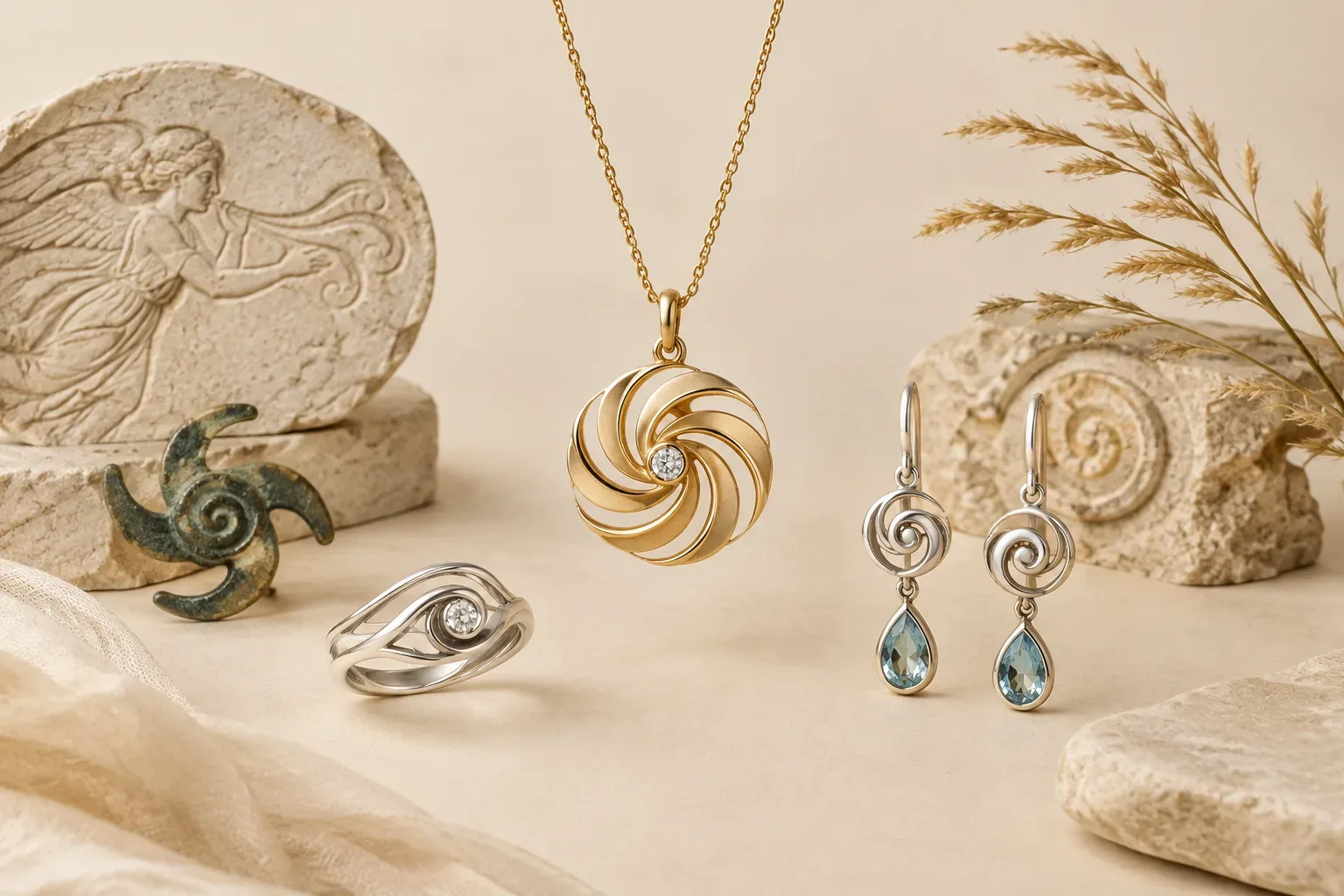
Form and motif. Designers and historic makers suggest wind visually through flowing lines, spirals, openwork that looks like gusts, feather imagery, fan shapes, and moving parts such as rotating elements or articulated links. Museum collections and exhibitions described by the V&A show examples where jewelers use these graphic devices to imply movement, whether in fixed metalwork or in kinetic pieces that actually move with the wearer.
Kinetic and engineered pieces. From early examples of articulated chains and articulated pendants to later mechanical novelties, makers have used movement to embody the idea of air. The V&A’s historical treatment of jewellery notes the role of technological and craftsmanship advances in enabling such effects, and collections include pieces that rely on hinges, swivels, and lightweight construction to animate a motif.
Gemstones and optical effects. Gemstones that show play-of-color, adularescence, or light-scattering effects are a natural complement to wind imagery because their surface variations suggest motion or changing light. The V&A’s A–Z of Gemstones explains how stones such as opal (play-of-color) and moonstone (adularescence) create visual dynamics that designers may use to evoke breath, shimmer, or moving air. Pearls and well-cut faceted stones can also be set to catch light as the wearer moves, reinforcing an impression of movement even in static metalwork.
Surface treatment and texture. Engraving, chasing, and granulation can create ripple-like textures that read as wind or breeze in miniature. Enamelling can add gradients and translucence that suggest shifting air. Museum documentation highlights these craft choices as part of a maker’s repertoire for suggesting natural phenomena.
Practical guidance for choosing or gifting wind-themed jewelry
Start from context. Ask what the recipient already values: do they prefer literal symbols (a feather or fan), abstract motifs (spirals or gust lines), or moving designs (spinner rings, articulated pendants)? Choosing a piece that matches personal style makes the symbolic layer more meaningful and wearable.
Respect cultural specificity. Because motifs drawn from different cultures can carry distinct, documented meanings, avoid assuming universality. If a piece clearly references a specific cultural tradition, take time to learn what that tradition expresses about the motif and, if appropriate, consult knowledgeable sources or the piece’s provenance before gifting. The V&A’s curatorial approach underlines the importance of provenance and context in understanding an object's meaning.
Prioritise quality and disclosure. Whether you buy vintage or new gemstones, follow consumer guidance about treatments and imitations. The Federal Trade Commission advises buyers to ask sellers about material treatments, enhancements, origin claims, and whether any stones are synthetic or assembled. Request written disclosure when possible and prefer reputable dealers who provide clear information about gemstone treatment and metal fineness.
Match durability to design. If you choose kinetic or moving pieces, consider the recipient’s lifestyle. Articulated chains, delicate swivels, and small moving parts are beautiful but can require more care than solid, fixed forms. For everyday wearers, sturdier interpretations of the wind motif—engraved bangles, sturdy pendants, or minimalist motifs—may better balance symbolism with longevity.
Personalise where appropriate. A simple way to give wind-themed jewelry personal meaning is to pair the motif with an engraved date, a small stone in a birth color, or by choosing a setting that reflects an inside memory (for example, a stone that reflects the hue of a coastline where a couple met). These choices make the object meaningful to the recipient without imposing a presumed cultural interpretation.
Care, authentication, and buying notes
Caring for wind-themed pieces follows normal jewellery practice but pay special attention to moving parts and delicate inlays. Clean pieces carefully according to metal and gem type, check joints and clasps periodically, and seek professional repair for any damage to articulated elements.
When buying vintage or marketed 'symbolic' jewellery, request provenance information or condition reports. The V&A’s catalogue approach shows how much context contributes to meaning: a documented provenance or maker’s record adds historical interest and may clarify whether a motif was intended as a sentimental emblem, fashion motif, or merely decorative flourish.
Ask sellers about gem treatments and verification. In line with FTC advice, expect disclosure about whether a gemstone has been heat-treated, dyed, impregnated, assembled, or is a lab-grown or synthetic material. Clear answers protect both buyer and giver and maintain the integrity of whatever meaning the piece is intended to carry.
Final considerations
Wind jewelry meaning is layered: museum documentation (for example the Victoria and Albert Museum’s work on jewellery history and its A–Z of gemstones) shows that makers have long used visual devices to suggest air and motion, but those museum records rarely support a single universal symbolic claim. Modern wearers freely attach contemporary meanings—freedom, change, breath—to wind motifs, and those interpretations are valid when acknowledged as personal or cultural choices rather than universal facts.
If your goal is a historically rooted gift, look for provenance and curatorial notes; if your goal is a meaningful contemporary gift, choose a design that resonates with the recipient and verify material quality and disclosure. Either approach becomes more thoughtful when informed by the kinds of object histories and gemstone information that institutions like the V&A collect and when buyers follow consumer-protection guidance such as that published by the FTC.
Frequently asked questions
Is the wind motif a universal symbol in jewellery?
No. Museum documentation shows that makers have used visual devices to suggest air or movement across many periods and cultures, but the specific meanings attached to those devices differ by time, place, and context. Modern meanings like freedom or change are contemporary interpretations rather than universal historical facts.
Which gemstones are best if I want a piece that suggests movement or air?
Gemstones that display optical effects—such as opal with play-of-color or moonstone with adularescence—are often chosen to suggest shimmer or motion, as described in the V&A’s A–Z of Gemstones. Faceted stones and pearls can also catch and reflect light in ways that reinforce a sense of movement.
What should I ask a seller when buying wind-themed jewellery?
Ask for provenance or a condition report for vintage pieces, and request disclosures about gemstone treatments, synthetic materials, or assembling processes. The Federal Trade Commission recommends that sellers disclose heat treatments, dyeing, impregnation, or synthetic origin of gemstones.
Are kinetic wind pieces (spinner rings, articulated pendants) durable for everyday wear?
Kinetic pieces are beautiful but can be more delicate than solid designs. If the recipient plans to wear the piece daily, choose well-constructed mechanical elements, verify the maker’s reputation, and be prepared for occasional maintenance or repair.
How can I respectfully gift a piece that references another culture’s motifs?
Learn the provenance and meaning of the motif when possible, consult reliable curatorial or scholarly sources, and consider whether the piece is an accurate cultural representation or a contemporary reinterpretation. When in doubt, choose designs that are clearly contemporary and personal rather than borrowing sacred or identity-specific symbols without context.
Sources and further reading
- Bedazzled: A History of Jewellery — Victoria and Albert Museum
- An A-Z of Gemstones — Victoria and Albert Museum
- Buying Gemstones, Diamonds, and Pearls — Federal Trade Commission