Meaning at a glance
Explain the documented history and changing contexts of the palm tree motif, separate cultural or religious evidence from later popular interpretations, and give practical guidance for choosing and wearing the motif in modern jewelry.
Short answer
Palm tree jewelry meaning is not a single, timeless message; museum scholarship shows that botanical motifs have appeared across periods and stylistic movements, while contemporary uses layer personal, regional, and commercial meanings on top of that history. The reliable record, as summarized by museum scholarship, documents changing styles and contexts rather than one uniform symbolic definition, and practical buying guidance focuses on materials, craftsmanship, and disclosure of treatments.
What the historical record shows
Museum accounts of jewellery history emphasise that designers have long borrowed plant and nature forms to signal taste, status, or sentiment rather than one fixed idea. The Victoria and Albert Museum's overview of jewellery history highlights how decorative motifs shift in meaning as they move between social classes and eras, especially during well-documented stylistic periods such as the Victorian era and the Art Nouveau movement.
Victorian jewellery (mid- to late 19th century) often used botanical forms as part of naturalistic sentimentality and mourning practices, while the Art Nouveau period (roughly late 19th to early 20th century) embraced organic lines and plant motifs as a deliberate design philosophy, according to the Victoria and Albert Museum. Those institutional accounts show that plant imagery in jewelry primarily functioned as style, emotional reference, or craft expression rather than as a single, universally agreed symbol.
There is less consistent, directly documented museum evidence that the palm tree motif carried one precise meaning across ancient civilizations and later European fashions. Where the V&A and similar collections discuss specific plant motifs, they emphasise context: the same motif can be decorative, civic, religious, or sentimental depending on when and where it was made and worn.
Documented historical meanings versus modern personal interpretations
Documented meanings in museum literature tend to describe how and why motifs were used—for example, to show wealth, follow fashion, or express mourning—rather than to offer a single symbolic translation of a single plant form. The reliable evidence therefore supports claims about changing social context and design trends, not a single ancient 'meaning' of the palm tree motif.
Modern interpretations are frequently personal, regional, or commercial. Contemporary wearers often associate palm tree jewellery with tropical holidays, relaxation, resilience, or a love of coastal landscapes. Those associations are valid personal or cultural meanings but are modern layers of interpretation rather than direct continuations of a single documented ancient meaning. It is important not to conflate these newer, popular associations with a universal historical symbol.
When cultural or religious meanings are claimed, check for supporting documentation for that specific tradition. Museum catalogues and scholarly publications typically record explicit religious or civic uses; when such evidence is absent, a cautious approach is best: treat contemporary symbolic statements as part of fashion and personal expression rather than as unbroken historic continuity.
How the palm motif, gemstones, and techniques appear in jewelry
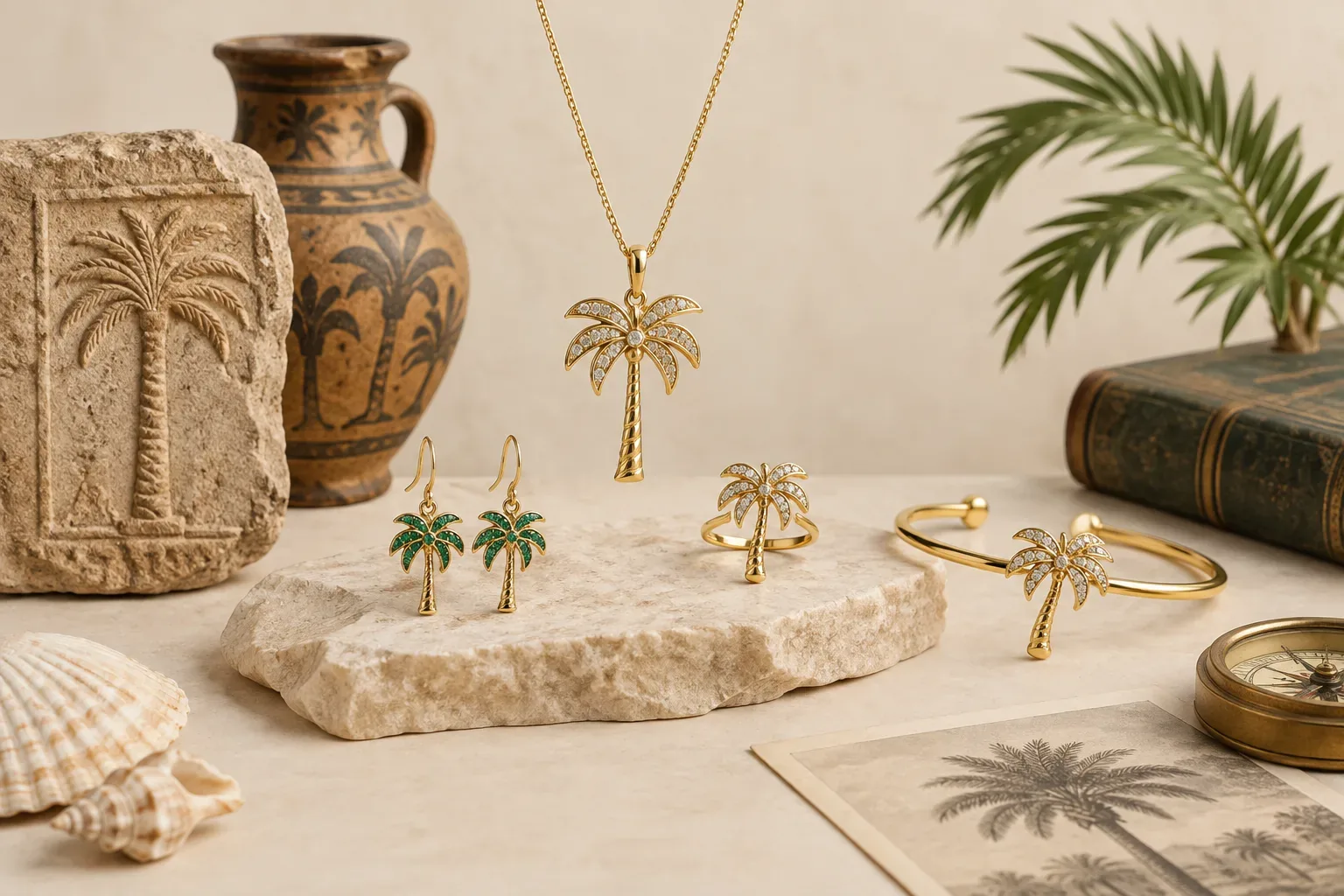
The palm tree motif appears in jewelry as pendants, charms, brooches, rings, and surface decoration on larger forms. The motif can be rendered as a silhouette, a detailed miniaturised scene, a stylised palmette, or as a single palm frond. Designers deploy a range of metalwork techniques—casting, engraving, filigree, and enamelling—to realise the motif, and museum surveys of jewellery history describe these techniques as recurring ways to translate botanical forms into wearable art.
Gemstones and materials used with palm motifs vary according to period and price point. For delicate contemporary pieces, small diamonds, peridots, or green tourmaline might accentuate fronds; turquoise or mother-of-pearl can evoke sea and sand associations. The Victoria and Albert Museum's A–Z of Gemstones provides accessible context on how particular gems have been used historically and the visual effects they contribute to jewellery design.
Modern makers also use non-precious materials—resins, shells, and coloured glass—in vacation or souvenir-style pieces. The choice of material affects both meaning and durability: precious metals and genuine gemstones tend to signal a more enduring, heirloom intention, while costume materials often signal seasonal or trend-driven wear.
Practical and respectful guidance for selecting or gifting palm tree jewelry
Decide what you want the motif to convey before you buy. If the intent is to commemorate a trip or season, a lightweight, casual piece may be appropriate. If you seek a gift that will become a long-term heirloom or symbol of resilience, prioritise quality metalwork and gemstones and choose a classic setting such as a small pendant in gold or a signet-style ring with a subtle palm engraving.
Ask direct questions about materials and treatments. The Federal Trade Commission advises buyers to seek clear disclosure about gemstone treatments, synthetics, and imitations. Request written information from sellers about metal content and any treatments to stones, and look for hallmarks or assay marks on precious metals. When a seller cannot provide straightforward answers, consider another trusted source.
Be culturally sensitive when gifting symbols. If a palm motif is an important symbol in the recipient's cultural or religious tradition, ask politely or research reputable sources before assuming a meaning. When in doubt, frame the gift as a personal token—a reminder of a place, a season, or a relationship—rather than a claim about cultural identity.
Consider durability and lifestyle. For everyday wear, choose higher karat gold or well-finished sterling silver with secure settings and a sturdy chain. For occasional or travel pieces, lighter, lower-cost designs may be more practical. Check clasp types, soldered jump rings, and the setting security of any stones.
Care, authenticity checks, and styling tips
Caring for palm tree jewellery follows standard practices for the materials used. Precious metals benefit from storage in a dry, airtight place and gentle polishing. Gemstones vary: some require professional cleaning, others tolerate light household methods. The V&A's general gemstone guidance and the FTC's consumer advice both underscore that treatment and imitation are common in the market, so follow the seller's care recommendations and avoid harsh chemicals unless a gem is explicitly rated safe for them.
To check authenticity, ask for documentation and look for common markers such as hallmarks on metals and reputable certification for higher-value stones. If you are uncertain about a stone or finish, a qualified gemmologist or a trusted independent jeweller can offer testing and appraisal.
Styling depends on context: small palm pendants layer well for a casual, modern look; a single palm frond ring can be an understated statement for everyday wear. For formal settings, choose restrained pieces that echo the motif without tipping into novelty. Remember that personal meaning is the most durable part of any symbol: wear it in a way that aligns with what it signifies to you.
Frequently asked questions
Does palm tree jewelry have one universal meaning?
No. Museum scholarship shows that plant motifs in jewelry change meaning by context and era. Contemporary associations—such as tropical escape, resilience, or coastal identity—are modern interpretations rather than a single historical meaning.
Are palm motifs associated with any specific historical period?
Botanical motifs appear in many periods, but museum accounts highlight strong naturalistic use in the Victorian era and the organic plant forms of Art Nouveau. Those sources emphasise stylistic trends rather than a single symbolic translation tied only to the palm.
What gemstones work well with palm tree designs?
Choices depend on the effect you want: green stones like peridot or tourmaline echo fronds, turquoise or mother-of-pearl evoke sea and sand, and small diamonds or white sapphires provide sparkle. Refer to museum gemstone guides for historical context and the Federal Trade Commission for disclosure of treatments or imitations.
How can I verify the quality and authenticity of a palm tree piece?
Ask sellers for written details about metal content and gemstone treatments, look for hallmarks, request receipts or certificates for higher-value stones, and consult an independent appraiser when in doubt. The FTC recommends clear disclosure about treatments and imitations.
Is palm tree jewellery appropriate to gift across cultures?
Often it is appropriate, but be mindful that symbols can carry specific cultural meanings for some recipients. If the motif has a special significance in a recipient’s tradition, ask respectfully or choose a neutral framing—such as a memory of travel—when presenting the gift.
Sources and further reading
- Bedazzled: A History of Jewellery — Victoria and Albert Museum
- An A-Z of Gemstones — Victoria and Albert Museum
- Buying Gemstones, Diamonds, and Pearls — Federal Trade Commission