Meaning at a glance
Explain the documented history and changing contexts of the pomegranate motif, separate cultural or religious evidence from later popular interpretations, and give practical guidance for choosing and wearing the motif in modern jewelry.
Quick answer
Pomegranate jewelry meaning is historically variable and context-dependent: museum records and gem guides show the pomegranate motif has been used across many periods and cultures to suggest ideas such as fertility, abundance, rebirth, and status, but those documented uses are specific to particular societies and contexts rather than universal. Modern wearers often adopt the motif for personal reasons—beauty, family, cultural identity, or reshaped symbolism—and practical buying considerations about materials and treatments remain the same as for any jewelry purchase.
Historical evidence and the cultures or periods where the motif appears
The Victoria and Albert Museum (V&A) places the pomegranate motif within the long sweep of decorative and jewellery history rather than attributing a single unchanging meaning. V&A exhibitions and catalogues show that natural motifs—including fruits and flowers—appear repeatedly in objects from classical antiquity through medieval and early modern Europe and in Islamic and Ottoman metalwork and enamel. In short, museum collections record pomegranate imagery in multiple periods and cultural traditions represented in those collections.
When curators and historians document such objects, they do so within specific cultural contexts: the same carved fruit on a late antique pendant will be treated differently by museum scholarship from a pomegranate depicted in a medieval Christian manuscript or an Ottoman textile. The V&A’s surveys of jewels and gemstones help trace those changes in use and technique over time rather than claiming a single continuous symbolic meaning across all cultures.
Documented historical meanings (what museums and gem literature record)
Museum records and gem histories typically report meanings that are tied to particular contexts rather than universal claims. The V&A’s general histories of jewellery and its A–Z of gemstones describe how natural motifs and colored stones carried associations that could include fertility, abundance, prosperity, or the afterlife in some contexts, as well as acting as markers of status or wealth in others. Those associations were derived from religious stories, local customs, or visual language within a culture and therefore vary from case to case.
Beyond symbolic interpretation, the V&A and related curatorial literature also treat technical and material aspects as part of meaning: the choice of metal, enamel, or red gemstone could signal a patron’s wealth, workshop traditions, or fashion of a period. For example, red gems and glass were historically chosen for their color as much as for any symbolic resonance, and their use on a pomegranate motif could be equally aesthetic and social as it was symbolic.
Modern personal interpretations (how people use the motif today)
Modern wearers and designers freely reinterpret historical symbols. Contemporary pomegranate jewelry commonly stands for family, fertility, abundance, resilience, feminine power, or a connection to specific cultures or religions—but these modern meanings are personal or conventional rather than documentary. A contemporary maker might use a pomegranate to celebrate motherhood, another to reference ethnic heritage, and a third to exploit the motif’s visual appeal.
It is important to keep historical documentation and modern use separate. Museums like the V&A record how objects were used and read in particular times and places; contemporary meanings are valid for the wearer but are not the same as those documented historical meanings unless a specific designer or community explicitly connects their design to that history.
How the pomegranate motif, gemstones, or tradition appears in jewelry
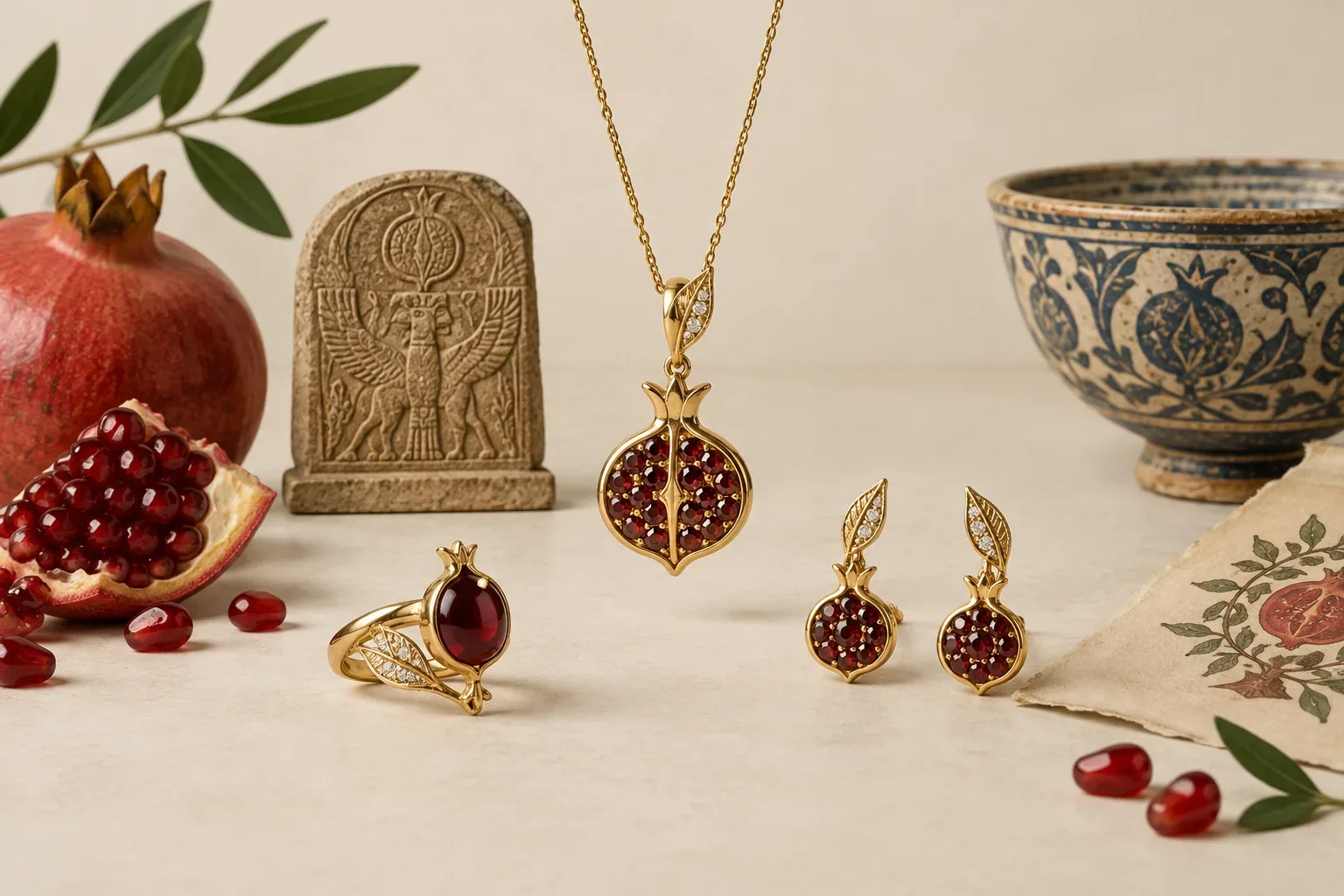
The pomegranate appears in jewelry in multiple forms: as a stylized pendant, an engraved or chased motif on metalwork, enamel decoration, carved gem intaglios and cameos, and as a pattern in chain or clasp work. Jewelers and silversmiths have adapted the motif to the techniques and tastes of their period: fine openwork or niello in metal pieces, painted or cloisonné enamel, and carved stone have all been used to suggest seeds, rind, and crown.
Gemstones are often chosen to evoke the pomegranate’s visual qualities. The Victoria and Albert Museum’s A–Z of Gemstones explains that red stones—such as garnet and ruby historically, among others—were and remain popular choices for evoking seed-like color. Designers can suggest the texture of pomegranate seeds using clustered small stones, pavé settings, or carved beadwork. Conversely, a highly stylized or graphic pomegranate may be rendered in metal alone or with subdued accents rather than vivid color.
Beyond single motifs, the pomegranate can be part of larger traditions in jewellery: it can be a motif on lockets, signet-like seals, or on decorative mounts and settings. When used in heirloom-style pieces, it may be combined with portrait lockets or memorial forms that reference family and lineage—contexts that the V&A’s histories note as common arenas for symbolic ornament.
Practical and respectful guidance for selecting or gifting pomegranate jewelry
Decide what you or the recipient want the motif to mean before you purchase. Are you choosing an object for its historical resonance, cultural connection, aesthetic look, or a personal message such as fertility or family? Being clear about the intended meaning helps you select an appropriate style, period reference, or contemporary maker.
If cultural or religious significance is part of the reason for the gift, ask respectfully or research carefully. Museums like the V&A emphasise the importance of context when interpreting motifs; a piece that references a cultural tradition should be selected with awareness of that tradition rather than assumed to carry a universal meaning. When in doubt, choose designs made by or with input from the relevant community or artisan.
Check materials and disclosures. The Federal Trade Commission’s guidance on buying gemstones, diamonds, and pearls reminds buyers to ask about treatments, synthetics, and imitations and to request clear disclosure from the seller. Request written information about metal content, gemstone type, treatments, and return policies. For red or seed-like effects, sellers may use garnet, ruby, glass, or treated stones; understand which to expect and what level of durability you need for everyday wear.
Match the style to use. For daily wear select durable settings and hard stones; for a display or occasional-wear piece you might choose more delicate enamel or carved work. Consider size and symbolism: a small pendant can be discreetly personal; a larger, ornate piece will make a public statement. For heirloom intent, documented provenance and materials care instructions add value and respect the piece’s future custodianship.
When giving a piece to someone from another cultural or religious background, avoid assumptions. A gracious approach is to explain your reasons for choosing the motif and to be open to the recipient’s response. If the motif will be used in a religious or ceremonial way by the recipient, consider consulting a knowledgeable member of that community or choosing a maker from that cultural tradition.
How to learn more and verify claims
Use museum catalogues and reputable gemstone guides to verify historical claims and technical details. The Victoria and Albert Museum’s publications and its A–Z of Gemstones are good starting points for understanding how motifs and materials have been used historically and technically. For market purchases and questions about treatments and synthetics, consult consumer guidance such as the Federal Trade Commission’s advice on buying gemstones, diamonds, and pearls to understand disclosure expectations from sellers.
If a piece claims historical provenance or cultural significance, ask for documentation or provenance statements. For contemporary designers, ask about their sources and whether the design is an interpretation rather than a reproduction of a specific historical object. For conservation, follow care guidance appropriate to the materials—enamel, carved stone, and certain soft materials each require different handling.
Frequently asked questions
Does pomegranate jewelry always mean fertility or abundance?
No. Historical records show those meanings in certain contexts, but museums caution that symbolism varies by culture and period; modern wearers may adopt other meanings or none at all.
Are red stones required for pomegranate motifs?
No. Red stones like garnet or ruby have often been used to suggest seeds, but silversmithing, enamel, carving, or non-red gems can also represent the motif depending on design.
How can I verify a gemstone's authenticity and treatments?
Ask the seller for written disclosure about type, treatments, and whether a stone is synthetic or imitation; consult the Federal Trade Commission’s guidance on buying gemstones for what sellers should disclose.
Is it appropriate to gift pomegranate jewelry to someone from another culture?
It can be appropriate if selected respectfully. Ask about cultural sensitivities, explain your reasons, and prefer makers from the community when cultural identity is central to the gift.
Can pomegranate motifs be part of heirloom jewellery?
Yes. When used in lockets or family pieces, the motif can serve as a personal emblem, but provenance and material care should be documented if the intention is long-term inheritance.
Where can I learn more about historical uses of the motif?
Begin with museum catalogues and reputable gemstone references such as the Victoria and Albert Museum’s publications, and consult specialists if you need provenance or conservation advice.
Sources and further reading
- Bedazzled: A History of Jewellery — Victoria and Albert Museum
- An A-Z of Gemstones — Victoria and Albert Museum
- Buying Gemstones, Diamonds, and Pearls — Federal Trade Commission