Meaning at a glance
Grapevine jewelry meaning has shifted across cultures and periods; museum documentation shows the motif appears repeatedly from the ancient Mediterranean through European medieval, Renaissance, and modern decorative movements, while many contemporary meanings are personal or newly assigned—choose pieces with attention to provenance, materials, and the recipient's cultural context.
Historical evidence and cultural periods
Physical examples in public collections demonstrate that grapevine and grape-cluster imagery have been used in jewelry and decorative metalwork across several distinct periods. The Victoria and Albert Museum records the breadth of jewelry history and changing social contexts, and its collections illustrate how motifs migrate and change in meaning from one era to the next.
Ancient Mediterranean contexts: Examples of vine and grape imagery appear in material culture inherited from the ancient Mediterranean world, where carved gemstones, metalwork and decorative objects occasionally include vegetal motifs. Museum narratives and catalogues represented at the Victoria and Albert Museum trace how classical motifs were reused or reinterpreted in later European decorative art.
Medieval and Byzantine Europe: During the medieval and Byzantine periods, vegetal ornament, including vine work, appears in liturgical metalwork, signets, and gem-studded pieces. The specific meanings for vine imagery in these contexts depend on local religious and courtly uses, and museum labels and scholarship (as summarized by institutions such as the Victoria and Albert Museum) emphasize context over a single symbolic reading.
Renaissance and post-Renaissance Europe: Jewelers in Renaissance and later periods revived classical plant motifs, including vine and leaf patterns, in portrait jewellery, rings, and pendants. The V&A’s history of jewellery describes how motifs drawn from antiquity were adapted for new fashions and social signals in successive eras.
19th-century and early 20th-century movements: The 19th century’s historicist revivals and the late 19th/early 20th-century decorative movements such as Art Nouveau favored natural forms; grape leaves and clusters featured as part of broader interest in organic ornament. Museum histories present these shifts as changes in taste and technique rather than as fixed symbolic messages.
Modern and costume jewellery: In the 20th century and today, the grapevine motif continues in fine and costume jewellery. Contemporary makers reference historical forms while also creating new, personal meanings for wearers. The Victoria and Albert Museum’s overview of jewellery history highlights this continuity and change across materials and social settings.
Documented historical meanings versus modern interpretations
Museum documentation and curatorial descriptions tend to privilege provenance, function and fashion over broad symbolic claims. Where grapevine imagery carried a clear public meaning, museum labels and scholarly literature note those associations in context; where such meaning is unclear, curators emphasize decorative lineage or patronage.
Documented meanings recorded by museums are context-specific. In some historical contexts the vine motif functioned as a decorative appropriation of classical or natural motifs, or as a signifier of leisure and feasting when paired with other related imagery. In other contexts the same motif was chiefly ornamental, used because it fit a fashionable repertory of leaves and scrolls rather than because it conveyed a particular doctrine or message. These distinctions are emphasized in institution-level histories such as the Victoria and Albert Museum’s account of jewellery and changing social context.
Modern personal interpretations are common and varied. Contemporary wearers and makers often ascribe meanings like abundance, celebration, fertility, connection to the land, or personal family symbolism to grapevine designs. Those interpretations are typically modern, subjective, and may reflect a giver’s or wearer’s intent more than any single historical consensus. It is important to keep the difference between historically documented association and current personal symbolism in mind when selecting or describing a piece.
How the motif, gemstones, and traditions appear in jewelry
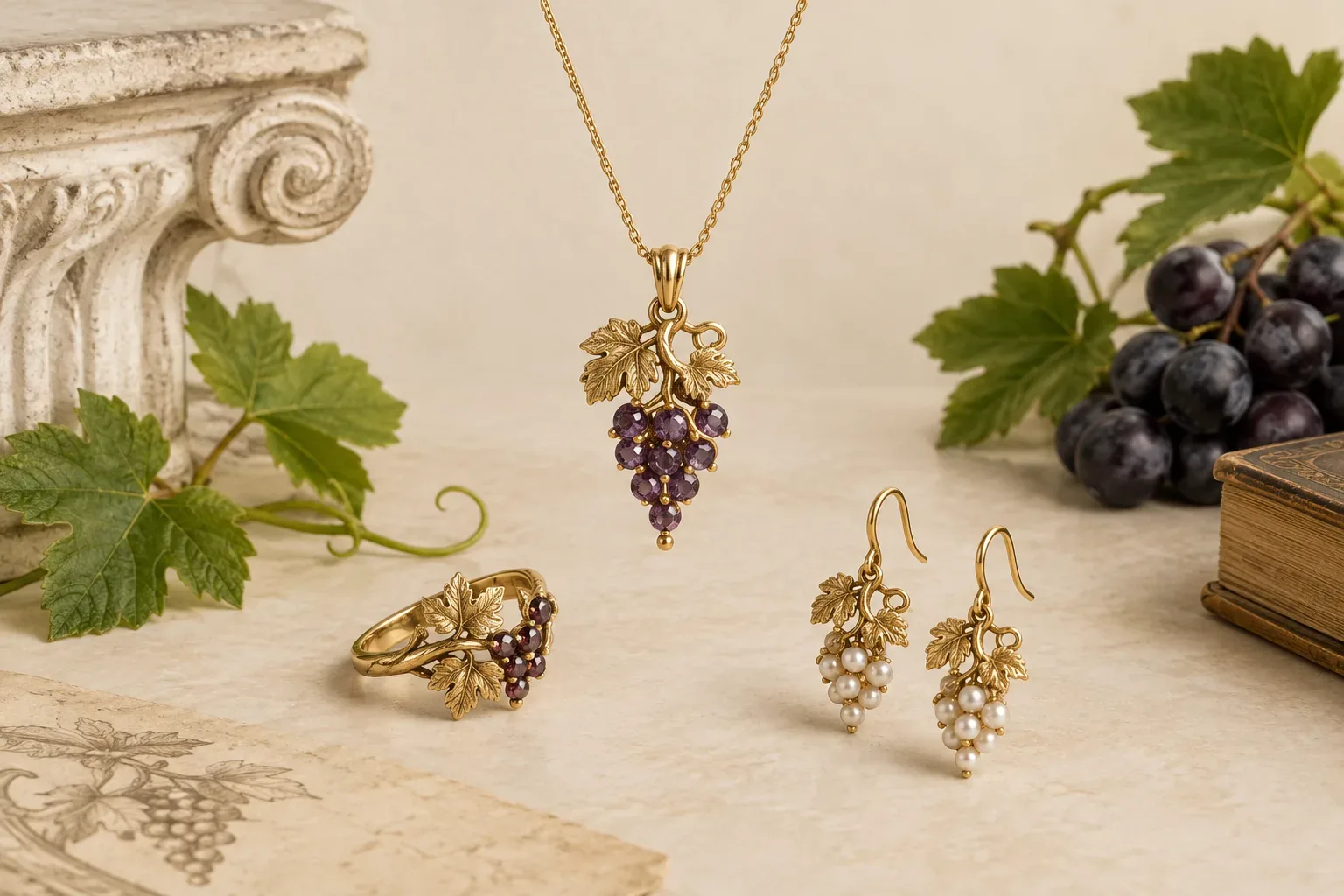
Forms and techniques: In object and catalogue records, grapevine motifs appear as brooches shaped like sprays of leaves and clusters, as small applied clusters set on pendants and rings, and as engraved or repoussé decoration on metal mounts. Jewelers have used metalworking, engraving, enamel, and gemstone setting to suggest the texture of leaves and fruit. Museum summaries at institutions such as the Victoria and Albert Museum document these technical and stylistic variations across periods.
Materials and gemstones: Historically, gold and silver were the primary metals for fine vine-motif jewellery, often combined with enamel, pearls, or cut gemstones to articulate leaves and berries. The Victoria and Albert Museum’s resources on gemstones describe how different stones and surface finishes were chosen to convey color, light, and richness in ornament. In later costume jewellery, glass paste, simulated gems and newer alloys reproduced the look at lower cost.
Scale and placement: The motif appears at a range of sizes and social functions: small ring decoration or seal settings that reference vegetal forms; pendant clusters and brooches used to punctuate a dress; and full wreath or diadem treatments in ceremonial pieces. Designers also adapted vine motifs to hair adornments and belt fittings in periods when such accessories were fashionable.
Technique-led variation: Enamel work, pavé setting of small stones, and chased or engraved metal surfaces have all been used to interpret vine textures. Museum collections show artisans chose techniques according to the scale of the motif, the desired realism or stylization, and the patron’s budget, offering a record of craft choices rather than a single symbolic program.
Practical and respectful guidance for selecting or gifting grapevine jewelry
Respect cultural differences and personal meanings. Because the motif has multiple historical resonances and many contemporary personal meanings, ask about the recipient’s preferences and sensitivities before gifting. If the person has a religious or cultural affiliation that could interpret vegetal imagery in a specific way, a brief, respectful conversation avoids unintended assumptions.
Consider provenance and age when you care about historical meaning. If an antique or museum-quality piece is desired for its historical associations, seek documented provenance or a credible dealer. Museum histories underscore that meaning depends heavily on context, so a well-documented piece will allow you to understand and explain its original setting.
Check materials and disclosures. Modern buyers should ask vendors about metal content, gemstone treatments, and whether gems are natural, lab-grown or simulated. The Federal Trade Commission provides guidance on the importance of clear disclosure of treatments, imitations, and enhancements, so insist on written or reputable catalogue information for higher-value purchases.
Match the style to the wearer’s taste and lifestyle. Large, ornate vine brooches or wreath-like pendants suit wearers who favour statement, historically inspired pieces, while small vine rings or delicate vine-pendant necklaces fit everyday wearers. Consider metal allergies, the practicality of settings for daily wear, and the recipient’s wardrobe when selecting scale and fastening types.
When gifting a symbolic meaning, make it explicit. Given that modern grapevine meanings are often personal, if you intend the piece to represent abundance, celebration, or family ties, include a short note explaining your intent. That makes the symbolism part of the gift rather than an assumed universal language.
Care, authenticity checks, and conservation notes
For modern pieces, follow the maker’s care guidance. Many vine-motif pieces include delicate settings or enamel; cleaning and storage instructions from the maker will safeguard finishes. For costume jewellery, avoid prolonged moisture exposure and store pieces to prevent entangling and abrasion.
For antiques, seek professional assessment. If you suspect a piece is period or has historical significance, a trained appraiser or conservator can confirm materials and condition. Museum practice, summarized in the Victoria and Albert Museum’s histories, draws a clear line between restoration, conservation and the removal of non-original parts—seek professional advice before any invasive work.
Demand transparency from sellers. The Federal Trade Commission’s consumer guidance emphasizes asking sellers about treatments, enhancements and whether gemstones are natural, lab-grown, or simulated. Obtain written confirmation for significant purchases and retain receipts and any lab reports.
Frequently asked questions
What does grapevine jewelry symbolize historically?
Historically the grapevine motif has multiple, context-dependent uses. Museum documentation indicates it appears across periods chiefly as a decorative motif or as part of a broader iconographic program; specific symbolic meanings vary by culture and time and are best confirmed by provenance or curatorial records.
Is grapevine jewelry a religious symbol?
The grapevine motif can have religious associations in certain contexts, but it is not universally religious. Where a religious meaning applies, museum labels and specialist scholarship typically note that context; otherwise the motif may simply be decorative.
How can I tell if a grapevine piece is an antique?
Look for documented provenance, period-appropriate construction techniques, signs of hand finishing, and authoritative appraisal. For significant pieces, seek a qualified appraiser or consult museum standards for identifying period materials and methods.
Are gemstones commonly used with grapevine motifs?
Yes. Historical examples combine metalwork with enamel, pearls, and cut gemstones to suggest leaves and fruit; museum resources on gemstones explain the range of stones and treatments used in different periods.
What should I ask when buying grapevine jewelry from a dealer?
Ask for written information about metal content, gemstone origin and treatments, provenance, and any restoration work. The Federal Trade Commission recommends clear disclosure of treatments, imitations, and whether gems are natural or lab-grown.
Sources and further reading
- Bedazzled: A History of Jewellery — Victoria and Albert Museum
- An A-Z of Gemstones — Victoria and Albert Museum
- Buying Gemstones, Diamonds, and Pearls — Federal Trade Commission