Meaning at a glance
The olive branch motif has documented roots in the classical Mediterranean and later Western decorative traditions; museums record its use as a civic, religious, and celebratory emblem, while modern wearers add personal meanings—choose materials and makers transparently and match style to the intended message.
What the historical evidence shows (and where that evidence comes from)
Evidence in museum collections and scholarship shows that the olive and olive-leaf motifs occur repeatedly across time and regions in decorative objects and jewellery. The Victoria and Albert Museum (V&A) treats the olive motif as part of the long sweep of jewellery history, noting how motifs acquire new social meanings as tastes, materials, and uses change. Descriptions in V&A publications and exhibitions place the olive motif within the broader visual vocabulary of the classical Mediterranean and in subsequent European decorative traditions, where it appears in metalwork, ceremonial objects, and personal ornament.
Those museum records do not present a single, immutable meaning for the olive branch. Instead they document particular uses in specific contexts: as an attribute in civic and ceremonial displays, as an agricultural emblem tied to local economies and identity, and as a decorative motif reused and reinterpreted across periods. Where specific cultures or periods treated the olive motif in distinctive ways, museum catalogues and exhibitions identify those contexts rather than asserting one universal symbolism.
Separating documented historical meanings from modern interpretations
Documented historical meanings are those that can be traced to objects, inscriptions, or written records and are described in museum scholarship. For example, the V&A and similar institutions record instances where olive imagery appears with civic regalia or in funerary and ceremonial contexts; those placements indicate social or symbolic roles tied to the object’s original use. Museum documentation focuses on the object and its original context rather than projecting later popular meanings back onto it.
Modern personal interpretations are the meanings wearers or makers attach to the motif today. Contemporary jewellery designers and buyers commonly adopt the olive branch as a symbol of peace, hope, reconciliation, renewal, or a link to Mediterranean heritage. These contemporary meanings are valid personal or cultural expressions, but they are different in kind from historically documented uses: the former are contemporary signification, the latter are contextualized by provenance, material culture, and archival evidence.
How the olive branch motif and related materials appear in jewellery
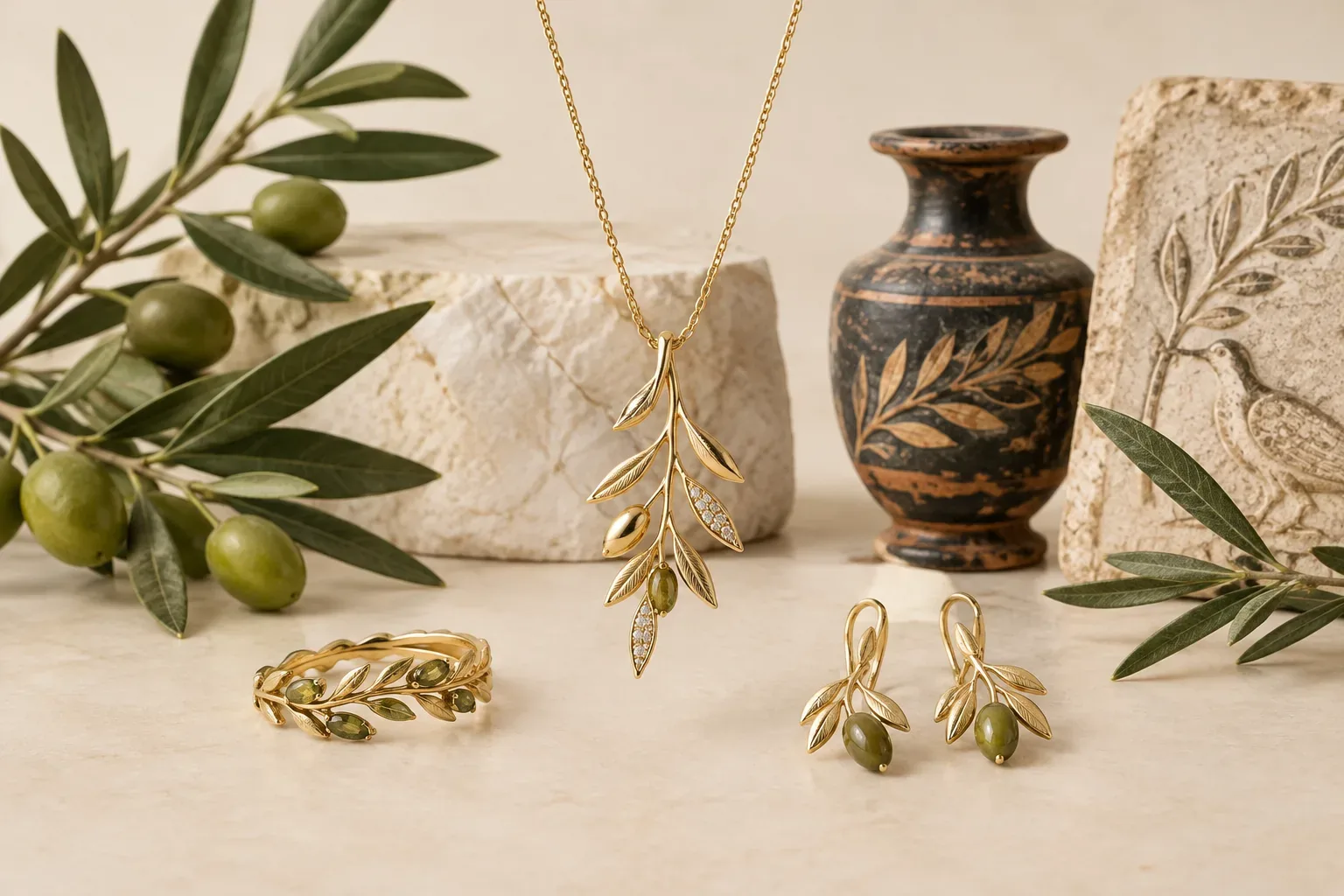
The olive motif appears in jewellery in several repeating forms: as stylised sprigs and wreaths worked in metal, as engraved or repoussé motifs on lockets and brooches, as delicate pendants and charms, and as larger statement pieces that mimic a laurel or olive crown. V&A accounts of jewellery history show that motifs commonly migrate between object types—what appears on a ceremonial crown or metal plate can later be simplified and worn as a pendant or brooch as fashions change.
Designers also pair the motif with particular materials to reinforce meaning or simply for aesthetic effect. Green or olive-toned gemstones are a frequent accompaniment where colour harmony is important. The V&A’s guidance on gemstones describes how different stones have been used historically for colour, durability, and status; in contemporary practice, peridot, green tourmaline, chrysoprase, and green-hued glass or enamel are examples of green materials that may be chosen to echo the olive leaf’s colour. The choice of metal—yellow gold, warm bronze tones, or oxidised silver—affects whether a piece reads as classical, rustic, or modern.
Design and craftsmanship considerations recorded by museums
Museum documentation emphasizes technique and social context. Historically, olive motifs appear in hand-hammered, cast, or chased work and may carry marks of their production technique that help date and situate them. The V&A’s exhibitions and articles on jewellery history stress how changing technologies and tastes transform the scale and finish of motifs: what was once large and ceremonial can become small and wearable as private jewellery.
When looking at a contemporary piece through a museum-informed lens, consider whether the maker references historical techniques or designs explicitly and whether the piece’s finish, weight, and construction match its stated heritage. Museum descriptions can help you distinguish reproductions, historically inspired designs, and genuinely aged objects in secondary markets.
Practical guidance for choosing, buying, and gifting olive branch jewellery
Decide which level of meaning matters for your purchase. If you value documented or historical authenticity, seek pieces with clear provenance or maker statements that refer to a particular tradition or technique. If personal symbolism is the priority, focus on the design, scale, and material that best express the intended message—small, delicate sprigs for private remembrance, bolder wreath forms for celebration or achievement.
Ask makers and sellers for material and treatment disclosures. The U.S. Federal Trade Commission (FTC) provides consumer guidance on buying gemstones, diamonds, and pearls and on the importance of disclosure for treatments, imitations, or enhancements. For any gemstone or dyed material paired with an olive motif, request clear information about whether the stone is natural, treated, synthetic, or an imitation, and ask for written confirmation when possible.
Consider durability and lifestyle. A fine, openwork silver pendant with delicate leaves may be beautiful but will require different care from a solid gold wreath-style necklace. Think about whether the recipient will wear the piece daily or on special occasions and choose metals and settings that tolerate that level of wear.
Match the style to the intended message and cultural sensitivity. If gifting across cultural lines, be mindful that different communities may attach distinct meanings to natural motifs. Frame the gift in words that explain your intended meaning where appropriate—an explanatory note or card that places the motif in personal rather than assumed historical terms can be both respectful and meaningful.
If authenticity or value is important, seek documentation. For antiques, ask for provenance or a condition report; for gemstone-set pieces, request a gem lab report for higher-value stones. The FTC guidance can help you evaluate seller claims about treatments and origin and protect you from undisclosed imitations.
Wearing and styling olive branch jewellery today
Wear olive branch jewellery in ways that match the piece’s scale and finish. Delicate sprig pendants work well layered with simple chains; brooches or wreath motifs can anchor a lapel or the neckline of a dress as a statement. Pair green-hued stones with complementary metals—warm golds accentuate olive tones while cooler silver or white gold can make a piece read as modern and understated.
Be attentive to context. Because the olive motif carries multiple potential meanings, choose pieces and occasions where the aesthetic or symbolic content will be understood or where you are comfortable offering your personal interpretation. For example, a graduation gift that uses the wreath form and a short note tying the motif to achievement and new beginnings communicates a clear, contemporary meaning without presuming historic authority.
Final considerations
Museums like the V&A show that the olive branch motif has traveled through many cultural moments and acquired multiple contextual meanings rather than a single, fixed definition. Modern wearers are free to adopt and adapt these motifs, but it is useful—and respectful—to separate historically documented uses from contemporary personal interpretations and to be clear with gift recipients or buyers about which you intend.
When buying, demand transparent information about materials and treatments and match the piece’s physical durability and aesthetic to how it will be worn. Whether you choose the olive branch for its classical echoes, its green colour associations, or its personal symbolism of peace and renewal, clear provenance and honest disclosure will make the piece both more meaningful and more durable as an object of jewellery.
Frequently asked questions
What does olive branch jewelry mean historically?
Museum documentation shows the olive motif appears in different historical contexts—civic, ceremonial, or decorative—and meaning depends on the object's original use and provenance rather than a single universal symbolism (Victoria and Albert Museum).
Is the olive branch a religious symbol?
The olive appears in religious, civic, and agrarian imagery in various traditions; museums record its presence in many contexts but do not ascribe one sole religious meaning, so check object provenance for specific religious associations (Victoria and Albert Museum).
Which gemstones complement olive branch jewellery?
Green-hued stones or materials are commonly paired with olive motifs for colour harmony. The Victoria and Albert Museum’s guides on gemstones explain historical uses; for modern purchases, ask the seller about natural, treated, or synthetic status.
How can I be sure a gemstone or treatment is disclosed?
Follow FTC consumer guidance: ask sellers for written disclosure of treatments, enhancements, origin, and any lab reports for higher-value stones; reputable dealers will provide clear information.
What should I consider when gifting olive branch jewellery?
Decide whether you want historical authenticity or personal symbolism, choose a style and material suited to the recipient’s lifestyle, and include a short note explaining your intended meaning to avoid assuming a universal message.
Sources and further reading
- Bedazzled: A History of Jewellery — Victoria and Albert Museum
- An A-Z of Gemstones — Victoria and Albert Museum
- Buying Gemstones, Diamonds, and Pearls — Federal Trade Commission