Meaning at a glance
Lavender jewelry meaning blends a long history of floral motifs in decorative arts with largely modern, personal interpretations; museum evidence documents changing uses of floral decoration across periods, while contemporary pieces pair pale purple stones and botanical motifs to suggest calm, devotion, or personal associations. When choosing or gifting, treat historical claims cautiously, check material disclosures, and match design and context to the wearer.
Quick answer
Lavender jewelry meaning cannot be reduced to a single historical message: museums show that floral motifs have played different roles in different periods, and direct, consistent evidence tying the lavender plant to one universal symbolic meaning in historic jewelry is limited. Today, pale purple stones and botanical motifs used to evoke lavender are often read as symbols of calm, devotion, or personal renewal, but those readings are modern and individual rather than universally documented in historical collections.
What the historical record shows
The curatorial record demonstrates that botanical motifs have been important in jewelry for centuries and that their meanings changed with time and context. Exhibition material and essays from the Victoria and Albert Museum describe how jewelers used plant forms to signal sentiment, social status, natural beauty, or artistic ideals in distinct periods such as the ornate sentimentalisms of the nineteenth century and the naturalism of the Art Nouveau era. These changing contexts matter when interpreting any floral motif, including lavender.
That same museum material indicates that many pieces in collections are best understood within their original social and stylistic contexts rather than by a single, fixed symbolism. Floral imagery could be decorative, fashionable, emblematic of a movement, or chosen for personal reasons by the maker or wearer. Within the museum record there is more documentary clarity about broad categories—Victorian sentimentality, Art Nouveau naturalism, modern fashion—than about one plant consistently meaning the same thing in multiple cultures or periods.
Separating documented history from modern interpretation
When we talk about 'lavender jewelry meaning' it helps to separate two things: documented historical practice and later or contemporary interpretation. The museum sources show that florals were used in particular ways in identifiable periods, but they do not provide a continuous, global record that the lavender plant carried a single symbolic meaning across cultures and centuries.
Modern interpretations—for example, reading lavender motifs as symbols of peace, healing, devotion, or calm—are common in contemporary marketing and personal use. These modern attributions are often meaningful to wearers, but they are not the same as documented historical consensus. In short, historical evidence supports the importance of floral motifs and shifting meanings by period (Victoria and Albert Museum), while many specific claims about lavender as a symbol are contemporary, localized, or personal.
How the lavender motif and lavender colours appear in jewelry
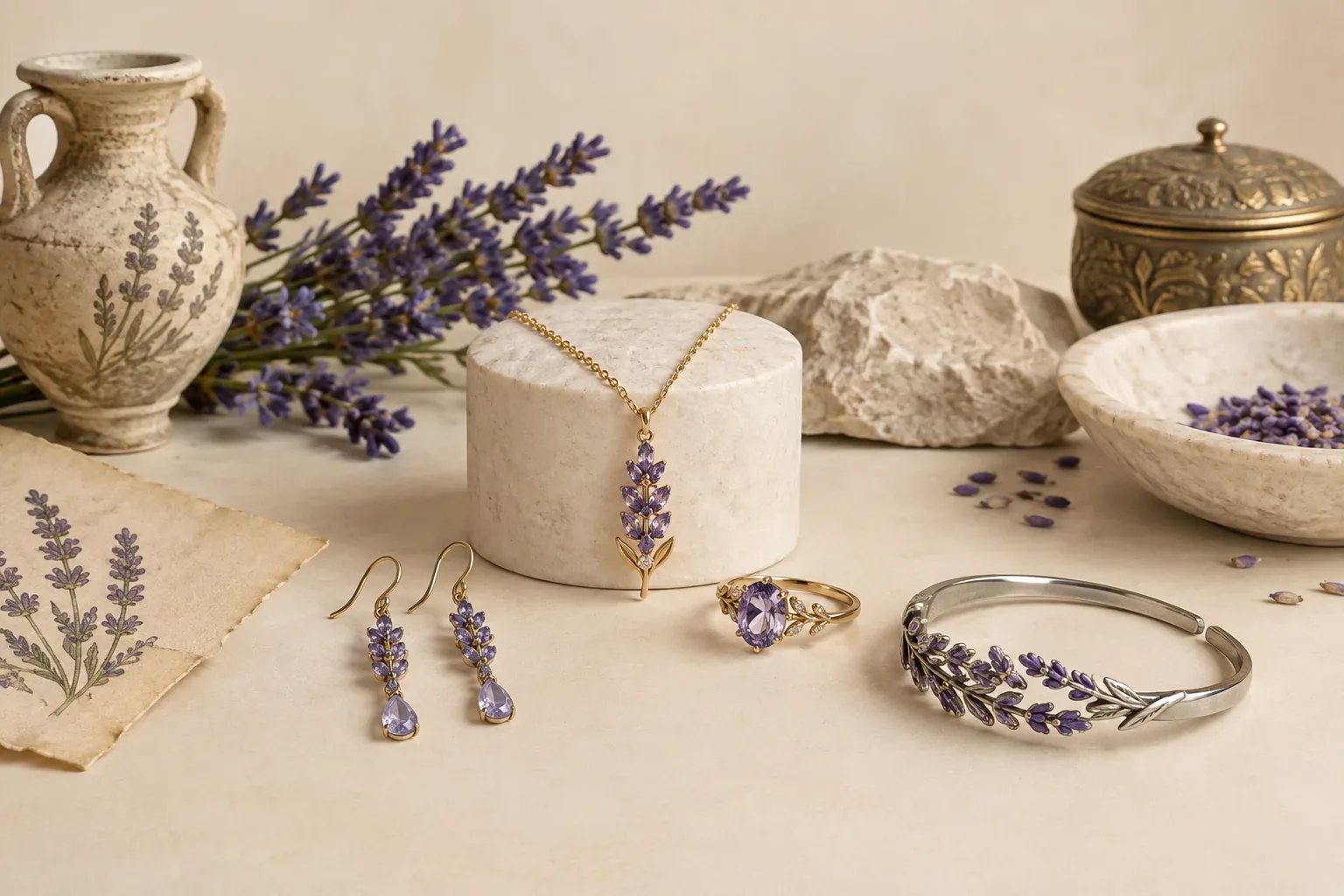
Jewelry makers use the lavender idea in two main ways: literal botanical representation and colour reference. Literal botanical representation appears as engraved or cast sprays of flowers, enamelled botanical portraits, or small sculptural pendants that resemble spray-like lavender blossoms. These treatments have long precedents in decorative jewellery traditions that valued detailed plant work as either sentimental keepsakes or artistic statements (Victoria and Albert Museum).
Colour reference is achieved by using pale purple or lilac materials that evoke the plant. Historically and today, pale purple gemstones and materials—most familiarly amethyst—have been used to suggest a lavender tone. Museum guides to gemstones discuss how particular hues have been achieved, valued, and imitated over time and how gem materials were chosen for their color and symbolic associations within particular styles (Victoria and Albert Museum: An A–Z of Gemstones).
In contemporary design, the motif can be rendered very simply as a line‑etch pendant, as a realistic miniature bloom set with enamel or colored gemstones, or as a stylized pattern repeated across a bracelet, locket, or signet. Makers may combine a botanical motif with a lavender‑toned stone to reinforce the visual association. When stones are used, it is common practice—and in many jurisdictions required—that sellers disclose treatments, whether the material is natural, enhanced, or an imitation (Federal Trade Commission).
Practical guidance for selecting or gifting lavender jewellery
Start by clarifying why you or the recipient value the motif. Is the choice aesthetic, linked to a memory, intended as a symbolic message, or meant to align with a favorite colour? When a piece is meant as a symbolic gift, be explicit in an accompanying note about what the motif means to you rather than assuming a universal interpretation, since consistent historical meanings for lavender in jewellery are not broadly documented.
Match the piece to the wearer’s usual style and to the occasion. A delicate lavender‑coloured pendant or enamel brooch might be right for someone who prefers subtle botanical touches, while a bold amethyst cluster or coloured-resin statement piece suits a wearer who likes visible colour. Consider practical details such as metal type and possible allergies, and choose a clasp, chain length, or mounting that will be comfortable for everyday wear if that is the intention.
Ask for and check material disclosures. If a seller uses gemstones or unusual colouring, request written information about whether the gem is natural, treated, synthetic, or an imitation and whether any coatings or stabilizing treatments have been applied. The Federal Trade Commission explains that accurate disclosure of treatments and imitations is a recognized consumer protection practice, and responsible sellers will provide this information.
Respect cultural and personal sensitivities. If lavender motifs are connected to a particular tradition for the recipient, or if the wearer has a specific spiritual or cultural association with floral imagery, choose a design and presentation that honours that context. If you are unsure, a modest, well-crafted piece accompanied by a thoughtful explanation of why you chose it will usually be well received.
Consider provenance and craftsmanship for long-term gifts. Museum materials remind us that jewellery acquires social meaning through use and context. Pieces with clear documentation of maker, materials, and care will hold value and personal significance more reliably than anonymous or poorly described items.
How to wear and combine lavender motifs respectfully
Treat the motif as you would any symbolic jewellery: wear it in ways that align with your intention. A small lavender pendant close to the heart works well as a private talisman, while a brooch or statement ring reads as a more public declaration of aesthetic or sentiment. Combine lavender tones with neutral metals or complementary colours for a balanced look, and avoid over‑contextualizing the symbol with claims about historical meaning that cannot be supported by documentation.
If you are incorporating lavender jewellery into heirloom or commemorative practices, consider adding a note explaining what the motif means to you today. That creates a record for future owners and honours the way meanings shift across time, as curators observe in museum collections.
Final note
Museum scholarship underscores two useful conclusions for anyone interested in lavender jewellery meaning: floral imagery in jewellery has long been significant but context‑dependent, and clear historical documentation tends to describe practices and styles rather than promote single, universal plant meanings (Victoria and Albert Museum). Contemporary wearers and makers supply much of what people today take as 'meaning' for lavender, and that personal layer is valid and often deeply felt. Choose and gift with clarity about your own intention, check material disclosures, and favour makers who document their materials and techniques.
Frequently asked questions
Does lavender jewellery have a single historic meaning?
No. Museum evidence shows floral motifs have had different meanings in different periods and contexts, and there is little documentary support for a single, universal historic meaning for lavender in jewellery. Many contemporary meanings are modern or personal.
What stones are commonly used to suggest a lavender colour in jewellery?
Pale purple gemstones such as amethyst are commonly used to evoke a lavender tone, and designers may also use coloured glass, enamel or treated materials. For guidance on specific gems and their histories, museum gemstone guides are useful resources.
How can I be sure a lavender‑coloured stone is natural and undisclosed?
Ask the seller for written disclosure about whether the stone is natural, treated, synthetic, or an imitation. The Federal Trade Commission advises that sellers should disclose treatments and imitations, and reputable sellers will provide this information.
Is it appropriate to gift lavender jewellery for healing or mourning?
Gifting is a personal act. If you intend a piece to convey healing or remembrance, explain your intention in a note. Because historical meanings are context dependent, explicit communication helps avoid misunderstandings and makes the gift more meaningful.
How should I care for delicate lavender enamel or gemstone jewellery?
Care depends on materials and construction. Keep pieces away from harsh chemicals and prolonged moisture, store them separately to avoid abrasion, and follow any maker’s care instructions. For valuable gemstones, consider professional cleaning advice.
Sources and further reading
- Bedazzled: A History of Jewellery — Victoria and Albert Museum
- An A-Z of Gemstones — Victoria and Albert Museum
- Buying Gemstones, Diamonds, and Pearls — Federal Trade Commission