Meaning at a glance
This article explains the documented history and changing contexts of the violet motif, separates cultural and religious evidence from later popular interpretations, and offers practical guidance for choosing and wearing violet-themed jewelry.
Historical evidence and specific cultures or periods
Museums such as the Victoria and Albert Museum present jewellery as an object class whose meaning shifts with social context, technology and taste. The V&A’s survey of jewellery history documents how materials and motifs have been reused and reinterpreted across periods, from antiquity through the medieval and Renaissance periods to the Victorian era and into modern design. Use of violet colours and floral imagery appears at multiple points in that sequence as part of broader trends in colour, material availability and fashion rather than a single uninterrupted symbolic tradition (Victoria and Albert Museum).
In the ancient and medieval worlds, jewelers selected coloured stones for their rarity, optical qualities and status value; violet or purple hues were often prized because purple dyes and pigments were historically expensive. The V&A’s A–Z of Gemstones explains how particular stones were identified, valued, and incorporated into objects of personal ornament and ceremonial dress over time (Victoria and Albert Museum).
During the long nineteenth century, European jewellery developed a rich language of sentimental motifs. Museums including the V&A document the Victorian appetite for floral symbolism and sentimental jewelry, where flowers and botanical motifs were widely used to convey personal messages. In many museum collections, small floral motifs appear on lockets, brooches and hair ornaments that relate to personal memory, mourning and private sentiment (Victoria and Albert Museum).
Documented historical meanings versus modern personal interpretations
Documented historical meanings are best read in context and attributed carefully. Museum records and gemological surveys show that violet-hued stones and floral motifs had functions that ranged from status signalling to decorative accompaniment in a changing visual vocabulary. For example, the V&A’s materials show how gemstones were valued for colour and rarity and how floral designs formed part of broader fashionable languages in different periods (Victoria and Albert Museum). Those institutional descriptions document practice and context rather than offering a single symbolic translation that applied everywhere or at all times.
Modern interpretations — the ideas found in gift notes, product descriptions and personal stories — often layer additional meanings onto older motifs. Contemporary wearers commonly read violets as signs of modesty, devotion, creativity, or individuality, or they pick a violet motif for its colour preference or birth-flower associations. These modern personal readings are valid and meaningful to the wearer, but they are not identical to a documentable single historical meaning and should be described as contemporary and personal interpretations rather than as universal historical facts.
How the violet motif and violet gemstones appear in jewelry
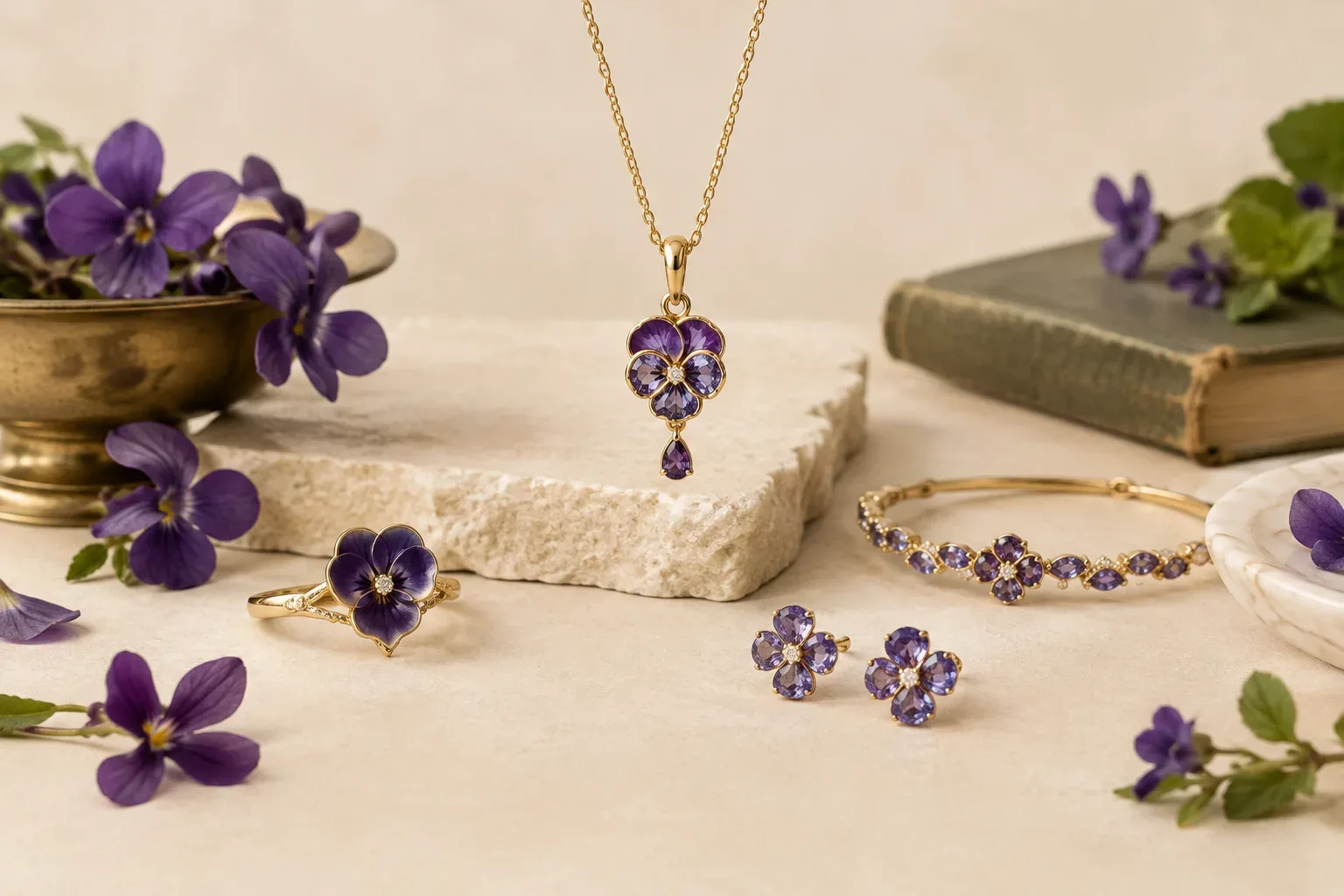
The violet motif in jewellery appears in two main ways: the floral motif of the violet (stylised petals, miniature enamelled blossoms, or engraved flower forms) and the use of violet-coloured stones. Floral violets appear from engraved goldwork to late nineteenth-century sentimental pieces and modern stylised designs. Museums document many examples where small flower motifs are used on lockets, brooches, hair combs and pendants as part of a broader floral vocabulary (Victoria and Albert Museum).
Violet-hued gemstones — historically and today most commonly represented by stones such as amethyst — have been set as focal gems in rings, pendants, and ecclesiastical jewellery and used as accent stones. The V&A’s A–Z of Gemstones provides guidance on identification and historical context for such stones, showing how particular materials enter fashion and craft practices at different times (Victoria and Albert Museum). In contemporary jewellery, violet is also achieved with colored glass, enamel, synthetic stones and other modern materials; these alternatives expand design options but change considerations about value and durability.
Choosing and gifting violet jewelry: practical and respectful guidance
When choosing or gifting violet-themed jewellery, first consider what you know about the recipient’s style and values. A small, naturalistic violet pendant suits someone who prefers understated antique or vintage-inspired jewellery, while a large violet-hued gemstone ring or contemporary enamel piece may better suit someone who enjoys bold colour. Respectful gifting also means being mindful that floral or colour symbolism may carry different personal or cultural meanings for different people, so avoid assuming a single message will be received.
Check the material and treatment disclosures for any gemstone or dyed material. The Federal Trade Commission advises buyers to ask sellers about treatments, imitations and disclosures before purchase because many gemstones are heat-treated, dyed, or created synthetically; transparent information helps you compare value and care needs (Federal Trade Commission). When buying antique or vintage pieces, consult the seller about restoration work and materials used so that the piece’s history and condition are clear.
If you want the gift to carry a specific message, pair the piece with a short, personal note explaining your intention rather than relying on assumed historical symbolism. For more guidance on choosing symbolic pieces and gift etiquette, see our related guide on How to Choose Meaningful Jewelry: A Practical Gift Guide and consult museum catalogues or reputable dealers for provenance on historical pieces (internal link). For sentimental or memorial jewellery, consider formats traditionally used for memory—lockets and mourning brooches—documented by jewellery historians and collection records (internal link to History of Lockets).
Care, authenticity and buying tips
Understand the material before you buy. Violet colour can come from a range of sources: natural violet gemstones, heat-treated or synthetic stones, enamel, glass and dyed materials. Materials differ in hardness, susceptibility to chemical exposure, and cleaning needs, so ask the seller about composition and recommended care and keep receipts and any certificates for resale or insurance purposes. The FTC’s consumer guidance recommends clear disclosure of treatments and imitations when you buy gemstones (Federal Trade Commission).
For vintage or museum-quality pieces, request provenance and a condition report. Institutions like the Victoria and Albert Museum document the changing social contexts of jewellery and the histories of specific objects; catalogue entries and curatorial notes can be useful reference points when researching older designs or makers (Victoria and Albert Museum). If you are commissioning a violet-themed design, discuss materials and finish with the jeweller so the object will match the intended meaning and wearability.
Summary and further reading
Violet in jewellery is not a single, timeless symbol. The historical record — as curated and explained by museums and gemological guides — shows that violet colours and floral motifs have recurred for reasons of material value, fashion and personal sentiment. Modern meanings are shaped by personal preference, commercial presentation and contemporary symbolic languages, and they sit alongside rather than in place of historic uses.
For more on the wider symbolic categories and research methods, see our parent Symbols category and the article on How to Research the Meaning of a Jewelry Symbol (internal links). For museum-curated histories of jewellery and specifics about stones, consult the Victoria and Albert Museum collections and A–Z guides and the Federal Trade Commission’s consumer advice on gemstones when purchasing.
Frequently asked questions
What does violet jewelry traditionally symbolize?
Traditionally, meanings attached to violet colours and floral motifs have varied by period and place. Museum research shows that violet hues were often prized for colour and rarity and that floral motifs were used in different periods to convey fashion, sentiment or memory. Modern symbolic claims such as modesty or devotion are often contemporary personal readings rather than a single documentable historical meaning (Victoria and Albert Museum).
Are violet gemstones like amethyst historically significant?
Yes. Gemstone guides such as the Victoria and Albert Museum’s A–Z of Gemstones describe how violet-hued stones have been valued and incorporated into jewellery across periods for their colour and optical qualities; the precise social meaning depends on the cultural and historic context (Victoria and Albert Museum).
How can I be sure a violet stone is natural and not treated or synthetic?
Ask the seller for full disclosure about treatments, enhancements and whether the stone is natural, synthetic or imitated. The Federal Trade Commission recommends clear disclosure of treatments and imitations for gemstones to help buyers compare value and care requirements (Federal Trade Commission).
Is it culturally insensitive to wear a violet motif?
Most floral and colour motifs are used widely and without special restriction, but meanings can vary by culture and personal belief. Choose with respect for the recipient’s background, ask about preferences if unsure, and avoid assuming a single symbolic message will apply universally.
How should I gift a violet-themed piece if I want to convey a personal message?
Pair the jewellery with a short written note explaining your intention rather than relying on assumed historic symbolism. Selecting a style that fits the recipient’s taste and providing material and provenance information will make the gift both meaningful and responsible.
Sources and further reading
- Bedazzled: A History of Jewellery — Victoria and Albert Museum
- An A-Z of Gemstones — Victoria and Albert Museum
- Buying Gemstones, Diamonds, and Pearls — Federal Trade Commission