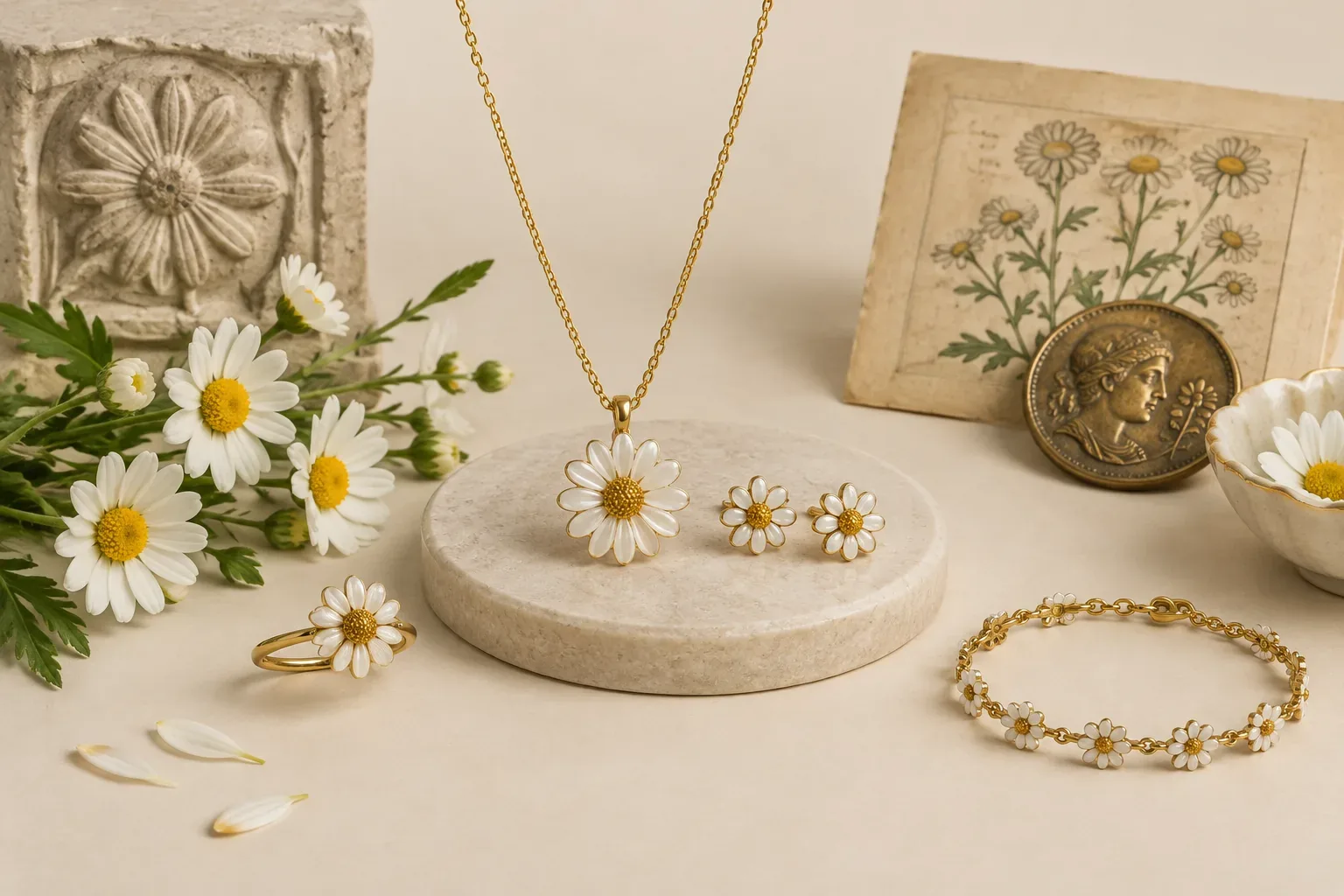
Meaning at a glance
Daisy jewelry meaning reflects changing social and design contexts recorded by museum scholarship; documented uses focus on botanical ornament and sentiment while modern readings like innocence or new beginnings are personal interpretations—choose metals, gems, and settings with wearer needs and disclosure rules in mind.
Quick answer
Daisy jewelry meaning cannot be reduced to a single, universal symbol. Museum scholarship shows the daisy as part of a broader taste for botanical ornament and sentiment in jewellery history, while modern wearers often interpret the motif as a personal sign of innocence, new beginnings, or cheerfulness. This article describes what is documented in the historical record, separates those facts from contemporary interpretations, explains how the motif appears in jewellery, and offers practical guidance for selecting and gifting daisy pieces.
What the historical evidence shows
The Victoria and Albert Museum's resources on jewellery history emphasise that floral and botanical motifs have been recurrent decorative themes across many periods because they suited changing fashions, tastes, and social practices. The V&A frames such motifs as elements of design language and social signalling rather than fixed symbolic systems, and it places floral jewellery in contexts like seasonal fashion, sentimental jewellery, and movements that celebrated nature in design.
That same museum's overview of gemstones and materials explains how jewellers used particular techniques and materials to render botanical forms: enamel for painted petals, seed pearls and pearls for soft white surfaces, mixed metals for contrast, and gemstones as focal 'centres' for flower motifs. The museum's accounts focus on materials and techniques and how they change over time rather than presenting a single cultural meaning attached to a flower motif.
Separate documented historical meanings from later interpretations
Documented historical evidence, as discussed by the Victoria and Albert Museum, treats the daisy motif primarily as part of decorative vocabulary and as a vehicle for personal or social messages embedded in jewellery contexts such as mourning, courtship, and fashion. In other words, historians can show when and how daisies were used and the settings in which they circulated, but that evidence does not support a single uniform symbolic definition across places and periods.
Modern interpretations—commonly heard associations such as innocence, childhood, fresh starts, or simple happiness—are primarily contemporary and personal readings rather than direct continuations of a single documented historical meaning. These modern readings are useful and meaningful for gift-giving and personal expression, but they should be presented as individual meanings that wearers or givers attach to the motif rather than as universal facts.
How the daisy motif and related gemstones appear in jewellery
Jewellers have translated the daisy motif into many forms. The simplest approach is a stylised metal silhouette of petals around a central bead or stone. Craftspeople also used enamel to paint white petals and seed pearls or pearls to suggest soft, rounded petal surfaces. A faceted gemstone, a cabochon, or a small cluster of diamonds often serves as the flower’s centre to catch light and draw the eye.
Different types of jewellery carry the motif in different ways: pendants and lockets with a daisy motif allow for sentimental personalization, brooches and hair ornaments present a larger, sculptural daisy for visible fashion statements, and rings or stud earrings frequently use the central gemstone to create a miniature flower. The Victoria and Albert Museum’s materials on gemstones and jewellery history illustrate these techniques and the historic use of particular stones and settings for botanical decoration.
Materials and gemstone considerations
When daisies in jewellery include gemstones, choices range from modest accent stones to genuine precious gems. The Victoria and Albert Museum’s advice on gemstones highlights how particular materials have been used historically and how their appearance and value influence design choices. Seed pearls and freshwater pearls were common for soft white effects, while diamonds and coloured gemstones could form the central eye of the flower for sparkle and contrast.
Buyers should be aware of treatments, simulants, and trade practices that affect price and appearance. The U.S. Federal Trade Commission recommends that sellers disclose treatments and imitations and advises buyers to ask for specific information about gemstone treatments and origins when that matters to them. This guidance is practical if authenticity or ethical sourcing is a priority for the buyer or recipient.
Practical guidance for choosing and gifting daisy jewellery
Begin by considering the recipient’s relationship to the motif. If the daisy already has personal meaning—such as a birth flower, a memory, or an in-joke—choose a design that reflects that intimacy. If the goal is fashion wearability, select scale and metal to match the recipient’s typical jewellery: small, low-set pendants and studs for everyday wear and larger brooches or statement necklaces for someone who likes bold accessories.
Select materials with use in mind. For everyday pieces choose durable metals and secure settings; for heirloom gifts consider stronger settings around gemstones and check for treatments or clarity enhancements when buying precious stones. If gemstone authenticity, provenance, or treatment-free stones are important, ask the seller directly and request documentation. The Federal Trade Commission recommends asking about any treatments or simulants so you and the recipient understand what you are buying.
If the gift is meant to convey a particular modern meaning, state that meaning in an accompanying note rather than assuming it will be self-evident. A short card explaining why you chose the daisy and what it represents to you creates a respectful context and prevents misinterpretation. For culturally sensitive contexts, avoid presenting a design as carrying a historical meaning that is not documented.
Care, wear, and pairing advice
Care depends on materials. Enamel and pearls require gentle handling and avoidance of harsh chemicals and prolonged moisture, while many modern metal alloys and settings withstand daily wear. Clean jewellery gently with a soft cloth and follow any jeweller-supplied care instructions. For delicate or treated gemstones, consult the seller or a qualified jeweller about appropriate cleaning methods.
Styling a daisy piece depends on its scale and finish. A small daisy pendant layers well with minimalist chains and complements casual looks. A larger brooch or floral necklace can be the focal point of a simpler outfit. When mixing metals, choose a unifying element such as a similar texture or a shared gemstone to tie the look together.
Concluding thought
The daisy motif in jewellery offers versatile possibilities because it functions both as a decorative form with a clear history of use in jewellery and as a vehicle for individual meaning. Museum scholarship documents how floral motifs have been used and how materials and techniques changed, while modern wearers create personal meanings that matter in the moment of giving or wearing. Choose a daisy piece with attention to materials, durability, and the specific meaning you intend to convey, and ask sellers for transparent information about gemstones and treatments when that matters to you.
Frequently asked questions
Does a daisy always mean innocence in jewellery?
No. While many modern wearers associate daisies with innocence, historical evidence treats floral motifs as design elements with variable social meanings. Museum scholarship emphasises changing contexts rather than a single universal symbolism.
What gemstones are commonly used in daisy designs?
Historically, jewellers have used materials such as seed pearls, pearls, enamel, and small faceted or cabochon stones as flower centres. The Victoria and Albert Museum’s overview of gemstones discusses how different materials were chosen for effect and durability.
How should I check a gemstone claim on a daisy piece?
Ask the seller for specific disclosure about treatments, enhancements, and whether the stone is natural, synthetic, or a simulant. The U.S. Federal Trade Commission recommends requesting information on treatments and disclosure before purchase.
Is a daisy motif appropriate for formal jewellery?
Yes. The daisy can be adapted to formal styles through choice of precious metals, fine gemstones, and refined settings. Conversely, it also suits informal, everyday pieces; choose scale and materials according to the recipient’s usual style.
Can I engrave a daisy pendant or locket to add meaning?
Yes. Adding a short inscription or including a small photograph in a locket is a widely used way to make floral jewellery explicitly personal and to clarify the intended meaning for the recipient.
How do I care for daisy jewellery with enamel or pearls?
Avoid harsh chemicals, perfume, and prolonged moisture. Clean gently with a soft cloth and follow any jeweller-supplied instructions. For delicate materials, consult a professional jeweller for safe cleaning methods.
Sources and further reading
- Bedazzled: A History of Jewellery — Victoria and Albert Museum
- An A-Z of Gemstones — Victoria and Albert Museum
- Buying Gemstones, Diamonds, and Pearls — Federal Trade Commission